
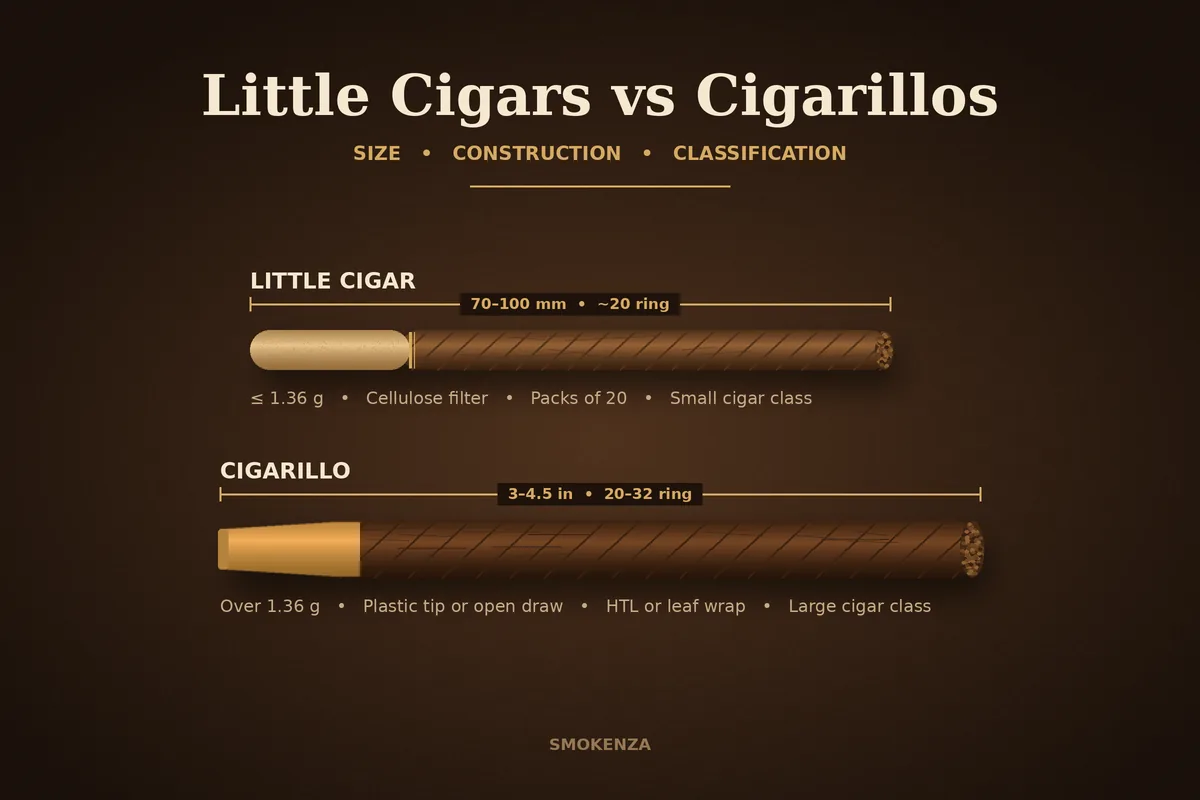
A little cigar is a cigarette-sized, usually filtered roll of tobacco wrapped in tobacco leaf or a tobacco sheet, and it weighs no more than 1.36 grams. A cigarillo is a slightly longer, wider, untipped or plastic-tipped cigar that weighs more than that, smokes for 10 to 20 minutes, and is not meant to be inhaled like a cigarette.
That is the short version of the little cigars vs cigarillos difference. The two names get swapped constantly on shelves and in brand copy, so this guide breaks the comparison into what actually separates them: size, construction, and legal classification.
Quick Comparison Table
| Feature | Little Cigar | Cigarillo |
| Typical length | 70 to 100 mm (about 2.75 to 4 in) | About 3 to 4.5 in |
| Ring gauge | Around 20 (cigarette diameter) | Roughly 20 to 32 |
| Weight per stick | 1.36 g or less (legal limit) | Over 1.36 g in almost all cases |
| Mouth end | Cellulose acetate filter | Open draw, plastic tip or wood tip |
| Wrapper | Tobacco sheet or leaf, brown | HTL sheet or natural leaf |
| Filler | Fine cigarette-style cut | Short filler, chopped leaf |
| Pack format | Packs of 20, cartons of 200 | Pouches of 2, packs of 5, boxes of 25 to 50 |
| Smoke time | 5 to 10 minutes | 10 to 20 minutes |
| Federal tax class | Small cigar | Large cigar |
What Is a Little Cigar?
If you are asking what is a little cigar, the cleanest answer comes from federal law, not marketing. Under the Federal Cigarette Labeling and Advertising Act, a little cigar is a roll of tobacco wrapped in leaf tobacco or any substance containing tobacco, where 1,000 units weigh no more than three pounds.
Everything else about a little cigar follows from that weight cap. To stay under three pounds per thousand, the product has to be thin, short, and light. In practice that means it looks almost exactly like a cigarette: same length, same diameter, same filter, same pack of 20. The only visible giveaway is the brown wrapper.
Swisher Sweets Little Cigars 100mm are a good reference point. They come in packs of 20, measure the length of a 100s cigarette, and carry a standard filter. The Menthol and Sweet Cherry versions follow the same format.
Little Cigar Size and Weight
Research published through the National Library of Medicine puts little cigar length at 70 to 100 mm, which matches regular and 100s cigarettes. The diameter sits near 8 mm, or roughly a 20 ring gauge.
The defining number is weight. Three pounds per thousand works out to about 1.36 grams per stick, filter included. That figure is the line between a "small cigar" and a "large cigar" in federal tax law, and it is the reason little cigars are built so lean.
Put simply, little cigar size and weight match a king-size cigarette closely enough that you could not tell them apart by heft.
What Is a Cigarillo?
What is a cigarillo? It is a small machine-made cigar, larger than a little cigar but much smaller than a premium cigar, usually sold in pouches of two or packs of five. Unlike little cigars, there is no single federal definition for "cigarillo." It is a trade term.
What cigarillos have in common is construction that looks and smokes like a cigar rather than a cigarette. Most use an open draw or a plastic tip, a short-filler blend, and a wrapper made from either homogenized tobacco sheet or natural leaf. We cover the full definition in our guide What Is a Cigarillo? Size, Wrapper and Legal Definition.
The best-known examples on the cigarillo collection include Swisher Sweets Regular Tip Cigarillos, 4 Kings Classic Green, and the White Owl and Game lines.
Cigarillo Ring Gauge and Length
Cigarillo ring gauge and length vary more than little cigar dimensions, because no law caps them. Most mass-market cigarillos fall between about 3 and 4.5 inches long, with ring gauges from roughly 20 at the slim end up to the low 30s.
A few reference points help:
- Minis such as Swisher Sweets Mini Cigarillos are the shortest, close to little cigar length but with no filter.
- Standard cigarillos sit around 4 to 4.5 inches.
- Slims trade ring gauge for length. Our Swisher Sweets Minis vs Slims comparison shows how the two shapes smoke differently.
Anything much past 5 inches or a 34 ring gauge usually gets sold as a "cigar," "blunt," or "corona" rather than a cigarillo.
Little Cigars vs Cigarillos: Construction Side by Side
Size gets the attention, but construction is what you taste.
Wrapper, Binder and the HTL Sheet
Most budget cigarillos use homogenized tobacco leaf, or HTL. HTL is made by grinding tobacco, mixing it with a binding agent, and rolling it into a continuous sheet. It runs cleanly on high-speed machines, which is why it dominates the category.
A homogenized tobacco binder (HTL) cigarillo usually uses the sheet in one of two ways:
- HTL wrapper and HTL binder. The whole outside is sheet tobacco. Most flavored pouch cigarillos are built this way.
- Natural leaf wrapper over an HTL binder. The outside is a real leaf, with sheet tobacco holding the filler underneath. Swisher Sweets Leaf Original and similar "leaf" lines use this approach.
At the premium end, cigarillos like ACID Krush Red Cameroon use natural wrapper leaf throughout. For a look at how leaf type changes flavor, see our guide to Connecticut Broadleaf.
Little cigars use a thin reconstituted tobacco sheet as wrapper, with no separate binder. It goes straight over the cut filler, the way cigarette paper does.
Little Cigar Filter vs Cigarillo Tip
This is where most shoppers spot the difference first. The little cigar filter vs cigarillo tip question comes down to purpose.
- Little cigar filter: a cellulose acetate filter, identical to a cigarette filter, often with ventilation holes. It is designed for inhaled smoking.
- Cigarillo tip: a plastic or wooden mouthpiece with no filtering media inside. It keeps the wrapper dry and gives your lips a firm grip. Smoke passes straight through.
The Black & Mild wood tip vs plastic tip breakdown shows how much the tip changes the draw even without a filter. Untipped cigarillos skip the mouthpiece entirely, which we compare in Unfiltered Cigars: Filter, Tip or Open Draw.
The rule is not absolute. Al Capone Sweets Filter Cigarillos carry a filter but are sold and taxed as cigarillos, while Al Capone Sweets in the same line have none. Our Al Capone Slims, Cognac and Sweets explainer covers why the brand runs both.
Filler Cut
Little cigars use a fine, cigarette-style shred, packed evenly so the stick draws like a cigarette. Cigarillos use short filler: chopped leaf in larger pieces. Some, like Black & Mild, use pipe tobacco as filler, which is why they smell sweeter and burn cooler. The full build process is covered in How Cigars Are Made and our cigar anatomy guide.
The 1.36-Gram Line: Why Weight Decides the Category
Here is the part most comparisons skip. Under federal tax law, there are only two kinds of cigar: small and large. The split happens at three pounds per thousand, or 1.36 grams per stick. Shape, filter, flavor and wrapper do not matter to the tax code. Weight does.
That means in the little cigars vs cigarillos debate, the legal answer is surprisingly simple. A little cigar is a small cigar. A cigarillo, in almost every case, is a large cigar, in the same tax class as a premium Churchill. We go deeper on this in Cigarillo vs Cigar.
Little Cigar vs Cigarette Tax Classification
The federal excise tax in 26 U.S. Code § 5701 sets these rates:
| Product | Federal excise tax |
| Small cigarettes | $50.33 per 1,000 (about $1.01 per pack of 20) |
| Small cigars (little cigars) | $50.33 per 1,000 (about $1.01 per pack of 20) |
| Large cigars (cigarillos and up) | 52.75% of the manufacturer's price, capped at 40.26 cents per cigar |
So on little cigar vs cigarette tax classification, the federal rate has been identical since the 2009 tax increase. A pack of 20 little cigars and a pack of 20 cigarettes carry the same federal tax.
The gap opens at the state level. Most states tax cigarettes with a per-pack stamp, often several dollars, while cigars of all sizes are commonly taxed as "other tobacco products" at a percentage of wholesale. That state difference is why little cigars still undercut cigarettes on price in many places.
Why Filtered Cigars Got Heavier
Now do the large-cigar math. A flat 5 cents per small cigar beats a percentage tax only when the manufacturer's price is above about 9.5 cents per stick. Below that, the large-cigar rate is cheaper.
Manufacturers noticed. A GAO report found that between fiscal 2008 and 2013, small cigar sales dropped from about 5.7 billion sticks to 0.7 billion, while large cigar sales more than doubled from 5.8 billion to 12.4 billion. Many brands simply added weight to their filtered products to cross the 1.36-gram line.
That is why you now see two cigarette-shaped products on the same shelf:
- Little cigars, still under 1.36 g, taxed as small cigars.
- Filtered cigars, the same shape but heavier, taxed as large cigars.
Cheyenne Full Flavor Filtered Cigars and the Djarum line, such as Djarum Black, are sold as filtered cigars. Our filtered cigars guide explains the sizes and classification in full.
The same weight-and-tax logic shaped loose tobacco too. It is the reason budget bags say "pipe tobacco," which we cover in Pipe vs Rolling Tobacco: Why the Bag Says Pipe.
Little Cigar FDA Classification
The little cigar FDA classification is simpler than the tax picture. Since FDA's deeming rule took effect in 2016, every cigar, from the smallest little cigar to a hand-rolled premium, falls under FDA's tobacco authority. FDA's own cigars, cigarillos and little filtered cigars page groups all three under the cigar umbrella.
What FDA Regulates the Same Way
- Minimum age. You must be 21 to purchase any cigar, little or large, anywhere in the US.
- Product review. New little cigars and new cigarillos both need FDA marketing authorization.
- Ingredients and registration rules. Manufacturers of both report ingredients and register with FDA.
Where Little Cigars Get Different Treatment
- Broadcast advertising. Little cigars, as defined by weight, have been banned from TV and radio advertising since the 1970s, the same as cigarettes. Large cigars and cigarillos were not covered by that ban.
- The cigarette question. If a product labeled "little cigar" is likely to be bought and used as a cigarette, regulators can treat it as one. That matters for flavors, because characterizing flavors other than menthol are banned in cigarettes but not, at the federal level, in cigars.
- State flavor bans. A handful of states, including Massachusetts and California, ban flavored tobacco across the board, which covers flavored little cigars and cigarillos alike.
FDA proposed a federal ban on characterizing flavors in all cigars, then withdrew it in January 2025. For now, flavored little cigars, flavored filtered cigars and flavored cigars remain legal federally.
Small Cigar Types Explained
Shelf labels mix these terms freely, so here are small cigar types explained in one place, from lightest to heaviest:
- Little cigar. Cigarette-sized, filtered, 1.36 g or under, pack of 20.
- Filtered cigar. Same look as a little cigar, built heavier to qualify as a large cigar. See our best filtered cigars by flavor.
- Mini cigarillo. Short, slim, no filter, sold in pouches of 3 or tins of 20.
- Cigarillo. The standard 4-ish inch machine-made stick, open draw or plastic tip.
- Tipped cigarillo. A cigarillo with a plastic or wood mouthpiece, like the Black & Mild Regular Wood Tip.
- Premium mini cigarillo. Natural-leaf, often all-tobacco, from brands like Ashton and Davidoff. Our Davidoff Mini Cigarillos Gold vs Silver post shows the category at its best.
- Petit corona and short premium cigars. Hand-rolled, long filler, 4 to 4.5 inches. Covered in our petit corona guide.
Blunts sit just above cigarillos in size, and leaf wraps are a separate product altogether. The White Owl blunts vs cigarillos vs tips comparison shows where those lines fall.
Little Cigars vs Cigarillos on the Shelf
Because the names get mixed up, read the box, not the brand. Three things tell you which one you are holding:
- Count per pack. Packs of 20 almost always mean little cigars or filtered cigars. Pouches of 2, packs of 5 and boxes of 25 to 50 mean cigarillo.
- The mouth ends. White or tan cellulose filter points to little cigars. Plastic tip, wood tip or bare tobacco points to cigarillo.
- The label wording. "Little cigars" and "filtered cigars" are deliberate legal terms. "Cigarillos" signals the large-cigar class.
Pack formats are explained in more detail in Cigarillo Pack Sizes Explained. Our small cigars collection groups both types on one page, so you can compare formats side by side.
Little Cigars vs Cigarillos: Which One Fits How You Smoke
Neither is "better." They suit different habits.
Smoke Time and Draw
Little cigars burn in about 5 to 10 minutes, roughly the length of a cigarette. Cigarillos take 10 to 20 minutes, sometimes longer for leaf-wrapped versions. Little cigars draw tight through a filter. Cigarillos draw looser and produce more smoke per puff.
Inhaling
Little cigars are designed to be inhaled, which is the main reason regulators keep comparing them to cigarettes. Cigarillos are traditionally puffed and held in the mouth, though many smokers inhale them anyway. Our Do You Inhale Cigars? guide covers the difference, and Cigar vs Cigarette explains why the two deliver nicotine differently.
Nicotine
Weight drives nicotine more than format. A cigarillo holds more tobacco than a little cigar, so total nicotine is usually higher, even if you absorb less of it by not inhaling. Real figures are in How Much Nicotine Is in a Cigar? and, for one popular cigarillo, Black & Mild nicotine content.
Flavor
Both come in sweet and flavored versions. Cigarillos have a bigger range, from fruit and wine to natural leaf. If you want a richer, less sugary smoke, our best dark cigars ranked guide is a good next step. For seasonal picks, see best flavored cigars for cold weather, and for a full brand breakdown, Swisher Sweets Explained.
Little Cigars vs Cigarillos for First-Timers
For someone new, the useful question is how you plan to smoke.
- Coming from cigarettes and want something familiar in the hand? A little cigar or filtered cigar will feel closest, though it is still a strong tobacco product.
- Want a short cigar experience without committing an hour? A tipped cigarillo or a natural-leaf mini gives you cigar flavor in 15 minutes. Our best cigarillos by flavor and strength list is a good starting point.
- Ready for a real cigar? Step up to the best cigars for beginners or the premium cigar collection.
Storage matters for both. Leaf-wrapped cigarillos dry out and can develop bloom or mold in damp conditions, which our cigar mold vs plume guide helps you tell apart.
If you mostly smoke budget tobacco for value, the same price logic that keeps little cigars cheap also applies to loose blends. Compare options in Best Cheap Pipe Tobacco and Good Stuff vs OHM vs 4 Aces, or browse the pipe tobacco collection.
Frequently Asked Questions
Is a cigarillo a little cigar?
No. A little cigar weighs 1.36 grams or less and is federally classed as a small cigar. A cigarillo weighs more and is classed as a large cigar, even though both are small by everyday standards.
Are little cigars just cigarettes with brown paper?
They look nearly identical, but the wrapper must contain tobacco, not paper. That single detail is what keeps them legally a cigar. Regulators have argued for years that some brands are cigarettes in practice.
Do cigarillos have filters?
Most do not. They have an open draw or a plastic or wood tip with no filtering material. A few lines, such as filter versions of Al Capone, are exceptions.
Why are filtered cigars cheaper than cigarettes?
Federal tax is the same for little cigars and cigarettes, but heavier filtered cigars fall into the large-cigar class, and states usually tax cigars at lower rates than cigarettes.
What does HTL mean on a cigarillo?
HTL stands for homogenized tobacco leaf, a sheet made from ground tobacco and a binding agent. It is used as the wrapper, the binder, or both in most budget cigarillos.
Which lasts longer, a little cigar or a cigarillo?
A cigarillo. Expect 10 to 20 minutes versus 5 to 10 for a little cigar. For full-size cigars, see How Long Does a Cigar Last?
Summary
The little cigars vs cigarillos difference comes down to weight first and everything else second. Little cigars stay at or under 1.36 grams, look like cigarettes, carry a cellulose filter, come in packs of 20, and share a federal tax rate with cigarettes. Cigarillos are heavier, wider, built with short filler under an HTL or natural leaf wrapper, use an open draw or a plastic tip, and are taxed as large cigars. FDA regulates both as cigars, but little cigars still sit closer to cigarettes in advertising rules and regulatory scrutiny. Pick the format that matches how you smoke, then compare both side by side in the small cigars collection and the cigarillo collection.
All tobacco products contain nicotine, an addictive chemical. For adults 21 and over only.
What did you think?
Share this article
Help others discover this content by sharing it with your network.