
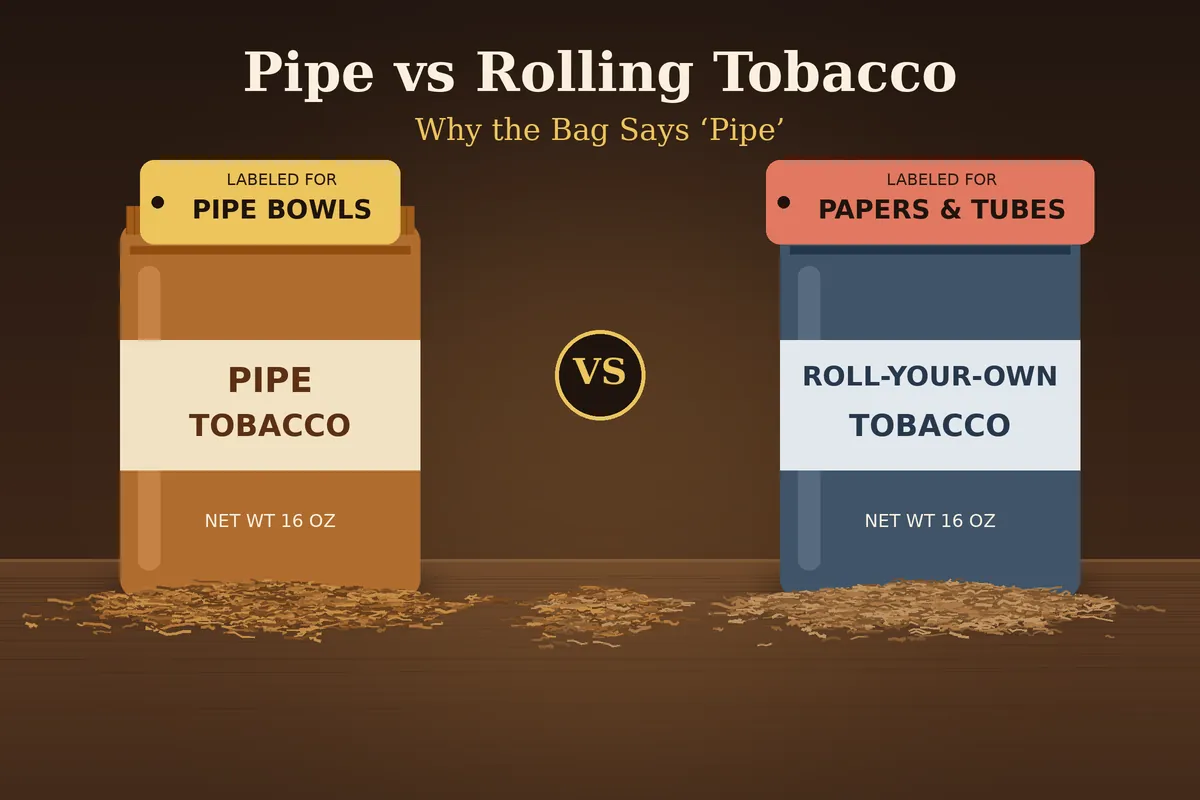
Pick up a 16 oz bag of budget tobacco and the front says "pipe tobacco." Turn to the shelf beside it and a bag of roll-your-own costs two or three times as much. The leaf inside both can look almost the same: shredded burley and Virginia, a little moisture, a resealable pouch.
So why does one say pipe, and why is it so much cheaper?
The word on the bag is a legal and tax decision, not just a description. This guide covers how federal law defines each product, where the price gap comes from, how the loophole opened in 2009 and what the label tells you.
Quick answer: Federal law defines pipe tobacco and roll-your-own tobacco by how a product is presented, meaning its appearance, type, packaging and labeling, not by a fixed cut or moisture standard. Since April 2009, pipe tobacco has carried a federal excise tax of about $2.83 per pound while roll-your-own carries $24.78 per pound. That gap of nearly nine to one is why budget bags are made, labeled and sold as pipe tobacco, and why they cost so much less. Congress has been urged to close the gap since 2012 but has not done so.
Pipe vs Rolling Tobacco: The Legal Definitions That Decide the Label
Most guides start with cut and texture. That is the wrong place to start, because the law does not.
The definitions sit in the Internal Revenue Code at 26 U.S.C. 5702, the same section that defines cigars, cigarettes and smokeless tobacco for tax purposes.
What the Law Says Pipe Tobacco Is
Pipe tobacco is any tobacco that, because of its appearance, type, packaging or labeling, is suitable for use and likely to be offered to or purchased by consumers as tobacco to be smoked in a pipe.
Notice what is missing. There is no minimum strand width, no moisture percentage and no list of approved leaf types. The test is how the product is likely to be offered and bought.
What Counts as Roll Your Own Tobacco
Roll your own tobacco gets the same style of definition, with one change in purpose. It is tobacco that, because of its appearance, type, packaging or labeling, is suitable for use and likely to be offered to or purchased by consumers as tobacco for making cigarettes. Since 2009 the definition also covers cigar wrapper and filler sold for making cigars at home.
Put the two definitions side by side and the difference between pipe tobacco and rolling tobacco, in legal terms, comes down to intended use as shown by presentation. The physical product can be very close.
Why the Label Matters More Than the Leaf
Because the test is about presentation, the manufacturer's choices decide the class:
- The declaration on the package. Federal rules require packages to state the class of product, such as "pipe tobacco" or "roll-your-own tobacco."
- What comes in the box. A pipe tobacco package that includes cigarette papers or tubes points to cigarette making, and regulators have treated that as roll-your-own.
- How it is marketed. Language, images or instructions about rolling cigarettes push a product toward the roll-your-own class.
That is why budget bags say "pipe" so clearly, and why the back of the bag usually describes the blend in pipe terms. The label is not an accident of design. It is the product's tax class printed on the front.
Why Is Pipe Tobacco Cheaper? Follow the Tax
Ask why pipe tobacco is cheaper and the answer is almost entirely federal excise tax. Leaf costs, cutting and packaging are broadly similar for budget pipe and roll-your-own bags. The tax is not.
Federal Excise Tax: Pipe Tobacco vs Roll Your Own
Before April 1, 2009, the two products were taxed at the same rate. The Children's Health Insurance Program Reauthorization Act of 2009 (CHIPRA) raised both, but by very different amounts. Current figures are on the TTB tobacco tax and fee rate schedule.
| Before April 2009 | Since April 2009 | Increase | |
| Pipe tobacco | $1.0969 per lb | $2.8311 per lb | About 2.6x |
| Roll-your-own tobacco | $1.0969 per lb | $24.78 per lb | About 22.6x |
| Factory cigarettes | $19.50 per 1,000 | $50.33 per 1,000 | About 2.6x |
CHIPRA set the roll-your-own rate to roughly match the tax on factory cigarettes per stick. Pipe tobacco was left on a much lower track. That single decision explains the federal excise tax pipe tobacco vs roll your own gap, and it is the heart of the pipe vs rolling tobacco price difference you see on the shelf today.
What the Gap Means Per Bag and Per Cigarette
On a one-pound bag, the federal tax alone works out like this:
- Labeled pipe tobacco: about $2.83
- Labeled roll-your-own: $24.78
- Difference: about $21.95 per pound, before any state tax or retail margin
To put it in cigarette terms, a pound of loose tobacco rolls very roughly 600 to 650 cigarettes at around 0.7 grams each. That is an estimate, since fill weight varies by tube and machine. On that basis, federal tax comes to well under half a cent per stick for pipe tobacco, close to 4 cents for roll-your-own, and about 5 cents for a factory cigarette.
That is the whole story behind a 16 oz bag of Good Stuff Red or 4 Aces sitting in the low teens while a pound of roll-your-own costs much more. We break down per-pound prices for the main budget brands in best cheap pipe tobacco: OHM vs 4 Aces vs Gambler.
State Pipe Tobacco Tax
The pipe tobacco tax you actually pay also includes state tax, which varies widely. Many states tax pipe and roll-your-own together as "other tobacco products," often as a percentage of wholesale price, while some treat roll-your-own more like cigarettes. The federal gap is the constant; the state layer is the variable. Shipping and flavor rules also differ by state, so check local law before ordering.
How the Pipe Tobacco Loophole Opened in 2009
When people say pipe tobacco loophole, they mean the situation CHIPRA created: two products that can be used the same way, defined by labeling, taxed nine to one apart.
Nobody had to break a rule for the market to move. More products were labeled as pipe tobacco, and smokers followed the price.
The Market Shift GAO Measured
The Government Accountability Office tracked the effect closely. In GAO-12-475, it reported that monthly pipe tobacco sales climbed from about 240,000 pounds in January 2009 to more than 3 million pounds by September 2011. Over the same period, monthly roll-your-own sales fell from about 2 million pounds to roughly 315,000 pounds.
GAO concluded that most of the swing came from people using pipe tobacco to make cigarettes, not from a sudden rise in pipe smoking. It also pointed to the core problem for regulators: the tax code's definitions of the two products do not specify physical characteristics that separate them.
Brands like OHM, Gambler and Golden Harvest all sit in the pound-bag tier that grew in those years.
Regulators Tried to Draw a Physical Line
The Alcohol and Tobacco Tax and Trade Bureau (TTB), which collects federal tobacco tax, did try to sharpen the boundary. In July 2010 it published Notice No. 106, an advance notice asking for public comment on physical standards to tell the two products apart. It reopened that comment period in August 2011.
Industry submissions proposed tests based on things like moisture content and cut width, the same traits smokers notice when they open a bag. Other ideas tied classification to when a product first came to market.
None of those standards became a final rule. When TTB finalized its 2009 roll-your-own regulations in 2012, it said the pipe tobacco question merited separate treatment and left the presentation-based definitions in place.
MAP-21 and the Roll-Your-Own Machine Rule
Congress did close one narrow piece. In the late 2000s, some retailers installed high-speed cigarette-making machines in-store. Customers bought labeled pipe tobacco and tubes, then used the store's machine to turn out cartons of cigarettes in minutes, paying pipe tobacco tax on the leaf.
The Moving Ahead for Progress in the 21st Century Act (MAP-21), signed on July 6, 2012, changed that. Under it, anyone who makes a cigarette-making machine available for consumer use for commercial purposes is treated as a manufacturer of tobacco products. TTB's guidance on roll-your-own cigarette machines explains that those operators now owe federal excise tax on the cigarettes the machines produce.
That rule targeted store machines. It did not change the tax on a bag of pipe tobacco, and it did not touch home injectors or hand rolling.
Where It Stands Now
GAO recommended in 2012 that Congress consider equalizing the pipe tobacco and roll-your-own rates. It repeated the point in 2019 and again in GAO-25-107903, published in August 2025. That report estimates equalizing the two rates could raise at least $1.5 billion over fiscal years 2025 to 2029, and notes that pipe tobacco has remained the top product in its market.
As of that report, Congress had not passed a fix. The two rates set in 2009 still apply, which is why the bag on the shelf still says "pipe."
Pipe vs Rolling Tobacco in the Bag: Physical Differences
The legal line is about presentation, but the products are not always identical. Traditional pipe tobacco and traditional rolling tobacco were developed for different jobs, and many bags still reflect that.
Is Pipe Tobacco the Same as Cigarette Tobacco?
Is pipe tobacco the same as cigarette tobacco? Not by design. Classic pipe blends are cut, moistened and cased for slow, cool smoking in a bowl, where the smoke is not meant to be inhaled. Cigarette and rolling tobacco is cut finer and conditioned for a thin paper that burns continuously and is drawn into the lungs.
Budget pound-bag pipe tobacco narrows that gap, which is exactly why the tax question exists. Even so, most of these bags are still cut as ribbon, run moister and lean on burley more than a typical rolling tobacco. Our full comparison of pipe tobacco vs cigarette tobacco goes deeper on leaf and casing, and pipe tobacco cuts explained shows how ribbon, flake and shag differ.
Pipe vs Rolling Tobacco at a Glance
| Typical budget pipe tobacco | Typical roll-your-own tobacco | |
| Label declaration | "Pipe tobacco" | "Roll-your-own tobacco" |
| Federal excise tax | About $2.83 per lb | $24.78 per lb |
| Usual cut | Ribbon, wider strands | Fine shred or shag |
| Moisture | Higher, held by humectants | Lower, set for even burn in paper |
| Leaf emphasis | Burley-forward with Virginia | Often Virginia-forward |
| Casing | Common, heavier in aromatics | Lighter, cigarette-style |
| Designed for | A pipe bowl, smoke not inhaled | Papers and tubes, smoke inhaled |
| Common bag sizes | 6 oz, 16 oz, 5 lb | Pouches, cans, 6 to 16 oz |
On pipe tobacco vs ryo tobacco, the table shows the pattern most smokers notice: the cheaper bag is usually wetter, wider and more burley-heavy. That is consistent with its job and its label.
Can You Roll Pipe Tobacco Into Cigarettes?
This is the question behind most searches on this topic, so here is the direct answer. Can you roll pipe tobacco into cigarettes? Physically, nothing in the bag stops it. But a product labeled pipe tobacco is made and taxed as pipe tobacco, and in a paper it often burns unevenly, tastes harsher when inhaled and can jam an injector.
We cover the burn, the injector problems and the health point in full in can you roll pipe tobacco into cigarettes. Two points are worth repeating here:
- The label decides the product class. What happens at home does not change what was made, labeled and taxed.
- It is no safer. A cigarette made from pipe tobacco is still a cigarette. Inhaled smoke reaches the lungs whichever bag the leaf came from.
If cigarettes are what you want, start with tobacco labeled for the job. Bugler is the long-running American roll-your-own name, and the roll-your-own collection holds the cigarette tubes and rolling papers sized for it. Our list of roll-your-own tobacco brands covers the main options on both sides of the line.
Where Good Stuff Fits
Good Stuff is a clear example of how labeling works in practice. It is made in the United States by RSB Tobacco, labeled as pipe tobacco and sold by Smokenza as pipe tobacco.
Its trademark registration lists a broad range of goods, including roll-your-own and hand-rolling tobacco. That list does not make the bags cigarette tobacco. A trademark goods list covers what the owner wants the name protected for, while the class of a product is set by how it is packaged and labeled. We walk through the record of who makes Good Stuff tobacco.
Every Good Stuff blend uses the same ribbon cut. The color tells you the leaf recipe and casing, as explained in Good Stuff tobacco colors explained.
| Blend | Style | Sizes at Smokenza |
| Good Stuff Red | Full flavor, the strongest | 2 oz, 6 oz, 16 oz, 5 lb |
| Good Stuff Gold | Light, same casing as Red | 2 oz, 6 oz, 16 oz |
| Good Stuff Silver | Ultra light, the mildest | 6 oz, 16 oz, 5 lb |
| Good Stuff Natural | No casing, no preservatives | 6 oz, 16 oz, 5 lb |
| Good Stuff Menthol | Strongest cooling | 2 oz, 16 oz, 5 lb |
| Good Stuff Menthol Gold | Gold blend, softer menthol | 6 oz, 5 lb |
Natural has no humectants, so it dries faster once opened. If additives are your concern, read additive free tobacco and Good Stuff Natural. Menthol and Menthol Gold are restricted in some states and cities, so check local rules first.
Good Stuff sits beside 4 Aces, OHM, Gambler, Kentucky Select, Cheyenne, Golden Leaf and Largo in our pipe tobacco collection. All are labeled pipe tobacco.
Reading the Bag Before You Order
A minute with the front and back of the bag tells you what the product is, how it was taxed and how it is meant to be smoked.
How to Read a Pipe vs Rolling Tobacco Label
Look for these five things:
- The class declaration. "Pipe tobacco" or "roll-your-own tobacco" is printed on the package. This is the single most important line.
- The net weight. Federal tax is charged by the pound, so weight is always shown. Compare price per pound, not price per bag.
- The nicotine warning. Pipe tobacco has been regulated by the FDA as a tobacco product since 2016, and roll-your-own since 2009. Both must carry the required nicotine warning.
- The blend description. Words like "full flavor," "mild" and "natural" describe taste and casing, not safety.
- What is in the package? Papers, tubes or rolling instructions belong with roll-your-own products, not pipe tobacco.
If the bag says pipe, use it as the package directs. If you are new to the pipe, our guide on how to pack a pipe gets you started, and pipe tobacco tongue bite covers the most common early problem.
Keeping a Pound Bag Fresh
Ribbon cut has a lot of surface area and dries fast. Reseal after every use, split 5 lb bags into airtight jars and keep them out of heat and sunlight. Fuzzy, raised spots that smell musty are mold, not dust. The visual checks in cigar mold vs plume work on loose tobacco too, and moldy tobacco should be thrown out.
If you also keep a few cigars for the winter months, our picks for the best flavored cigars for cold weather and Swisher Sweets explained cover easy, affordable options.
FAQs
What is the difference between pipe tobacco and rolling tobacco?
Legally, it is how the product is presented: pipe tobacco is packaged and labeled for smoking in a pipe, rolling tobacco for making cigarettes. Physically, pipe tobacco is usually a wider ribbon cut, moister and more burley-heavy.
Why is pipe tobacco cheaper than rolling your own tobacco?
Federal excise tax. Pipe tobacco is taxed at about $2.83 per pound and roll-your-own at $24.78 per pound, a gap created by CHIPRA in April 2009.
What is the pipe tobacco loophole?
The informal name for that tax gap. Because the two products are defined by labeling rather than physical standards, products labeled as pipe tobacco pay the lower rate.
Did the government close the loophole?
Only partly. MAP-21 in 2012 made commercial roll-your-own machine operators count as manufacturers. The tax rates themselves have not been equalized.
Is Good Stuff pipe tobacco or rolling tobacco?
Pipe tobacco. It is labeled and sold that way and should be used as the package directs.
Is pipe tobacco safer than cigarettes?
No tobacco product is safe. All of these contain nicotine, which is addictive, and are for adults 21 and over only.
Summary
The pipe vs rolling tobacco question is mostly a question about the label. Federal law defines both products by appearance, type, packaging and labeling, not by a fixed cut or moisture test, and since 2009 the two have been taxed at about $2.83 and $24.78 per pound. That gap is why budget bags are made and labeled as pipe tobacco, why they cost far less, and why GAO has asked Congress to close the loophole three times without result. Physically, most pipe tobacco is still wider, moister and more burley-forward than rolling tobacco, and it smokes best in a pipe. Compare the Good Stuff blends and the full pipe tobacco collection, or start with Bugler and the roll-your-own collection of cigarettes are what you want.
What did you think?
Share this article
Help others discover this content by sharing it with your network.