
You open the humidor and a cigar you have rested for months has a fine white dusting on the wrapper. Is it the sign of a well-aged smoke, or a fungus about to spread through the whole box?
The two can look alike at a glance, but they are not alike at all. One is crystallized oil you can brush off and smoke. The other is a living organism that ruins tobacco and moves from stick to stick. This guide covers what each looks like, a five-check method, what to do if you find mold, and how to stop it coming back.
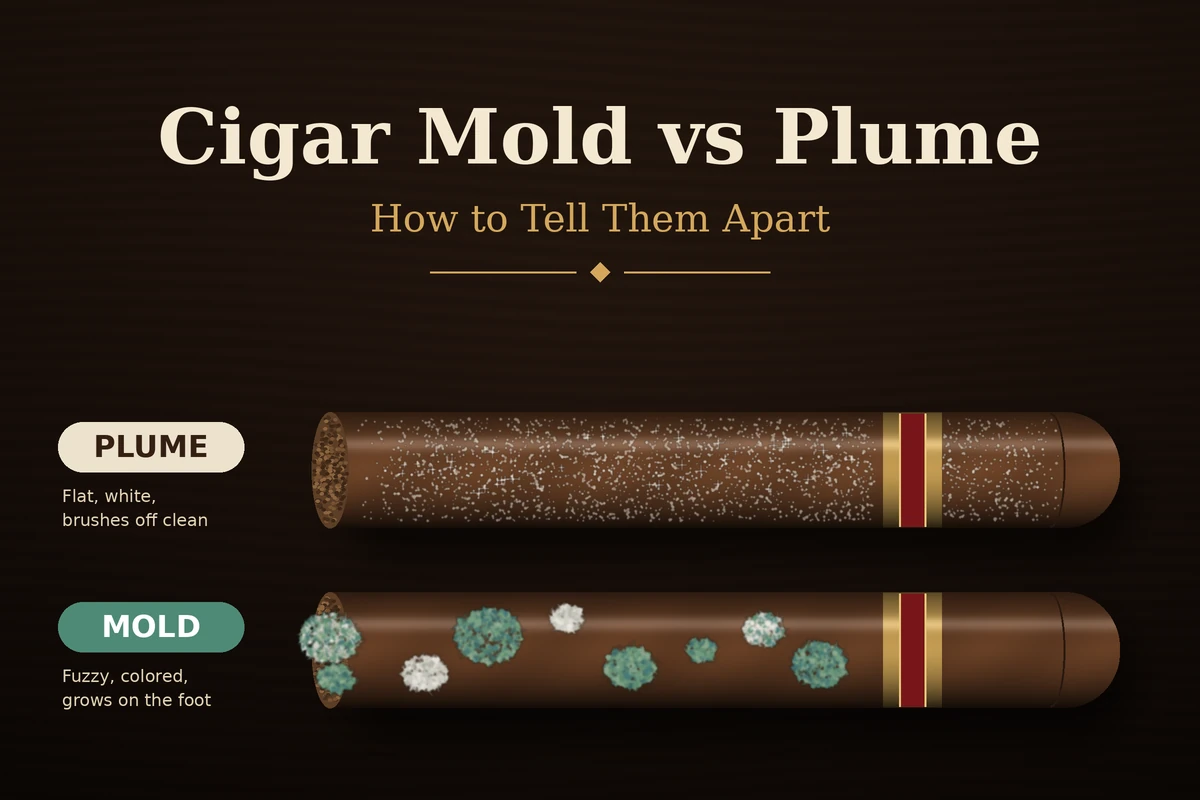
Quick answer: Plume is a flat, white or light gray, powdery or crystalline film that sits on the wrapper only, never on the foot. It brushes off with a fingertip, leaves no stain and has no smell beyond tobacco. Mold is raised and fuzzy, can be white, blue, green, yellow or black, can grow on the foot and cut ends, smells musty and often leaves a mark when wiped. If any check points to mold, treat it as mold: isolate the cigar, inspect the rest, and fix your humidity.
What Is Cigar Plume?
Cigar plume is a thin layer of tiny crystals that forms on the wrapper leaf during long, stable aging. As a cigar rests, oils and natural sugars inside the leaf slowly migrate to the surface. When they reach the outside, they dry and crystallize into a fine white or pale gray coating.
A few things define real plume:
- It takes time. Plume rarely appears on young cigars. It usually takes many months to a year or more of steady storage to form, which is why it is linked with aging. Our guide to aging cigars at home explains what rest does to a cigar.
- It favors oily wrappers. Dark, oily leaf such as maduro and Habano throws plume more often than a pale Connecticut Shade. We cover why those wrappers carry more oil in maduro vs natural cigar and the Habano wrapper explained.
- It sits only on the wrapper. It forms from the wrapper's own oils, so it does not grow on the exposed filler at the foot.
- It is harmless. Cigar Aficionado's glossary describes plume as a fine white powder that brushes off without leaving a mark and does not harm the cigar.
Many collectors see cigar plume as a badge of good storage: it tells you the stick has sat in steady conditions for a long time.
Cigar Bloom vs Mold: Same Question, Different Name
If you have read about bloom, you have read about plume. "Bloom" and "plume" are two names for the same crystalline film. So the cigar bloom vs mold question is identical to plume vs mold, and every check in this guide applies to both.
Plume is debated. Some smokers argue most "plume" is really mild white mold, and some samples sent to labs have come back as fungal growth. Others point out that true crystallized oil exists and behaves very differently. You do not need to settle it: if the coating passes every check below, it is behaving like plume. If it fails even one, treat it as mold.
Cigar Crystals vs Mold
Look closely at plume under a bright light and you may see tiny glinting points, almost like frost or fine sugar. Those are the crystals. Mold does not sparkle. Under magnification it shows threads, tufts or a velvety pile.
That is the quickest way to frame cigar crystals vs mold: crystals are flat and reflective, mold is raised and matte. A phone camera on macro mode, with a light shining across the wrapper at a low angle, is enough to see the difference.
What Cigar Mold Looks Like
Mold is a fungus. Spores land on cigars all the time but only grow with too much moisture, too much warmth and still air. Once a colony starts, it feeds on the leaf and releases more spores into the box.
Typical signs of mold:
- Raised, fuzzy or web-like texture, often in spots or clusters rather than an even film
- Color that can be white, gray, blue, green, yellow or black
- Location anywhere, including the foot, the cut head and under the band
- A musty, damp or sour smell, sometimes noticeable as soon as you open the humidor
- Staining or discoloration left behind after you wipe it
The CDC notes that mold can show up as spots of many colors and usually smells musty. The same is true inside a humidor.
Blue Green Mold on Cigar Wrappers
This is the easy case. Any blue green mold on cigar wrappers, or anything green, blue, yellow, orange or black, is mold. Plume is only ever white to light gray. There is no colored plume.
Colored growth usually starts as small, round, fuzzy spots, often where cigars touch each other or a damp humidifier. If you see color, skip the other checks and go straight to the response steps below.
White Cigar Mold: The Hard Case
White is where people get fooled. White mold is common, and at an early stage it can look like a light dusting. The difference is in the details:
- White mold looks cottony, hairy or tufted up close, while plume looks flat and dusty
- White mold appears in patches and spots that grow, while plume spreads evenly across the wrapper
- White mold can sit on the foot, while plume will not
- White mold smells, while plume does not
If a white coating is fuzzy, patchy or on the foot, it is mold no matter how pale it looks.
Cigar Plume vs Mold: Side-by-Side
Here is the cigar plume vs mold comparison in one place.
| Check | Plume (bloom) | Mold |
| Color | White or light gray only | White, gray, blue, green, yellow, black |
| Texture | Flat, powdery or crystalline | Raised, fuzzy, hairy or velvety |
| Location | Wrapper only | Anywhere, including the foot and cut head |
| Pattern | Even, fine film | Spots or clusters that grow |
| Smell | Normal tobacco | Musty, damp or sour |
| Wipe test | Brushes off clean, no mark | Smears or leaves a stain |
| Time to form | Months to years | Days to weeks in bad conditions |
| Common on | Oily wrappers, long-aged cigars | Over-humid, warm, stagnant storage |
| What to do | Brush off and smoke | Isolate, inspect, fix humidity |
How to Tell If a Cigar Has Mold: Five Checks
If you are standing over the humidor asking "is my cigar moldy?", run these checks in order. They take less than a minute, and most cases are settled by the second one.
- Check the color. Anything other than white or pale gray means mold. Stop here.
- Check the foot. Look at the open end where the filler shows. Any growth on the foot is mold, since plume does not form on filler.
- Check the texture. Tilt the cigar under a bright light. Flat and sparkly points to plume. Fuzzy, tufted or raised points to mold.
- Smell it. Hold the cigar close and breathe in. Normal tobacco and cedar is fine. Musty, damp basement or sour notes mean mold.
- Do the wipe test. Use a clean, dry fingertip or a soft brush and stroke gently along the wrapper. Plume lifts away and the leaf underneath looks unchanged. Mold smears, resists or leaves a faint stain.
Pass all five and you are almost certainly looking at plume. Mixed results mean mold. Still unsure? Isolate the cigar in a sealed bag for two or three days. Plume does not change. Mold grows.
White Spots on Cigar Wrappers That Are Neither
Not every mark is plume or mold. Some white spots on cigar wrappers have other causes:
- Water spots or mineral marks from humidifier splashes or tap water. These are flat, often ring-shaped and do not brush off.
- Natural leaf spotting, sometimes called "freckles," which are part of the leaf from the field. Our guide to wrapper leaf quality, color, veins and texture shows what normal leaf variation looks like.
- Tobacco beetle damage, which shows up as tiny pinholes with fine powder nearby. That powder is tobacco dust from the insects, not plume. Look for round holes before you decide.
Our cigar anatomy guide covers wrapper, binder, filler, head and foot.
Can You Smoke a Moldy Cigar?
No. We do not recommend smoking a cigar with mold on it.
- You cannot see how deep it goes. By the time growth shows on the wrapper, it may already be in the binder and filler. Wiping the surface does nothing for what is inside.
- It changes the flavor. Mold gives a musty, stale or bitter taste. The cigar you were aging is not the cigar you will be smoking.
- Mold can irritate people. The CDC says mold exposure can cause a stuffy nose, coughing, wheezing or eye irritation in sensitive people, and those with allergies or lung conditions may react more strongly. Burning it and drawing the smoke into your mouth is not a sensible test.
Some smokers wipe off a tiny spot of white growth and watch the cigar, but that is a gamble with a stick that has already changed. A replacement costs less than finding out the hard way. For something to light tonight, a fresh pick from our premium cigar collection or a mixed cigar sampler is a safer choice.
Plume is a different story. Brush it off and smoke as normal. Our guide on how to smoke a cigar covers the cut, light and pace, and how to cut a cigar explains how to open the head cleanly.
How to Remove Mold From Cigars and Your Humidor
People ask how to remove mold from cigars as if a cleaning trick saves the stick. There is no reliable one. The real job is saving the rest of your collection and resetting the humidor.
Step 1: Isolate Everything
Take every cigar out. Seal the moldy ones in a bag. Move clean-looking cigars to a separate airtight container with a two-way humidity pack.
Step 2: Inspect Each Cigar
Check every stick, including under bands and inside cellophane, especially those that touched the moldy ones or sat near the humidifier. Discard anything that fails the five checks.
Step 3: Clean the Humidor
Wipe every interior surface, trays and lid included, with a cloth dampened in distilled water and isopropyl alcohol. Air-dry with the lid open for at least 24 hours. Very fine sandpaper lifts stubborn stains on cedar. Skip bleach, soap and scented cleaners, since cedar absorbs odors.
Step 4: Replace or Clean the Humidifier
Sponge and foam humidifiers often harbor mold. Replace the element rather than cleaning it, and refill only with distilled water or the maker's solution.
Step 5: Re-Season and Recalibrate
Re-season the empty humidor and test your hygrometer with a salt test: damp salt sealed in a bag with the gauge for about a day should read close to 75%. Many cases of mold on cigars in humidor setups start with a hygrometer that reads several points low.
Our best cigar humidor for home use guide covers seasoning and setup in detail.
Freezing is a proven fix for tobacco beetles, but it is not a dependable cure for mold and will not reverse growth already in the leaf.
How to Prevent Cigar Mold in Your Humidor
Prevention is far easier than cleanup. Mold needs three things: moisture, warmth and still air. Take away any one of them and it struggles to start.
Keep humidity in range. Most premium cigars do well between 65% and 70% relative humidity. Mold risk climbs once readings sit above about 72%. Boveda's guidance suggests 69% for airtight humidors, 72% for most wood humidors that leak a little moisture, and 65% for Cuban cigars, since they tend to mold at higher humidity. If you keep Cuban sticks, our best Cuban cigars worth buying guide is a useful read.
Keep it cool. Aim for roughly 65°F to 70°F, away from windows, heaters and appliances. Summer is the riskiest season.
Use stable, two-way humidity control. Sponge humidifiers can overshoot, especially when topped up too generously. Two-way packs like Boveda add or absorb moisture as needed, which avoids the spikes that let mold start.
Use distilled water only. Tap water carries minerals and microbes that can feed growth and leave spots on wrappers.
Rotate, air and do not overpack. Open the humidor every few days, move cigars around, and leave space so air can move. Stagnant air and tight contact points are where colonies start.
Take care with tubes and cellophane. A tubed cigar stored sealed in a humid box can trap moisture inside the tube. Open the cap or take the cigar out when storing long term, especially with tubos like the Undercrown Gran Toro Tubo or Punch Rare Corojo Gusto Tubo.
Quarantine new arrivals. One contaminated cigar can seed a colony, so keep new sticks in a separate bag with a humidity pack for a week before they join the collection.
Every one of these steps is really cigar mold insurance, and a five-minute weekly check costs far less than replacing a collection.
Why Cigar Mold Spreads So Fast
Once one cigar has an active colony, it releases spores into the closed air, and every damp surface becomes a new site. Cedar trays hold spores too, which is why wiping one cigar is never enough and why the response steps start by taking everything out.
Coolerdors and electric cabinets follow the same rules. Coolers are very airtight, so overhumidification shows up fast, and cabinets can form warm spots or condensation, so use a second hygrometer in a different spot.
If plume is what you are hoping to see, oily, slow-aging cigars are where it tends to appear. Good candidates for long rest include the Oliva Serie V Maduro Toro, Rocky Patel Java Maduro Robusto, San Lotano Requiem Maduro Toro and Punch Knuckle Buster Maduro Robusto. More dark, oily options sit in our full bodied cigars collection, and our guide to Connecticut Broadleaf explains the leaf behind many maduro wrappers.
Do Cigarillos and Pipe Tobacco Get Moldy Too?
Yes. Any tobacco stored too wet and too warm can grow mold.
Natural leaf cigarillos. Backwoods use a whole leaf wrapper, so packs left in a hot car or an over-humid jar can grow mold, especially at the frayed foot. Our guides on how to store Backwoods, whether you need a humidor for Backwoods and whether Backwoods go bad cover safe storage. If a pack has gone dry rather than moldy, how to rehydrate a dry Backwood explains the slow fix. The full range sits in our Backwoods cigars collection and wider cigarillo collection.
Pipe tobacco. Pipe tobacco is moister than cigar leaf and often cased with sugars, which feed mold in a damp, warm bag. Sweet aromatics are the most prone, such as Middleton's Cherry Blend and Half and Half in the 7 oz can. Our guide to aromatic vs English vs Virginia pipe tobacco explains why casing matters.
Large bags need the most care. A Kentucky Select Red 5 lb bag or a Good Stuff Natural 16 oz bag stays open for weeks, so split it into airtight jars and keep only one jar in use. Smaller formats such as Largo Regular pouches or an OHM Silver 6 oz bag are easier to finish before they change. Brands like Good Stuff, OHM, Gambler and Red River are all in our pipe tobacco collection.
Fuzzy growth, a musty smell or colored spots mean the bag should go. Loose pipe tobacco does not form plume, so a white coating is not a good sign. For shelf life and storage, read does pipe tobacco go bad, and if a bag has dried out rather than molded, see how to rehydrate pipe tobacco bags.
FAQs
Is plume a sign of a good cigar?
It is a sign of long, stable storage, which usually means the cigar has aged well. It does not guarantee quality on its own.
Can you smoke a moldy cigar if you wipe it off?
We advise against it. Wiping removes what you can see, not what may be growing in the binder and filler, and mold changes the taste.
Does plume affect taste?
Brushed off, plume has little to no effect on flavor. Most of what people credit to plume is really the aging behind it.
What humidity causes mold in a humidor?
Risk rises once relative humidity sits above about 72%, especially combined with warmth above about 70°F and still air.
Do flavored or infused cigars mold more easily?
Sweetened coatings can add sugars to the surface, so they need the same careful humidity control. Our guide to infused vs flavored vs dipped cigars explains how each is made. All products here are for adults 21 and over.
Summary
Plume is a flat, white, odorless film of crystallized oil that forms on the wrapper over long aging and brushes off clean. Cigar mold is a raised, fuzzy fungus that can be any color, grows on the foot, smells musty and spreads. Check color, foot, texture, smell and the wipe test, and treat any failed check as mold. Discard moldy cigars, clean and re-season the humidor, and hold humidity at about 65% to 70% and temperature at about 65°F to 70°F to keep it from coming back. For more on keeping cigars in shape, see how long does a cigar last.
What did you think?
Share this article
Help others discover this content by sharing it with your network.