
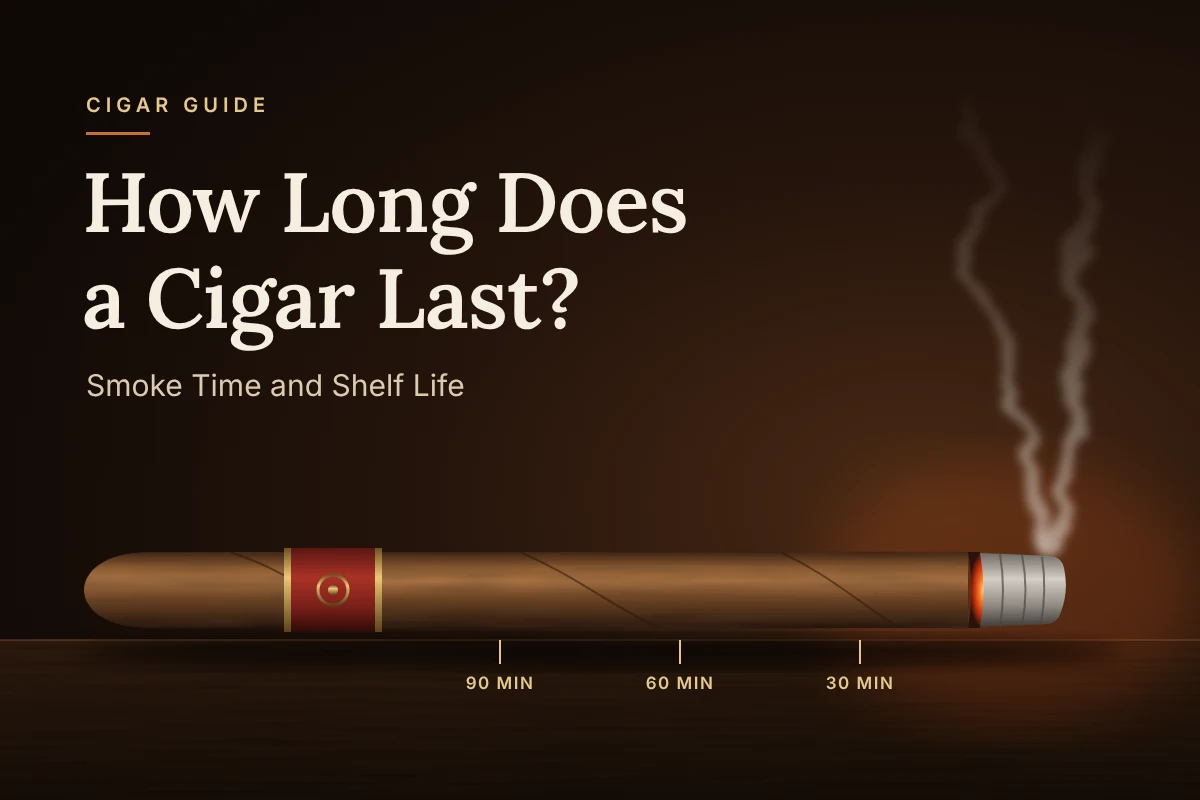
Most cigars take 30 to 90 minutes to smoke, depending on size and pace. An unlit cigar has no fixed expiration date. Stored at about 70% humidity, it can stay smokable for years or even decades. Left in open air, it can turn dry and harsh in about a week.
Those are two separate timelines: how long a lit cigar burns, and how long an unlit cigar keeps. This guide covers both, with time ranges by size and by storage method, so you can pick the right cigar for the time you have and keep the rest in good condition.
How Long Does a Cigar Last Once Lit?
How long does it take to smoke a cigar? Plan on 45 to 60 minutes for a standard premium cigar. Small cigars can finish in 30 minutes or less, while large formats can run well past 90 minutes.
Size sets the baseline, and your pace does the rest. Published cigar smoke time charts rarely match because every smoker draws at a different speed. Treat the figures below as planning ranges, not fixed times.
How Long Does a Cigar Last by Size?
This chart shows typical cigar smoking time by size. Length is in inches, and ring gauge is the diameter in 64ths of an inch.
| Cigar size | Typical dimensions | Smoke time |
| Cigarillo | About 4 to 5 x 26 to 34 | 10 to 20 minutes |
| Petit Corona | 4.5 x 40 to 42 | 25 to 40 minutes |
| Corona | 5.5 x 42 to 44 | 30 to 50 minutes |
| Robusto | 5 x 50 | 45 to 60 minutes |
| Toro | 6 x 50 | 60 to 90 minutes |
| Churchill | 7 x 47 to 50 | 75 to 110 minutes |
| Gordo | 6 x 60 | 75 to 120 minutes |
For a quick estimate on a cigar with a ring gauge of 48 or more, allow 10 to 15 minutes per inch. A 6-inch toro works out to 60 to 90 minutes, which matches the chart.
How Long Does a Robusto Last?
A robusto usually lasts 45 to 60 minutes. Its 5 x 50 format is long enough for the flavor to change from start to finish, but it does not take over your evening. That balance makes it the safest first choice when you are unsure of your pace.
The Arturo Fuente Don Carlos Robusto is a classic example of this size. If you want a robusto with a lighter profile, start with our mild cigars.
How Long Does a Toro Last?
A toro usually lasts 60 to 90 minutes. The extra inch adds roughly 15 to 30 minutes to a robusto, so it suits a long dinner, a game or a slow evening outdoors.
The San Lotano Requiem Maduro Toro from AJ Fernandez is one option in this size. Our AJ Fernandez cigars ranked guide can help you compare the brand's other lines.
How Long Does a Churchill Cigar Last?
A Churchill usually lasts 75 to 110 minutes. Its length gives you the longest session of the common sizes, and the narrower ring gauge keeps the draw refined rather than heavy.
Save this size for a time when you will not be interrupted. Rushing a Churchill overheats the tobacco and turns the flavor bitter. The AJ Fernandez Enclave Broadleaf Churchill and the Arturo Fuente Churchill both fit this slower style of smoking.
What Affects Cigar Burn Time?
Two cigars of the same size can finish 30 minutes apart. These five factors explain most of the difference in cigar burn time:
- Ring gauge: A thicker cigar holds more tobacco. A 54 ring gauge cigar burns longer than a 42 ring gauge cigar of similar length.
- Puffing pace: One puff every 30 to 60 seconds keeps a cigar lit without overheating it. Faster puffing shortens the smoke and makes it harsher.
- Humidity: A dry cigar burns fast and hot. An over-humidified cigar burns slowly, draws tightly and may go out.
- Construction: Long-filler cigars tend to burn more slowly and evenly than short-filler cigars. A tight roll also slows the burn.
- Conditions: Wind speeds up the burn on one side, so a cigar smoked outdoors often finishes sooner.
Strength does not set smoke time. A mild robusto and a full-bodied robusto contain similar amounts of tobacco, although many smokers naturally slow down with stronger blends. Our cigar strengths guide explains how mild, medium and full-bodied cigars differ.
Can You Relight a Cigar?
A cigar that has gone out can usually be relit within an hour or two with good results. Tap off the ash, blow gently through the cigar to clear stale smoke, then toast the foot before you draw.
After a few hours, stale flavors build quickly. A half-smoked cigar left overnight usually tastes sharp and bitter, so most smokers discard it.
You will also rarely smoke a cigar down to the very end. Most smokers stop with an inch or two left, once heat builds and the flavor turns harsh. That is normal, and the time ranges above already allow for it.
Do Cigars Expire?
No, cigars do not expire the way food does, and they carry no use-by date. They do go bad when storage fails. A cigar is fermented tobacco that holds a small, steady amount of moisture, and that balance is what you are protecting.
Too little moisture and the oils fade, the wrapper cracks and the cigar burns hot. Too much and the tobacco swells, the draw tightens and mold can form. So do cigars go bad on their own? Not really. Poor conditions are what ruin them.
That means the answer to how long does a cigar last in storage depends less on the calendar and more on humidity, temperature and stability.
Time can even work in a cigar's favor. Under steady conditions, the tobaccos in a blend meld, sharp edges soften and strong cigars often mellow. Aging is not a guaranteed upgrade, though. Some blends improve for years, then gradually lose flavor and turn flat.
How Long Does a Cigar Last in Storage?
Cigar shelf life ranges from a few days to several decades, depending on the storage method. These are general estimates for a premium, handmade cigar in a typical home. Hot, dry or very damp climates will shorten them.
| Storage method | Expected shelf life | Main risk |
| Humidor at 65% to 72% humidity | Years to decades | Humidity or temperature swings |
| Sealed bag or container with a two-way humidity pack | 1 to 3 months | Spent pack or poor seal |
| Cellophane, stored at room temperature | Up to about 4 weeks | Slow drying |
| Closed cigar box, no humidity source | A few weeks | Slow drying |
| Ziplock bag, no humidity source | 1 to 2 weeks | Drying, trapped heat |
| Open air, no protection | About 3 to 7 days | Fast drying |
How Long Do Cigars Last in a Humidor?
Cigars can last for decades in a humidor when the conditions stay steady. Aim for 65% to 72% relative humidity and a temperature of about 65°F to 70°F. The classic benchmark is 70% humidity at 70°F, although many smokers prefer the mid to upper 60s for a slightly better burn.
Stability matters more than a perfect number. Keep the humidor away from sunlight, heating vents and exterior walls. Use a digital hygrometer to check the reading, and fill traditional humidifiers with distilled water, because tap water can encourage mold.
Cellophane can stay on for short-term storage. For long-term aging, many smokers remove it so humidity reaches the wrapper evenly. Keep flavored cigars, including infused lines from ACID, apart from traditional cigars. Their aromas can transfer through the humidor over time.
How Long Do Cigars Last Without a Humidor?
Without a humidor or any other humidity source, a premium cigar usually stays at its best for about a week and may remain smokable for a little longer. Air conditioning and winter heating pull moisture out fastest, so an indoor room can be harder on a cigar than you would expect.
Do not keep cigars in a bathroom, a car or a kitchen cabinet. Each of these places brings temperature swings or strong odors. If you have no storage setup yet, smoke your cigars within a few days of delivery or use the sealed bag method below.
How Long Do Cigars Last in Cellophane?
Cigars last up to about four weeks in cellophane without a humidity source. Cellophane looks airtight, but it is slightly porous. It slows moisture loss rather than stopping it.
That makes cellophane useful for shipping and handling, not for storage. If you plan to keep a cigar longer than a couple of weeks, move it somewhere with controlled humidity.
How Long Do Cigars Last in a Ziplock Bag?
Cigars last 1 to 2 weeks in a ziplock bag on their own. The bag slows drying, but it adds no moisture. With a two-way humidity pack inside, the same bag can keep cigars in good condition for 1 to 3 months.
For the best result, use a thick freezer bag, press out most of the air and keep it somewhere cool and dark. Check the cigars every week or so, and replace the pack when it turns stiff. Do not use a wet sponge or damp paper towel. Uneven moisture can stain the wrapper and invite mold.
How Long Does a Cigar Last in Its Original Box?
A cigar lasts a few weeks in a closed original box with no humidity source. Cedar helps buffer small changes, and a closed lid slows moisture loss, but a retail box was not built to control humidity. Adding a two-way humidity pack and sealing the box in a large bag can extend that to a month or more.
This matters most when you order by the box. A box of 20 smoked at one cigar per week lasts about five months, far longer than a closed box can protect it. If you order boxes such as the AJ Fernandez Last Call line, plan your storage first. If you smoke only now and then, a smaller sampler from our cigar gift sets may suit you better.
Do Machine-Made Cigars Last Longer?
Yes, many machine-made cigars last longer outside a humidor because they are built from drier tobacco and are not meant to hold the same moisture as a handmade cigar. They often stay smokable for roughly 12 to 24 months in sealed packaging.
Once a pouch is opened, the clock moves faster. Natural-leaf styles such as Backwoods can dry out in days, while tipped cigars like Black & Mild are also best smoked within a few weeks. Keep packs sealed, cool and out of the sun.
The everyday options in our cigar collection mostly fall into this group. If you are unsure which format you have, our cigarillo guide and cigarillo vs cigar comparison explain the differences.
How to Tell If a Cigar Is Bad
To tell if a cigar is bad, check its feel, surface, smell and draw before you cut it. A healthy premium cigar feels firm with a slight give, and it smells like clean tobacco.
| What you notice | Likely cause | What to do |
| Cracked or flaking wrapper, crackles when squeezed | Too dry | Rehydrate slowly if the wrapper is intact |
| Spongy feel, tight draw, trouble staying lit | Too much humidity | Lower the humidity gradually |
| Fine white or gray dust that brushes off cleanly | Plume | Usually harmless, so brush it off |
| Fuzzy blue, green or white growth with a musty smell | Mold | Discard it and check nearby cigars |
| Pinholes and fine tobacco dust | Tobacco beetles | Isolate all nearby cigars right away |
| Flat, bitter or sharp flavor after lighting | Dryness or age | Rest in humidity once, or discard it |
Can You Save a Dry Cigar?
Often, yes, if the wrapper has not started to crumble. Raise the humidity in stages over several weeks, starting at around 60% to 62%. Sudden moisture makes the filler swell faster than the wrapper, and that can split the cigar.
A cigar that has been dry for a long time can take months to recover, and some of its oils and aroma will not return. If the wrapper breaks apart when touched, it is past saving.
Plume or Mold?
Plume sits on the surface as fine, even, crystal-like dust, and it wipes away without leaving a mark. Mold looks fuzzy or blotchy, usually shows blue or green tones, smells musty and tends to stain the wrapper. When you are unsure, treat it as mold. Remove the cigar immediately, then inspect everything stored near it.
Why Tobacco Beetles Are a Bigger Risk Than Most Guides Admit
Tobacco beetles are small pests whose eggs can be present in tobacco. Many guides say the eggs only hatch above 72°F, but the research is less tidy. Purdue University Extension reports that eggs hatch in 5 to 6 days at 95°F and can take up to 22 days at 68°F, with 70% to 80% relative humidity being the most favorable range.
An older USDA study also recorded a hatch rate of close to 60% at about 65°F, compared with about 1% at about 60°F. So there is no magic safe line at 72°F. Warm, humid storage carries the highest risk, and that risk builds with time.
The practical rule is simple: keep your cigars at or below 70°F, keep humidity under 72% and inspect them often. If you find pinholes, seal the affected cigars in a plastic bag, freeze them for about three days, then move them to the refrigerator for 24 hours before returning them to a cleaned humidor. Discard any cigars with visible damage.
How to Make Your Cigars Last Longer
The steps below cover nearly every storage failure. Most take only a few minutes a month.
- Match your order to your storage. Keep only as many cigars as you can store properly.
- Hold humidity between 65% and 72%, and verify it with a digital hygrometer.
- Keep the temperature at or below 70°F, away from sunlight and heating or cooling vents.
- Use two-way humidity packs or distilled water. Never use tap water.
- Rotate cigars every few months so those near the humidity source do not stay wetter than the rest.
- Store infused and traditional cigars apart.
- Inspect your cigars monthly for mold, pinholes and cracked wrappers.
Which Cigar Fits the Time You Have?
Start with the time you have, then choose a strength you enjoy. Picking the right size keeps you from rushing a good cigar or leaving it half-smoked.
| Time available | Best size | Where to start |
| Under 20 minutes | Cigarillo | Cigarillos |
| About 30 minutes | Small cigar or petit corona | Small cigars, Davidoff Primeros, Arturo Fuente Short Story |
| 45 to 60 minutes | Robusto | Mild cigars, medium cigars |
| 60 to 90 minutes | Toro | Full-bodied cigars, Dominican cigars |
| 90 minutes or more | Churchill or gordo | Premium cigar collection |
New to cigars? Start with a smaller, milder cigar so you can stop before it feels like too much. Our best cigars for beginners collection and mild cigar picks are good places to begin.
If you already know what you like, compare our Dominican cigar brands or read how Alec Bradley Black Market and Black Market Esteli differ.
FAQs
How Long Does a Cigar Take to Smoke for a Beginner?
A beginner usually takes about the same time or a little less, since new smokers tend to puff faster. A robusto may take 40 to 50 minutes. Slow down to one puff every 30 to 60 seconds for a cooler, smoother burn.
Can You Smoke a 20-Year-Old Cigar?
Yes, if it was stored at steady humidity and shows no mold, pinholes or cracked wrapper. Expect softer, more blended flavors than a fresh cigar. Some very old cigars taste wonderful, while others taste flat.
Can You Store Cigars in the Refrigerator?
No, not for regular storage. A refrigerator is cold and dry, and it can transfer food odors to the tobacco. Its only useful role is as a short step when you bring cigars back from the freezer after a beetle treatment.
Do Cigars in Tubes Last Longer?
A sealed tube slows drying a little, but it does not control humidity. Treat a tubed cigar like one in cellophane. It is good for carrying and short-term protection, not for long-term storage.
How Long Does a Cut Cigar Stay Fresh?
A cut cigar dries out faster than an uncut one because the head is open. Smoke it the same day when you can. Avoid cutting a cigar until you are ready to light it.
Is It Okay to Smoke a Dry Cigar?
You can, but it will burn hot and fast and taste harsh. Give it time in a humidified space first. If the wrapper is flaking away, it is usually better to discard it.
The Bottom Line
How long does a cigar last comes down to two things: size sets the smoke time, and storage sets the shelf life. A robusto gives you 45 to 60 minutes, a toro 60 to 90 and a Churchill up to about 110. Unlit, a cigar can last days in open air or decades at steady humidity, so match your order to your storage and smoke what you cannot keep well.
What did you think?
Share this article
Help others discover this content by sharing it with your network.