
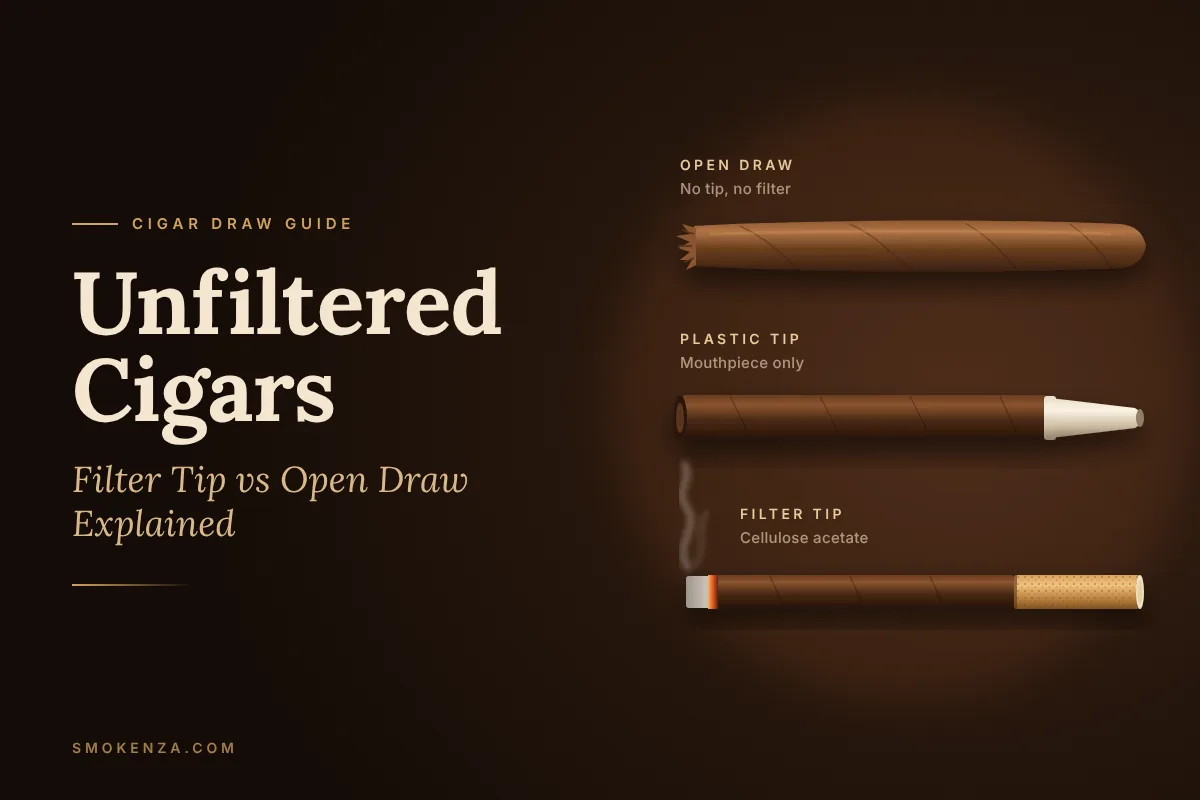
Quick answer: Most cigars have no filter at all. Premium handmade cigars, most cigarillos and brands like Backwoods are smoked with an open draw, meaning smoke passes straight from the tobacco to your mouth. A filter tip is a plug of cellulose acetate, the same material used in cigarette filters, found mainly on filtered little cigars and some cigarillo lines. A plastic or wood tip is different again. It is a mouthpiece, not a filter, and it does very little to the smoke.
People often treat "tip" and "filter" as the same thing. They are not. A Black & Mild with a plastic tip and an Al Capone Filter Cigarillo both have something on the mouth end, but only one of them filters the smoke. This guide explains the three options: open draw, tip and filter. It also covers how each one changes the draw, flavor and smoking experience, and which products on Smokenza fall into each group.
Do Cigars Have Filters?
The short answer to "do cigars have filters" is: usually not. It depends on the type of cigar.
Premium Handmade Cigars
A traditional handmade cigar is built from three parts: filler, binder and wrapper. There is no filter. You clip or punch the cap, light the foot, and the smoke travels through the tobacco and out through the cut head. The tobacco itself is the only thing between the burning end and your mouth.
That is by design. Premium cigars are meant to be tasted, not inhaled, and a filter would strip out the flavor the blender worked to build. Our guide on how to smoke a cigar covers the basics of that open-draw ritual.
Cigarillos and Machine-Made Cigars
Most cigarillos are also unfiltered. They are smaller and often made by machine, but the draw works the same way as a full-size cigar. Some come with a plastic or wood tip for convenience. A few lines come in a filtered version too, sold next to the regular non-filter version.
If you are new to the category, what is a cigarillo breaks down size, wrapper type and how cigarillos are classified.
Filtered Little Cigars
This is where filters actually live. Filtered little cigars look a lot like cigarettes. They are slim, roughly cigarette length, and finished with a cellulose acetate filter. The difference is the wrapper: a filtered cigar is rolled in tobacco leaf, either natural or reconstituted, instead of paper.
For a deeper look at how these are built and taxed, read what are filtered cigars.
Filter, Tip or Open Draw: Three Different Things
Before comparing them, it helps to define each option clearly.
| Mouth end | What it is | Filters smoke? | Common examples |
| Open draw | No tip or filter; you draw straight through the tobacco | No | Premium cigars, Backwoods, most cigarillos |
| Plastic tip | Molded plastic mouthpiece fixed to the head | No | Standard Black & Mild |
| Wood tip | Wooden mouthpiece fixed to the head | No | Black & Mild Wood Tip |
| Filter tip | Cellulose acetate plug, often with a paper or foil-look wrap | Yes, partially | Djarum filtered cigars, Al Capone Filter Cigarillos |
The key point: a tip changes how the cigar feels on your lips. A filter changes the smoke itself.
What Are Unfiltered Cigars?
Any cigar that delivers smoke through an open path counts as unfiltered, whether it has a tip or not. That covers almost every premium cigar, most cigarillos, and tipped machine-made cigars such as Black & Mild, since a plastic or wood mouthpiece does not filter anything.
In everyday use, though, "unfiltered" or "non-filter" is mostly used to tell apart two versions of the same cigarillo line. Al Capone is the clearest example. Each flavor comes in a filter version and a non-filter version, sold side by side.
How an Open Draw Works
Open draw cigars have nothing between the tobacco and your mouth. When you draw, air pulls through the lit foot, through the filler and out the head. That gives you:
- Fuller flavor: nothing traps the oils and aromatic compounds that carry the taste
- A looser draw: less resistance, so less effort per puff
- Wrapper contact: your lips touch the leaf, so you taste the wrapper and any sweetener on it
- More room for heat: without a filter, puffing too fast quickly turns the smoke hot and harsh
Open draw puts you in control. Pace matters more, and a well-made unfiltered stick rewards slow, steady puffs.
Unfiltered Cigarillos
Unfiltered cigarillos are the most common format in this group. They are usually pre-opened at the head, so there is nothing to cut, and many have a sweetened or flavored wrapper you taste as soon as the cigarillo touches your lips.
The Al Capone non-filter range is a good reference point:
If you want to know what sets these blends apart, see our breakdown of Al Capone Blues vs Sweets and the Al Capone Jamaican Blaze flavor guide. The full cigarillo range, filtered and not, sits in the cigarillo collection.
Filter Tip Cigars and Filtered Little Cigars
Filter tip cigars take the cigarillo or little cigar format and add a cigarette-style filter. The result smokes much more like a cigarette than a traditional cigar.
What the Filter Actually Does
A cellulose acetate filter is a dense bundle of fibers. As smoke passes through, it traps some particulate matter and cools the smoke a little. In practice, that means:
- A tighter draw: more resistance, closer to a cigarette
- Softer, cooler smoke: less heat on the tongue
- Muted flavor: some of the oils that carry flavor stay in the filter
- No wrapper contact: your lips touch the filter, not the leaf
Some filtered cigars also use additives in the filter material. A 2018 study on little cigars, filtered cigars and their carbonyl delivery found filtered cigars delivered less formaldehyde per stick than the comparison cigarettes, which the authors put down to sepiolite in the filters, but higher levels of most other carbonyls measured.
That finding matters. A filter changes the feel of the smoke. It does not make a cigar safe or low-risk. Cigar smoke contains the same kinds of toxic and carcinogenic compounds as cigarette smoke, whether or not there is a filter.
Why Filtered Little Cigars Exist
Filtered little cigars grew largely because of how tobacco is taxed and regulated. In the US, products wrapped in tobacco leaf are classified as cigars rather than cigarettes, and cigars have historically faced different tax rates and rules.
That gap has drawn scrutiny. A Georgetown University study found that many filtered little cigars meet the legal definition of cigarettes under existing federal, state and local laws, because smokers use them the same way. Classification rules vary by state, so what is sold where can change.
On Smokenza, the filtered cigars collection groups the current range. That includes the Al Capone filter versions:
- Al Capone Sweets Filter Cigarillos
- Al Capone Jamaican Blaze Filter Cigarillos
- Al Capone Blues Filter Cigarillos
It also carries Djarum's clove-blend filtered cigars, such as Djarum Black, Djarum Black Cherry (Ruby), Djarum Black Ivory Vanilla and Djarum Special. If you are choosing by taste, our guide to the best filtered cigars by flavor sorts them into sweet, menthol and natural.
Filtered vs Unfiltered Cigars: Side by Side
Here is the filtered vs unfiltered cigars comparison across the things that actually change when you light one.
| Factor | Filtered | Unfiltered (open draw) |
| Draw | Tighter, cigarette-like | Looser, more open |
| Flavor | Softer, muted | Fuller, more direct |
| Wrapper taste | Not on the lips | Directly on the lips |
| Smoke temperature | Slightly cooler | Hotter if puffed fast |
| Typical size | Slim, cigarette length | Varies, cigarillo to full cigar |
| Typical smoking style | Often inhaled like a cigarette | Traditionally puffed, not inhaled |
| Smoke time | Short, around cigarette length | Longer, depending on size |
| Best for | Smokers who want a cigarette-like feel | Smokers who want tobacco and wrapper flavor |
The biggest difference is not the filter itself. It is how the product is used. Filtered little cigars are designed to be smoked like cigarettes, while open-draw cigars and cigarillos are built for slower, mouth-only smoking.
If you are weighing nicotine across formats, how many cigarettes is a Backwood and how many cigarettes equal one Black & Mild compare lab-measured figures.
Tipped vs Untipped Cigars
Tipped vs untipped cigars is a separate question from filtered vs unfiltered. A tip is just a mouthpiece. It changes grip and feel, not the smoke.
Why choose a tipped cigar?
- Clean lips: no loose leaf or sweetener on your mouth
- Firm hold: the tip keeps its shape, so the head does not get soggy
- Easy draw: the opening is already set, so there is nothing to cut
Why choose untipped?
- More flavor: you taste the wrapper directly
- Traditional feel: the same experience as a premium cigar
- Less material: no plastic or wood to throw away
Wood Tip vs Plastic Tip Cigars
Black & Mild is the brand most people think of when comparing wood tip vs plastic tip cigars, because it sells the same blends in both. The Black & Mild brand page lists both versions.
Plastic tip:
- Smooth and slightly slick on the lips
- Keeps its shape for the whole smoke
- Feels closer to a pipe stem
- The standard version for most Black & Mild blends, such as Black & Mild Regular, Jazz and Wine
Wood tip:
- Natural, slightly textured feel
- Absorbs a little moisture, which some smokers find more comfortable
- Can soften or splinter if chewed
- Available as Regular Wood Tip, Jazz Wood Tip and Wine Wood Tip
Neither tip filters the smoke. The tobacco and flavor are the same; only the mouthpiece changes. For a flavor-by-flavor take, see what Black & Mild Jazz tastes like.
Best Unfiltered Cigars on Smokenza
There is no single best pick, because unfiltered covers everything from a natural-leaf cheroot to a sweet cigarillo. These are the strongest options by style.
Backwoods: the open draw benchmark. If one brand defines the open draw, it is Backwoods. There is no tip and no filter. Each stick has a frayed foot, a tapered body and an unfinished head, all wrapped in natural leaf rather than the homogenized sheet used on most machine-made cigars. You taste the wrapper from the first puff.
The full lineup sits in the Backwoods cigars collection. Start with the unflavored Backwoods Original to taste the leaf on its own, then move to infused blends like Honey Bourbon or Russian Cream. Every infused option is grouped in the Backwoods flavors collection, and standard pouches are in the Backwoods 5-pack collection.
If you roll your own, Backwoods True Wraps give you the same natural leaf without filler, so the draw stays fully open. Our guide to tobacco wraps vs rolling papers explains how leaf wraps compare.
Al Capone non-filter cigarillos. The best way to judge filtered vs unfiltered for yourself is to try both versions of the same blend. Al Capone sells every flavor both ways, so Sweets against Sweets Filter gives you a direct comparison with no other variables. Details are on the Al Capone brand page.
Black & Mild (tipped, unfiltered). A good middle ground if you want an unfiltered smoke with a clean mouthpiece. The pipe tobacco filler gives a sweeter, more aromatic smoke than most cigarillos.
Premium small cigars. For a step up in tobacco quality, small premium formats from Davidoff, Zino and Ashton give you an open draw built from handmade-cigar tobacco in a short smoke.
For more flavored options across brands, see the flavored cigars collection and our explainer on what flavored cigarillos are.
Who Should Choose Unfiltered Cigars
Go unfiltered if:
- You want to taste the tobacco and wrapper, not just the smoke
- You smoke slowly and do not inhale
- You like natural-leaf products such as Backwoods
- You are moving toward premium cigars and want the same kind of draw
Stick with filtered if you specifically want a cigarette-style draw and a shorter smoke. Even then, remember the filter does not reduce risk in any meaningful way.
How to Smoke Unfiltered Cigars Without Harshness
An open draw is less forgiving than a filter, so technique matters:
- Slow down: about one puff a minute keeps the smoke cool
- Do not inhale: draw the smoke into your mouth, taste it, and let it go
- Keep them fresh: a dry wrapper burns hot and fast; see how to store Backwoods, and if one is already brittle, how to rehydrate a dry Backwood
- Light evenly: toast the foot all the way around before you draw
- Let it rest: if the smoke turns bitter, put it down for a minute before the next puff
Frequently Asked Questions
Do all cigars have filters?
No. Premium cigars, most cigarillos and brands like Backwoods have no filter. Filters are mainly found on filtered little cigars and on the filter versions of some cigarillo lines.
Is a plastic tip a filter?
No. A plastic or wood tip is a mouthpiece. It changes how the cigar feels on your lips but does not filter the smoke.
Are filtered cigars safer than unfiltered ones?
No. A filter changes the draw and the feel of the smoke, but filtered cigars still deliver harmful compounds, and research has found higher levels of several of them than in comparison cigarettes. No cigar is a safe tobacco product.
Do filtered cigars taste different from non-filter versions?
Yes. The filter mutes some flavor and keeps the wrapper off your lips. Non-filter versions taste fuller and sweeter, especially when the wrapper is flavored.
Should you inhale a cigarillo?
Cigars and cigarillos are traditionally puffed, not inhaled. Filtered little cigars are often inhaled because they are designed to smoke like cigarettes, which increases exposure.
Are Backwoods filtered?
No. Backwoods have no filter and no tip. They are open draw from end to end, with a natural leaf wrapper.
How many cigarillos come in a pack?
It depends on the brand. Common formats run from 2 and 3 packs up to 5, 10 and 12. Our guide to cigarillo pack sizes covers the most common counts and price comparisons.
Summary
Unfiltered cigars, from premium handmade sticks to cigarillos and Backwoods, deliver smoke through an open path, giving a looser draw, fuller flavor and direct contact with the wrapper. Filter tips use cellulose acetate to tighten the draw and soften the smoke, while plastic and wood tips are only mouthpieces and filter nothing. Filtered little cigars smoke much like cigarettes, but the filter does not make them safer. Choose open draw for flavor and a traditional slow smoke, and compare filter and non-filter versions of the same blend, such as Al Capone, to feel the difference for yourself.
What did you think?
Share this article
Help others discover this content by sharing it with your network.