
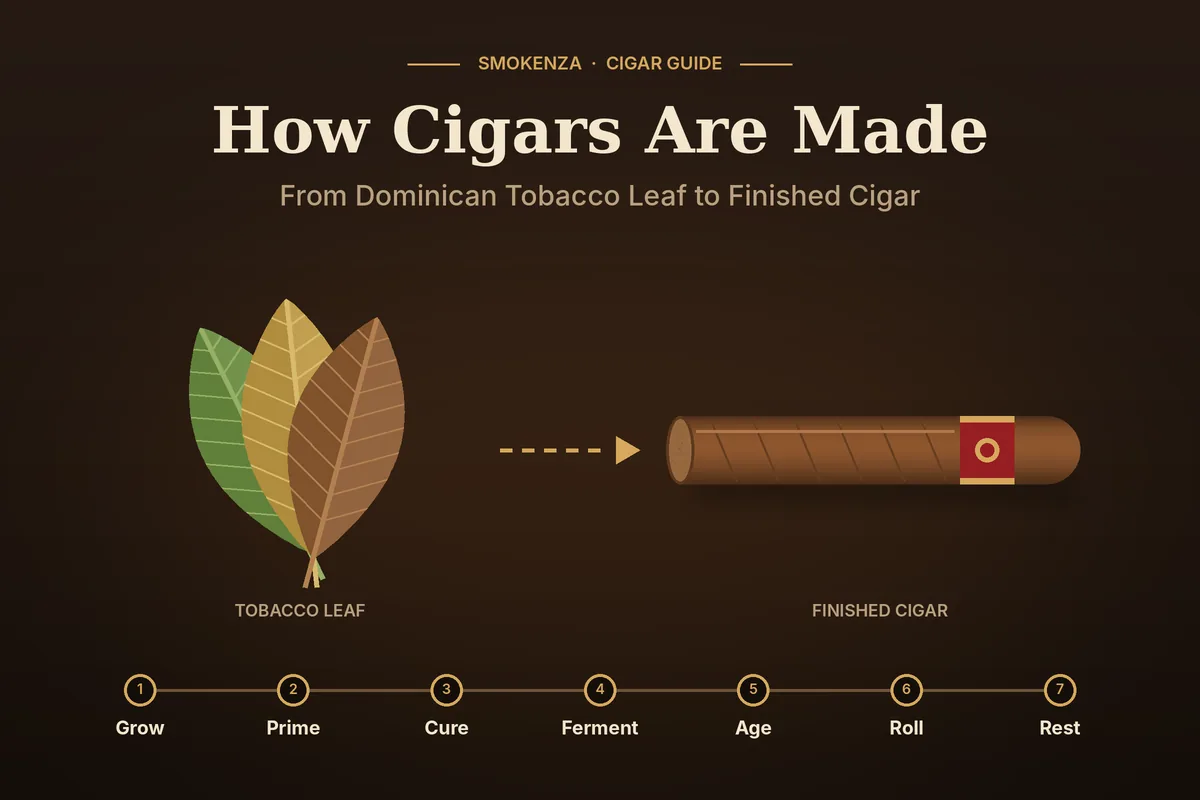
A premium cigar takes far longer to produce than most people expect. The rolling itself takes only minutes. The months and years before it go into growing, curing, fermenting and aging the leaf.
This guide follows one cigar from a seedbed in the Dominican Republic to a banded stick in a box. It covers each stage, why it matters to flavor, and how the handmade process compares with machine production.
The Three Parts Every Cigar Is Built From
Every premium cigar has three layers: filler, binder and wrapper. Knowing the parts of a cigar makes every later stage easier to follow.
Cigar filler is the core. It's a blend of several leaves, often from different farms, countries or harvest years. The filler supplies most of the strength and flavor.
Cigar binder is a tough, elastic leaf wrapped around the filler. It holds the bunch together and helps the cigar burn evenly.
The cigar wrapper is the outer leaf. It needs to be thin, smooth, elastic and free of large veins. Wrappers are the most expensive leaf in a cigar, and they add a lot of the first flavor and aroma you notice.
Where a leaf grows on the plant also matters. Leaves near the top get more sun and tend to be stronger. Leaves near the bottom, such as volado, are milder and help the cigar burn. Our guide to cigar strength levels covers each leaf position in detail.
That's the basic cigar anatomy. The rest of the process is about getting each of those leaves ready.
How Cigars Are Made in the Dominican Republic, Stage by Stage
The Dominican Republic is one of the world's main producers of premium handmade cigars. Most of the tobacco used in Dominican cigars grows in the Cibao Valley in the north, around Santiago, Villa González, Navarrete and Tamboril.
Here is the full path from seed to box.
Growing Tobacco in the Cibao Valley
Tobacco seeds are tiny, close to the size of a grain of dust. Growers start them in covered seedbeds, then move the young plants to the field after about six weeks.
From there, the plants grow in one of two ways:
- Sun-grown tobacco grows in open fields. Full sunlight produces thicker leaves with more oil and flavor.
- Shade-grown tobacco grows under cloth tents. The shade produces thinner, smoother, lighter-colored leaves. This is how a Connecticut shade wrapper gets its pale golden color and mild taste. Today, much of this leaf is grown from Connecticut seed in Ecuador, where natural cloud cover does the job of the tents.
- The technique dates back over a century. The history of Connecticut shade tobacco shows how cloth tents were first used to cut sunlight and raise humidity around the plants.
Most Dominican tobacco is grown for filler and binder. Two well-known Dominican seed types are Piloto Cubano, valued for strength and depth, and Olor Dominicano, known for aroma and a lighter body.
Harvesting Leaf by Priming
Cigar tobacco usually isn't cut down as a whole plant. Workers harvest it by priming tobacco, which means picking a few leaves at a time from the bottom of the plant and working upward.
Each pass happens about a week apart, so the leaves at every level can mature properly. A single plant may be visited several times over a month or more.
Each priming is kept separate. Lower leaves, middle leaves and top leaves all go on to be used for different jobs in a blend.
Air Curing in the Tobacco Barn
After harvest, leaves are strung onto poles and hung in tall wooden curing barns. This is air cured tobacco: no added heat, just airflow and humidity managed by opening and closing the barn doors.
Tobacco curing usually takes several weeks, often around two months. During that time the leaf slowly turns from green to yellow to brown as chlorophyll breaks down and moisture leaves the leaf.
Curing too fast leaves the tobacco green and bitter. Curing too slowly risks mold. Barn managers watch the weather closely for this reason.
Fermentation in Pilones
Cured leaves are still harsh. Fermentation is what makes them smokable.
Workers stack the leaves into large piles called pilones. The weight and moisture of the stack generate heat on their own. Workers check the temperature inside the pile, then break it down and rebuild it, moving the outer leaves inward, before it gets too hot.
This cycle repeats for weeks or months. Tobacco fermentation releases ammonia, reduces harshness and develops the flavors that end up in your cigar. In terms of taste, this stage shapes how cigars are made more than the rolling does.
Wrapper leaves get gentler fermentation than filler. Thick ligero filler leaves need the longest time.
Sorting, Grading and Aging the Leaf
After fermentation, the tobacco is lightly moistened so it can be handled without cracking. Workers then remove the center vein from most leaves, sort them by size, color and texture, and grade them.
The sorted leaves are packed into bales and left to age. This can last a few months or several years. Older leaf generally smokes smoother and more rounded, which is one reason aged blends cost more.
Before a single cigar is rolled, the master blender tests different combinations of leaves to set the recipe for each line.
How Cigars Are Made at the Rolling Table
In most Dominican factories, rolling is a two-person job. A buncher prepares the inside of the cigar, and a torcedor, the cigar roller, finishes the outside.
Here is what happens at the table:
- Bunching. The buncher gathers the filler leaves for the blend and wraps them in a binder leaf. Some factories use the entubado method, where each filler leaf is rolled into a small tube before bunching. The tubes leave air channels that help the draw.
- Pressing. The bunches go into wooden molds and sit under a press. Workers turn them partway through so they don't develop a flat seam.
- Wrapping. The torcedor stretches a wrapper leaf on the table, cuts it to shape with a flat curved blade called a chaveta, and rolls it around the bunch in a spiral.
- Capping. A small round piece of wrapper is fixed to the head with a natural, plant-based gum. Many premium cigars use a triple cap, built from three layers.
- Cutting. The foot is trimmed so every cigar in the batch is the same length.
If you've ever wondered how to roll a cigar by hand, this is the short answer. Doing it well takes years of training. Good cigar rolling depends on getting the amount of filler right. Too much and the cigar draws tight. Too little and it burns hot and fast.
Quality Control: Weight, Draw and Appearance
Finished cigars are checked before they move on. Many factories weigh each cigar or batch against a target weight, which is a quick way to catch over- or under-filled bunches.
Draw testing machines measure how easily air passes through a sample. Inspectors also check the wrapper for tears, color consistency and a clean, even cap. Cigars that fail get sent back or downgraded.
How Cigars Are Made Ready to Smoke: Aging Room and Banding
Freshly rolled cigars contain extra moisture from rolling, so they aren't smoked right away. They rest in cedar-lined aging rooms, usually for several weeks and sometimes for months or longer.
During this rest, moisture evens out across the cigar and the different leaves blend together in flavor. Factories often call this letting the blend "marry."
After aging, cigars are sorted again by wrapper shade so every box looks uniform. They're banded, sometimes wrapped in cellophane, boxed and sent to market.
How Cigars Are Made by Hand vs by Machine
The biggest difference is the filler. Hand rolled cigars use whole leaves throughout, while most machine made cigars use chopped tobacco and processed sheet wrappers.
| Handmade premium cigars | Machine-made cigars | |
| Filler | Long filler: whole leaves running the full length | Short filler: chopped or shredded tobacco |
| Binder | Natural tobacco leaf | Often homogenized tobacco leaf (HTL) |
| Wrapper | Natural tobacco leaf | Natural leaf or HTL sheet |
| Flavor | Changes as the cigar burns | Usually consistent from start to finish |
| Burn time | Longer, depends on size | Shorter, often quick |
| Price | Higher | Lower |
Long filler cigars burn cooler and more slowly, and the flavor tends to shift as you smoke through the blend. Short filler cigars cost less to produce and can be made in large volumes.
HTL is a paper-like sheet made from ground tobacco. It's common on cigarillos and flavored cigars. Our guide on what a cigarillo is explains HTL wrappers in more detail.
Both types have a place. If you prefer a quick, affordable smoke, machine-made cigars fit the bill. If you want a slower smoke with more layered flavor, premium handmade cigars are the better match. Handmade cigars take far more labor, which is reflected in the price.
Why Dominican Tobacco Suits Blending
Dominican tobacco is known for being smooth, aromatic and balanced. That makes it a strong base for blends, especially when mixed with fuller-bodied leaf from Nicaragua or a wrapper from Ecuador or Connecticut.
The country also has a long cigar-making tradition and a skilled workforce of rollers, blenders and leaf handlers. Many major producers make their premium lines there. Davidoff has produced its cigars in the Dominican Republic since the early 1990s, and Arturo Fuente built much of its reputation in the Cibao Valley. You can read more in our piece on the Fuente family.
Many Dominican cigars lean mild to medium in strength. That makes them a good starting point for new smokers, and a reliable everyday choice for experienced ones. For brand-by-brand differences, see our comparison of leading Dominican cigar brands. If you like mellow blends with a pale wrapper, browse our Connecticut shade mild cigars.
Common Myths About Cigar Making
"Cigars are rolled on women's thighs." This is a romantic myth. Cigars are rolled on flat wooden tables with a chaveta and a cutting board.
"Cuban seed means it's a Cuban cigar." Cuban seed refers to the plant's genetic line, not where it grew. Cuban-seed tobacco is widely grown in the Dominican Republic and Nicaragua.
"A darker wrapper means a stronger cigar." Not always. A dark maduro wrapper often tastes sweeter and richer, but strength mostly comes from the filler. A dark cigar with mild filler can still be mild.
"Older is always better." Aging smooths tobacco, but it doesn't fix a poor blend. Past a certain point, some cigars lose flavor instead of gaining it.
Summary
Knowing how cigars are made explains why two cigars of the same size can taste so different. Flavor comes mostly from the growing region, the priming level, the length of curing and fermentation, and how long the leaf is aged. Rolling skill decides whether the cigar draws and burns well. Every handmade premium cigar passes through dozens of hands across months or years before it reaches a humidor.
Frequently Asked Questions
How are cigars made, in simple terms?
Tobacco is grown, harvested leaf by leaf, air cured in barns, fermented in piles and aged. Rollers then bunch filler leaves inside a binder, press them in molds, wrap them in a wrapper leaf and add a cap. The finished cigars rest in an aging room before they're banded and boxed.
What are cigars made of?
Cigars are made entirely of tobacco. A premium cigar has three parts: filler leaves in the center, a binder leaf holding them together and a wrapper leaf on the outside. The cap is fixed with a natural plant-based gum. Machine-made cigars may use chopped tobacco and a homogenized tobacco sheet instead of whole leaves.
How long does it take to make one cigar?
Rolling a single cigar takes a skilled roller only a few minutes. The full process, from planting the seed to a boxed cigar, usually takes at least a year and often several years, because the leaf needs time to cure, ferment and age.
Are Dominican cigars hand rolled?
Most premium Dominican cigars are hand rolled with long filler. The Dominican Republic also produces some machine-made cigars, so check whether a cigar is listed as long filler or handmade.
What is the difference between long filler and short filler?
Long filler uses whole tobacco leaves that run the length of the cigar. Short filler uses chopped pieces of leaf. Long filler cigars burn slower and cooler, while short filler cigars are cheaper and faster to make.
What did you think?
Share this article
Help others discover this content by sharing it with your network.