
Ask five tobacco sellers about fronto and grabba and you will hear five answers. One says they are the same leaf. Another says grabba is the rough grade left after the best fronto is sorted out. A third says the whole difference is in the curing.
Each answer is partly right, which is why the topic stays confusing. Neither word is a legal category or a seed variety. Both are trade names that grew out of Caribbean tobacco culture, and their meaning shifts with the island, the brand and the person selling the bag.
This guide sorts out what each word means, what the leaf actually is, how the two differ in strength and flavor, and how to prepare each one.
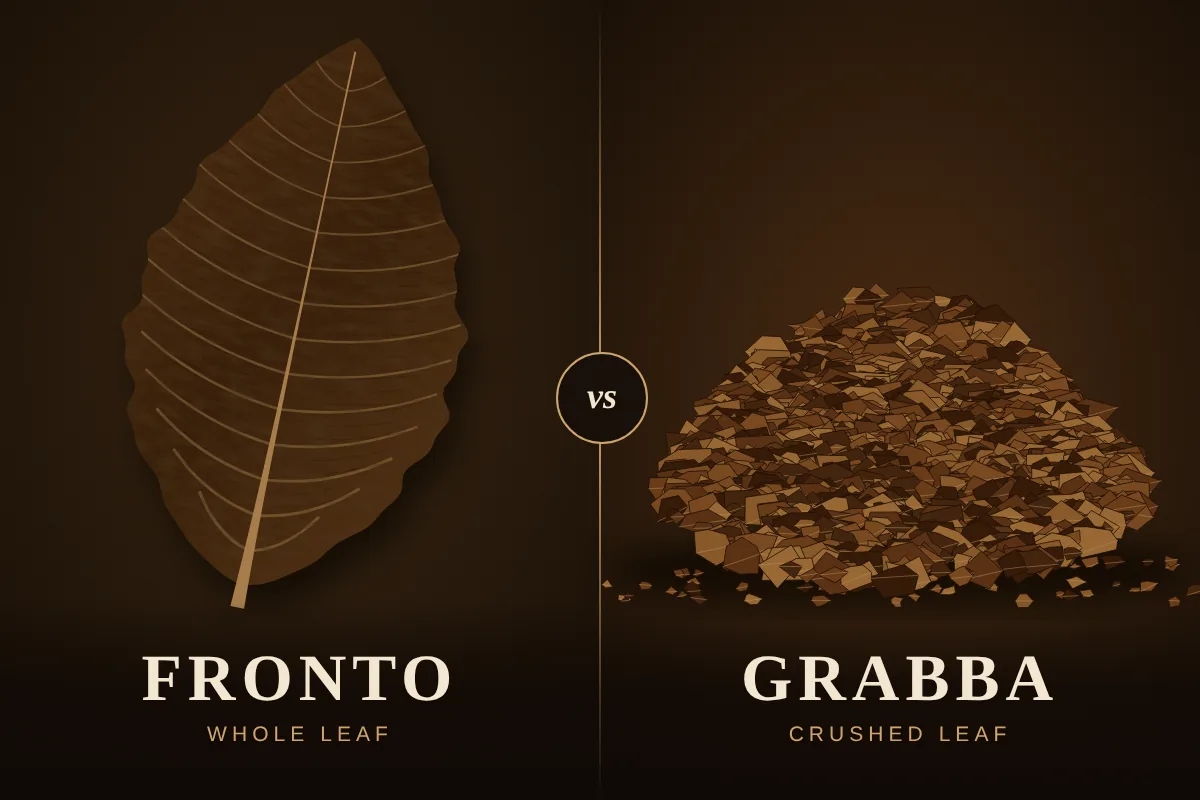
Quick answer: Fronto is a whole, dark tobacco leaf sold intact and used mainly as a wrapper you cut to size. Grabba comes from the same family of dark leaf, but it is usually crushed or torn into pieces and mixed into a blend, and it is often thicker or fire-cured. In Jamaica, "grabba" can also mean raw tobacco leaf in general. The practical split is form and use: whole and pliable versus broken and blended. Neither is safer than any other tobacco.
What Is Fronto Tobacco?
Fronto tobacco is a large tobacco leaf that has been cured and packed whole. It is dark, slightly oily and soft enough to roll when it holds the right moisture. You tear or cut it to the size you want, and it becomes a natural wrapper.
If you are asking what is fronto, the short answer is this: it is the leaf itself, before anyone has shaped it into a finished product.
That separates it from most wraps on the shelf. Loose Leaf wraps are real tobacco leaf too, but they are pre-cut for you. Homogenized wraps go further, grinding tobacco into a uniform sheet. Our guide to tobacco wraps vs rolling papers explains those construction types.
Fronto Leaf Master Palma is a typical example: one unbroken dark air-cured leaf in a sealed foil pouch, rated medium to full in strength.
Whole leaf does not always mean plain leaf. The Fronto Leaf brand page also lists styles named Cream, Blue Ice and Sweet Woods, so check the label if you want unflavored tobacco.
Where the Name Fronto Comes From
The origin of the word is poorly documented. Common accounts tie it to Jamaican speech, where the leaf also goes by Fanta, Funta and Franta. We could not find a reliable record of its first use, so treat any confident origin story with caution.
What is clearer is the route. Caribbean communities carried the habit to US cities, and American companies now package fronto for that demand.
What Is Grabba?
What is grabba depends on where you ask, because the word has two working meanings.
- US retail meaning: dark tobacco leaf that has been crushed, shredded or broken into chips, then mixed into a blend.
- Jamaican meaning: raw, unprocessed tobacco leaf in general, whole or broken.
Both are in common use. That is the first reason the two terms get tangled.
Grabba Leaf in Jamaica
In Jamaica, grabba leaf is an everyday market term. In 2016 the Jamaica Gleaner reported that Carreras, the island's major cigarette distributor, had started a pilot for its own raw tobacco product because grabba demand kept rising. The paper used "raw tobacco" and "grabba" as the same thing.
The trade had real scale. The Jamaica Observer reported in 2015 on an agricultural agency count of about 600 farmers growing raw tobacco on 300 acres, producing roughly 496,000 pounds a year.
Jamaica also has a much older form of the leaf called jackass rope, a twisted tobacco that works much like the rope cut in our pipe tobacco cuts guide.
Hot Grabba and Other Names
You will run into several related labels:
- Hot grabba: fire-cured dark leaf with a smoky, spicy edge. Also called spicy leaf.
- Crushed grabba: leaf ground from fine to coarse.
- Grabba chips: larger broken pieces, usually from thick leaf.
- Red Herring: a Jamaican name long attached to strong, dark leaf.
- Grabba Leaf: a brand name as well as a product type. Some of its pouches hold a whole fronto leaf, which adds to the confusion.
Fronto vs Grabba at a Glance
The table shows how each term is most often used in the US market. Individual brands can break any of these patterns.
| Fronto | Grabba | |
| Form | Whole leaf | Crushed, shredded or torn pieces |
| Main use | Wrapper, cut to size | Mixed into a blend |
| Leaf condition | Needs to be intact, few holes | Holes and blemishes do not matter |
| Common curing | Dark air-cured | Dark air-cured or fire-cured |
| Texture | Soft and pliable | Dry enough to crumble |
| Strength | Medium to full | Medium to very strong, depending on curing |
| Flavor | Earthy, woody, cocoa | Sharper, peppery, smoky if fire-cured |
| Prep | Hydrate, de-vein, cut | Dry, de-stem, crush |
| Control | Set by wrapper size | Set by the pinch |
Why Sellers Give Different Answers
We read through the most-cited pages on this topic, and they rest on three different definitions:
- By form: fronto is whole, grabba is crushed.
- By grade: fronto is the clean leaf, grabba is the rougher leaf.
- By curing: fronto is air-cured, grabba is fire-cured.
Each one is true of some brands, and none is true of all of them. That is not surprising, because US leaf is graded by curing method, district and stalk position. "Fronto" and "grabba" do not appear in that system.
So do not rely on the name alone. Read the bag for two facts: is the leaf whole or broken, and how was it cured? Those two answers tell you more than either word.
The Leaf Behind Both Names
Most of the fronto vs grabba confusion clears up once you look at the tobacco itself. Both come from heavy, dark leaf, and the way that leaf is cured pushes it toward one use or the other.
Dark Air-Cured Leaf
Dark air-cured tobacco hangs in ventilated barns and dries with little or no added heat. A University of Kentucky extension guide describes mature leaf as thick and leathery with a light oily sheen, usually ready five to seven weeks after topping.
The same guide notes that it takes on moisture readily and often turns pliable without any added water. That trait helps explain why this leaf suits wrapper use. It stays soft enough to roll.
Dark Fire-Cured Leaf
Fire-cured tobacco dries in closed barns over low, smoldering fires, and the smoke settles into the leaf. The Kentucky guide notes it takes on moisture far less readily than air-cured leaf.
That makes it a natural fit for crushing. It holds a smoky aroma, and it crumbles rather than bends. This is the leaf behind most hot grabba.
To taste fire-cured tobacco without any rolling, try a finished cigar built around it, such as Kentucky Fire Cured Ponies from the Kentucky Fired Cured line.
Grade and Stalk Position
Dark leaf is stripped into stalk positions, from lower lugs to upper leaf. Upper leaf is heavier and stronger. Our Good Stuff colors guide explains how stalk position changes a blend, and cigar strengths explained covers the same logic from the cigar side.
Grade follows use. A wrapper leaf with a hole is a problem. A crushed leaf with a hole is not. That is why cheaper, blemished leaf tends to end up as grabba, and why some sellers treat the split as a matter of grade.
How Each One Smokes
The leaf can be nearly identical, yet the two smoke differently because of how much you use and where it sits in the roll.
Fronto vs Grabba Strength
We could not find published lab nicotine figures for fronto or grabba products, so all strength claims here are relative.
Some sellers call fronto smooth and mild. That holds next to hot grabba, but not next to a paper or a mild cigar. Our Palma listing rates it medium to full, and any tobacco wrapper adds nicotine that a paper does not. For context, see how much nicotine is in a cigar and how much nicotine is in a Backwood.
Grabba works differently. A small pinch of crushed leaf can be gentle, and a large one can be very strong. With a fire-cured leaf, the same pinch hits harder and tastes heavier. You set the dose yourself.
If you are new to dark leaf, start small. Neither is a beginner's tobacco, and our mild cigars are a far easier place to begin.
Fronto vs Grabba Flavor and Burn
Air-cured fronto tastes earthy and woody, and some leaf leans toward dark cocoa or leather. As a wrapper it burns slowly and evenly, because a thick single layer has little exposed surface.
Grabba tastes more direct. Air-cured pieces read peppery and dry. Fire-cured pieces bring campfire smoke that can take over a mild blend.
Crushed leaf also burns faster. More surface area means more contact with air and flame, the same rule that sets burn speed across pipe tobacco cuts. Very dry, fine leaf can run hot and sharp.
How to Prepare Each One
Preparation is where the difference becomes practical, and where one leaf can serve both roles.
Preparing a Whole Fronto Leaf
- Check the moisture. The leaf should bend without cracking. If it feels wet, let it air out for a few minutes.
- Lay it flat. Find the thick center vein, called the midrib.
- Cut away from the midrib. Tear or cut along the side veins, keeping pieces free of the thick stem.
- Size the piece. Cut only what you need, and keep the smoother side facing out.
- Reseal the rest. Fold it back into the pouch right away.
If a leaf has gone stiff, do not soak it. Rehydrate it slowly in a sealed jar with a two-way humidity pack. The same slow method appears in our guide to rehydrating a dry Backwood.
Whole leaf takes practice, and our list of Loose Leaf wrap mistakes beginners make applies here too, from overfilling to sealing too wet.
Turning Fronto Into Grabba
Any spare piece of fronto can become grabba:
- Let the piece dry until it feels crisp.
- Pull out the stem and thick veins.
- Crumble it by hand, keeping the pieces coarse.
- Store it in a small airtight jar.
Treat dark leaf as a seasoning, not a base. Pipe blenders often add a small pinch to a plain tobacco such as Good Stuff Natural, then adjust from there. Our pipe tobacco collection has other plain blends from brands like OHM.
Storing Whole and Crushed Leaf
Whole leaf keeps best sealed in its foil pouch, away from heat and sun. Once opened, move it to an airtight bag or jar with a humidity pack. Our guide on how to store Backwoods covers the same setup, and do you need a humidor for Backwoods explains when a jar is enough.
Crushed leaf has far more exposed surface, so it loses moisture and aroma faster. Crush small amounts as you need them instead of a whole leaf at once.
Dried-out leaf is rarely ruined, but mold is different. Throw away any leaf with fuzzy white or green spots. Our guide on whether Backwoods go bad covers shelf life in more detail, and the same logic applies to any natural leaf.
How Whole Leaf Compares to Pre-Cut Wraps
Whole leaf costs less per roll, but you do the work. Sellers quote wildly different yields for one leaf, from a handful of cuts to about 30, because it depends on leaf size and how large you roll. The table uses a conservative 6 to 12 cuts as our own estimate.
| Product | Format | Price | Approx. cost per wrap |
| Fronto Leaf Master Palma | 1 whole leaf | $2.75 | $0.23 to $0.46 |
| Loose Leaf Natural Dark | 20 packs of 2 | $40.99 | $1.02 |
| Backwoods True Wraps Original | 16 packs of 5 | $89.99 | $1.12 |
Prices were checked on November 5, 2026 and can change.
Pre-cut wraps win on consistency. Every piece is sized, and each pouch stays sealed until you need it. Whole leaf wins on cost and control, as long as you can finish the leaf before it dries.
At Smokenza, whole leaf is available as single pouches, including Fronto Leaf Master Natural and Fronto Leaf Master Black. We do not currently list a product sold as grabba, so a whole leaf is the route to crushing your own. The full range of options sits in our cigar wraps collection. Our Backwoods wraps guide covers the True Wraps line.
Fronto vs Grabba: Which One Fits How You Smoke?
Match the leaf to the job:
- You want a natural wrapper: whole fronto.
- You want to add strength in small, measured amounts: crushed air-cured leaf.
- You want a smoky, heavy note: fire-cured leaf, used sparingly.
- You want leaf flavor with no cutting: pre-cut natural wraps such as Loose Leaf San Andres.
- You want a ready-made smoke: Backwoods or something from the cigarillo collection.
- You want no tobacco in the wrapper: rolling papers.
One caution on labels. Words like "natural" and "unprocessed" describe how leaf was handled, not how safe it is. Our article on additive free tobacco explains why most harmful smoke constituents form during burning, whatever the leaf.
Flavored tobacco is also restricted in some states and cities, so check your local rules before ordering.
FAQs
Are fronto and grabba the same thing?
Often they are the same type of dark leaf in different forms. Fronto usually means whole leaf, and grabba usually means crushed leaf. In Jamaica, grabba can also mean any raw tobacco leaf.
Is grabba stronger than fronto?
Fire-cured hot grabba is usually stronger. Otherwise it depends on how much you use, since neither product carries a printed nicotine figure.
Can you make grabba from fronto?
Yes. Dry a piece of fronto until crisp, remove the stem and crumble it by hand.
Can you use grabba leaf as a wrapper?
Only if the leaf is whole and pliable. Thick fire-cured leaf tends to crack when rolled, which is why it is usually crushed instead.
Does grabba leaf have tobacco in it?
Yes. Grabba is tobacco leaf, not a hemp or herbal product. It contains nicotine.
Is a roll wrapped in fronto a cigar?
Generally yes. Federal tax law sorts rolled tobacco by its wrapper, so leaf-wrapped tobacco usually counts as a cigar. Our cigar vs cigarette guide explains the wrapper split.
Is fronto safer than processed wraps?
No. Whole leaf has fewer processing steps, but burning it still produces nicotine, tar and the harmful constituents found in all tobacco smoke.
Who can order fronto leaf?
Adults 21 and over only. Nicotine is addictive, and no tobacco product is safe.
Summary
The fronto vs grabba question comes down to form and use more than any strict definition. Fronto is whole, pliable dark leaf used as a wrapper. Grabba is that same family of leaf broken into pieces for blending, often thicker or fire-cured, and in Jamaica the word can simply mean raw tobacco. Neither name is a formal category, so read the bag for leaf form and curing method, then choose by how you plan to use it. Start with a single leaf from the Fronto Leaf brand page, cut what you need, and crush a little of the spare leaf to taste both styles side by side.
What did you think?
Share this article
Help others discover this content by sharing it with your network.