
You reach for a backwood and the wrapper crackles under your fingers. A flake of leaf drops off near the foot. You light it anyway and the first draw is hot, fast and papery, with almost none of the flavor you were expecting.
That is a dry Backwood, and it is one of the most common complaints about the brand. The good news is that most dry sticks can be saved. The bad news is that the fixes people reach for first, like a wet paper towel or a slice of bread, are usually the ones that finish the wrapper off.
This guide walks through the slow method that actually works, how long it takes, what to avoid, and how to tell when a stick is past saving. It applies to every blend in the Backwoods cigars collection, from Original-style sweet blends to the coffee-led Dark Stout.
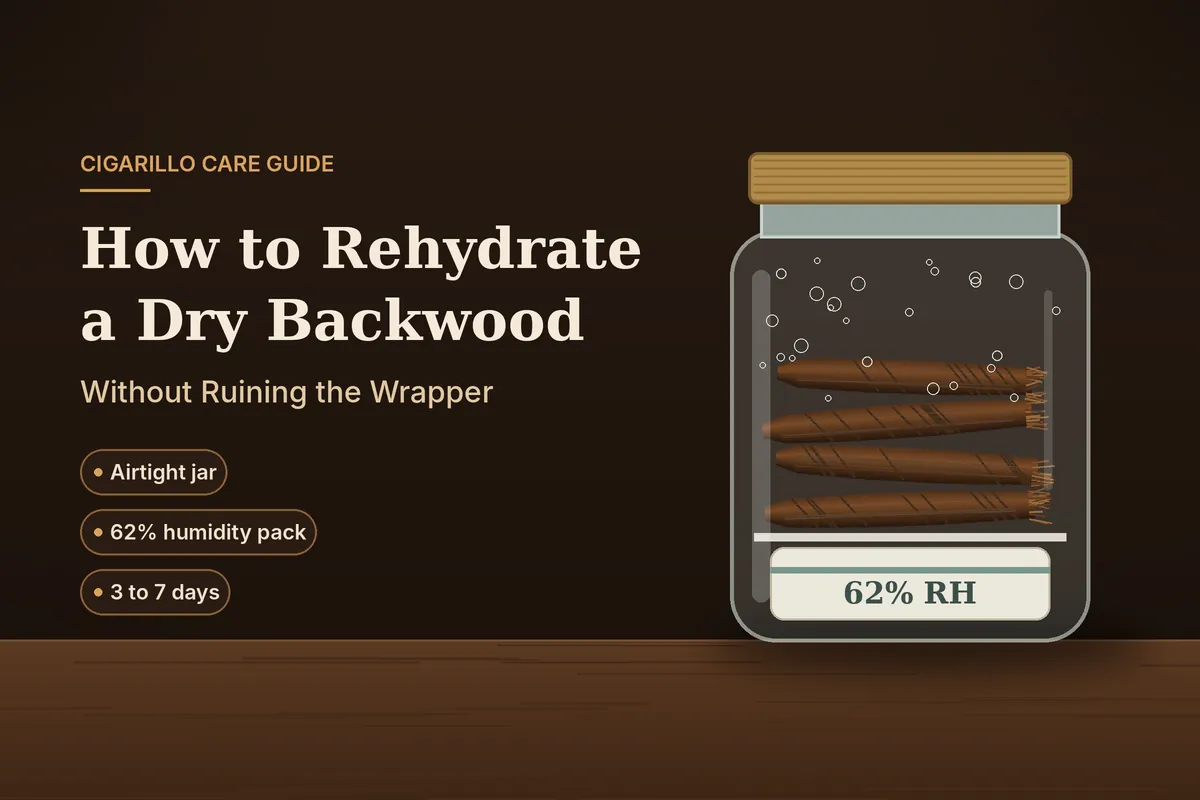
Quick answer: Take the dry Backwoods out of the pouch and seal them in an airtight jar with a 62% two-way humidity pack, not touching it. Leave them for three to seven days, turning them once a day, until the wrapper flexes without crackling. Never add water directly, and never use bread, fruit peel, steam or a microwave. Cracked wrappers will not close back up, and flavor that has evaporated will not return.
Why Backwoods Dry Out and What It Does to the Wrapper
Most budget cigarillos use a homogenized tobacco leaf (HTL) wrapper, a uniform sheet made from processed tobacco. It holds moisture well and bends without splitting.
Backwoods use natural Connecticut Broadleaf instead, as our guide to what are Backwoods explains. Whole leaf trades moisture with the air around it until the two match. In a dry room, a hot car or an open pouch, that happens within days.
The open foot and unfinished head make it worse. Air reaches the filler from both ends, so the whole stick dries at once rather than from the outside in.
What Backwoods Wrapper Damage Looks Like
Backwoods wrapper damage follows a pattern. Broadleaf is thick and heavily veined, as our cigar wrapper leaf quality guide shows, and the veins are where it fails first.
- Stage one: the wrapper feels stiff and makes a faint crackle when pressed. No visible cracks yet.
- Stage two: fine hairline splits appear along the veins, usually near the foot.
- Stage three: the wrapper lifts away from the binder in patches, and pieces flake off.
- Stage four: long splits run up the body, and the stick may snap if bent.
Stages one and two respond well to rehydration. Stage three can be improved but will never look new. Stage four is usually a loss.
The Squeeze Test
Hold the Backwood between your thumb and forefinger and press gently near the middle.
| What you feel | Condition | What to do |
| Slight give, springs back, no sound | Healthy | Smoke or store as normal |
| Firm, faint crackle | Mildly dry | Rehydrate for 2 to 4 days |
| Hard, loud crackle, flakes at foot | Very dry | Rehydrate for 5 to 7 days |
| Spongy, damp, sticky | Too wet | Air it out, drop to a lower humidity |
| Splits when bent | Damaged | Smoke slowly or discard |
A dry stick also gives itself away when lit. It burns fast and hot, the ash flakes rather than holding, and the smoke tastes harsh and thin. If you have noticed your Backwoods burning down far quicker than usual, dryness is the most likely cause.
What You Need to Rehydrate a Dry Backwood
The kit is cheap and you may already own most of it.
| Item | Why it matters | Notes |
| Airtight glass jar or food container | Holds a stable environment | Mason jars work well |
| Two-way humidity pack, 62% | Adds moisture slowly and evenly | 69% works but is slower to control on infused blends |
| Small hygrometer (optional) | Confirms the humidity inside | Calibrate it before relying on it |
| Paper towel or folded napkin (dry) | Keeps sticks off the pack | Used as a spacer only, never wet |
| Patience | The method depends on it | Three to seven days is normal |
A two-way pack is the key piece. It releases moisture when the air inside the jar is dry and absorbs it when the air is damp, so it never overshoots. That matters because relative humidity is a balance between the air and the leaf. Push it too hard and the outside of the wrapper swells before the inside catches up, which is exactly how splits happen.
Why 62% and not 70%? Backwoods are built to be smoked fresh, not aged, and flavored blends carry sugar on the wrapper. A lower target brings the leaf back without making it tacky or spongy.
How to Rehydrate a Dry Backwood Step by Step
The method below works for any Backwood, flavored or not, and for most natural leaf cigarillos.
The Slow Jar Method to Rehydrate a Dry Backwood
- Inspect each stick. Set aside any with long splits or snapped bodies. They will not recover structure and can go in last.
- Remove them from the pouch. A closed pouch blocks moisture from reaching the leaf. Take the sticks out, or cut the pouch fully open.
- Set up the jar. Place the humidity pack at the bottom and lay a dry paper towel over it as a spacer.
- Lay the sticks flat. Keep them in a single layer with a little room between each. Do not stand them up or pack them tight.
- Seal and store cool. Close the jar and keep it somewhere dark at 65 to 70°F. Heat speeds evaporation inside the jar and can push humidity unevenly.
- Turn them daily. Rotate each stick a quarter turn once a day so all sides rehydrate evenly.
- Test after day three. Use the squeeze test. If there is still a crackle, close the jar and give it more time.
- Rest before smoking. Once the wrapper flexes without sound, leave the sticks in the jar one more day so the filler catches up with the wrapper.
Patience is the whole method when you rehydrate a dry Backwood. Every shortcut on the list below exists because someone tried to make a one-week job happen in an hour.
How Long It Takes to Rehydrate a Dry Backwood
Timing depends on how dry the stick was to start with.
| Starting condition | Typical time in the jar | Signs it is ready |
| Mildly dry (open pouch, a few days) | 2 to 3 days | No crackle, slight give |
| Very dry (open for weeks, or a hot car) | 5 to 7 days | Wrapper flexes, foot holds together |
| Bone dry (months loose) | 7 to 10 days | Improved texture, flavor likely muted |
These are working ranges, not promises. Humidity inside the jar, the size of the pack and how many sticks share it all change the timing. A small hygrometer in the jar removes the guesswork.
One more check: if you see any white or blue-green fuzz that smears when wiped, that is mold, and the stick should go. Mold is rare at 62%, which is one more reason to stay at the lower setting.
Quick Fixes That Ruin the Wrapper
Search any forum for a dry backwood fix and you will find the same handful of tricks. Most of them work fast and fail badly.
| Method | What people expect | What actually happens |
| Wet paper towel in the pouch | Fast moisture | Wet spots swell, dry spots stay brittle, wrapper splits and stains |
| Slice of bread | Gentle moisture | Uneven moisture, bread smell, real mold risk within days |
| Orange, lemon or apple peel | Moisture plus flavor | Citrus or fruit aroma soaks in, sugar and mold risk |
| Licking or spraying the wrapper | Instant flex | Outside softens, inside stays dry, wrapper unravels when lit |
| Steam from a kettle | Quick fix | Wrapper blisters and peels from the binder |
| Microwave with a damp cloth | Fast warm moisture | Hot spots dry some areas further and can scorch the leaf |
| Fridge overnight | Cool and fresh | Fridge air is dry and full of food odors |
The common thread is speed. Leaf needs to take on moisture at the same rate on the surface and in the core. Any method that soaks the outside first creates tension between the wet wrapper and the dry binder underneath, and the wrapper gives way.
Temperature is the other trap. Warm, damp conditions are also the conditions tobacco beetle eggs need to hatch. Cigar Aficionado notes that larvae hatch above roughly 72°F and 72% humidity, so a warm, wet rehydration setup can trade one problem for a worse one.
Rehydrating Flavored Backwoods
Infused blends need a little extra care. The flavor sits in the tobacco and on the wrapper, and sugar changes how the leaf behaves.
Sweeter blends. Honey, Honey Berry, Vanilla, Russian Cream and Black Russian carry more sugar. Stay strictly at 62% and give the sticks extra space. Too much moisture turns the wrapper tacky on the lips.
Drier, roast-led blends. Dark Stout and Dark Leaf are less sugary and tolerate 62% to 65% well. Their roast and cocoa notes are the first things lost when they dry, so expect a revived Dark Stout to taste milder than a fresh one. Our Dark Stout vs Black Russian comparison covers what each should taste like at its best.
Spirit-style blends. Honey Bourbon keeps its honey longer than its oak and caramel notes. Our Honey Bourbon taste guide describes the full profile.
Two rules apply to every flavor. Rehydrate one flavor per jar so aromas do not mix, and never use a jar or humidor that also holds unflavored premium cigars. For more on how flavor gets into the leaf, see infused vs flavored vs dipped cigars. The full lineup of blends sits on the Backwoods flavors collection.
How to Soften Dried Cigarillos From Other Brands
If you want to know how to moisten dry cigarillos beyond Backwoods, the answer depends on the wrapper.
Natural leaf cigarillos respond to the same slow jar method. Anything with a whole-leaf wrapper behaves like a Backwood, just usually with a capped head that slows drying a little.
HTL cigarillos are a different case. Brands with a homogenized sheet wrapper rarely crack, but they can go stiff and lose flavor. A few days in a sealed jar at 62% softens them, but they will not regain much aroma. Our guide to what is a cigarillo explains how to tell the two wrapper types apart, and the cigarillo collection covers both.
The principle for how to soften dried cigarillos of any type stays the same: gentle, even moisture over days, never direct water. The same advice applies to infused sticks from the wider flavored cigars collection.
Rehydrating Backwoods True Wraps
Dry wraps are less forgiving than dry cigars. A cigar can still be smoked with a hairline crack. A wrap that cracks while you are rolling it is finished.
To rehydrate cigarillo wrapper leaf sold on its own, use the same jar and 62% pack, but lay the wraps flat and separated rather than stacked. Wraps are thinner than a finished stick, so they usually come back in one to three days. Test by gently curling a corner. If it bends without a crackle, it is ready.
Do not try to unroll a dry wrap before it has rehydrated. That is how most of them tear. Wraps from the Backwoods True Wraps collection, including True Wraps Original and True Wraps Vanilla, all follow this method. For other natural leaf wraps, see the full wraps collection.
When a Dry Backwood Cannot Be Saved
Rehydration fixes texture. It does not reverse everything. These are the limits.
- Long cracks stay cracked. Moisture softens the leaf but does not glue a split back together. A stick with a split running past the midpoint will usually unravel when lit.
- Lost aroma stays lost. Once the infusion has evaporated, it is gone. You can revive dry backwood cigarillo texture, but not its original flavor.
- Mold means discard. Fuzz that smears or a musty smell means the stick should go, along with a careful check of anything stored next to it.
- Pinholes mean beetles. Small round holes and tobacco dust point to beetles. Isolate the batch and freeze it sealed before doing anything else.
If a stick has a minor crack near the foot, you can still smoke it. Light it slowly, draw gently, and accept that the burn may run a little uneven.
Keeping Them From Drying Out Again
The best way to bring back dry Backwoods is to not need to. A few habits prevent most cases:
- Reseal the pouch after every stick and press the air out.
- Move opened pouches into a jar with a humidity pack.
- Keep packs out of cars, windowsills and pockets.
- Smoke an opened pouch within one to two weeks.
- Match the format to your pace. Occasional smokers do better with the Backwoods 5 pack collection, 3-pack cartons like the Honey 10 packs of 3, or singles such as Dark Stout singles and Sweet Aromatic singles.
Our full Backwoods storage guide covers humidity targets, jar setups and how to store each flavor in detail. If you order in cartons to save money, as our Backwoods price guide suggests, storage is what protects that saving.
The complete range of formats sits on the Backwoods brand page.
Frequently Asked Questions
Can you bring back dry Backwoods in one day?
Not safely. A mildly dry stick may improve noticeably within 24 hours in a jar, but it needs two to three days for the filler to catch up with the wrapper. Faster methods soak the surface and split the leaf.
Is it safe to rehydrate dry Backwoods with a damp paper towel?
No. A damp towel puts liquid water close to the leaf, which swells the wrapper unevenly and often causes stains, splits and mold. A two-way humidity pack does the same job slowly and evenly.
Will a rehydrated Backwood taste the same as a fresh one?
The texture and burn come back. The flavor usually comes back only partly, because the infusion's aroma evaporates as the leaf dries. Sweetness tends to survive better than coffee, cocoa or spirit notes.
Can I rehydrate a Backwood that has been in a hot car?
Usually, yes, if the wrapper has not split. Let the sticks cool to room temperature in a sealed bag first, then use the jar method. Check for pinholes, since heat can also trigger beetle eggs.
Does rehydrating change the strength?
No. Nicotine content stays the same. A dry Backwood can feel harsher because it burns hotter, but it is not stronger. For nicotine figures, see how many cigarettes is a Backwood.
What humidity pack works best?
A two-way 62% pack suits most Backwoods, especially sweeter blends. A 69% pack works for unflavored or drier blends if you prefer a softer wrapper, but watch flavored sticks for tackiness.
Summary: Slow Moisture Saves the Wrapper
To rehydrate a dry Backwood without ruining the wrapper, take it out of the pouch, seal it in a jar with a 62% two-way humidity pack, keep it cool and dark, turn it daily, and give it three to seven days. Skip water, bread, fruit peel, steam and the microwave, since every fast fix swells the surface before the core and splits the leaf. Accept the limits: long cracks stay cracked and lost aroma does not return. Then stop it from happening again with sealed pouches and a proper jar. Compare every current blend on the Backwoods flavors collection, or start fresh with a pouch from the Backwoods 5 pack collection.
Backwoods are tobacco products for adults 21 and older. Every tobacco delivery needs an adult signature from someone 21 or older; see our shipping page for details. Rehydration times are general guidance and vary with conditions.
What did you think?
Share this article
Help others discover this content by sharing it with your network.