
The Short Answer
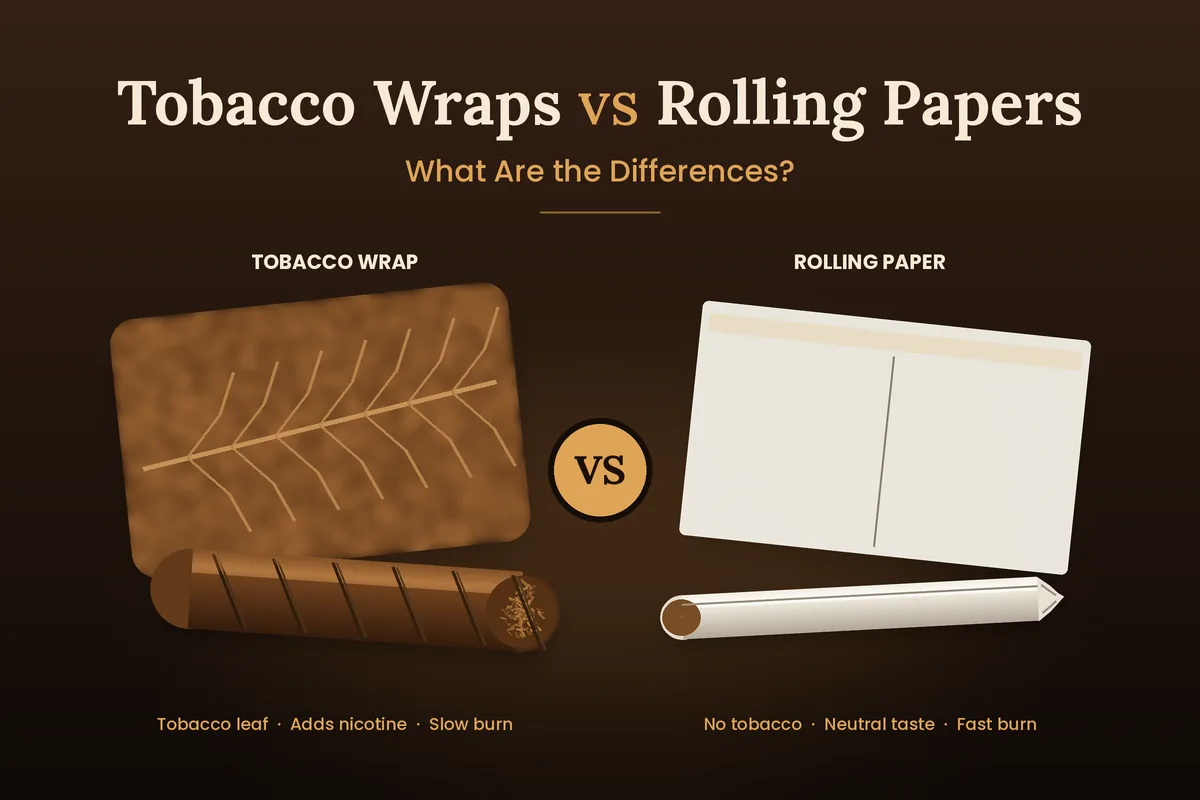
A tobacco wrap is made of tobacco. A rolling paper is not. That single fact drives every other difference: flavor, nicotine, burn time, size, price and how you store them.
Tobacco wraps are sheets of cured tobacco leaf, or a paper-like sheet made from ground tobacco. They add their own taste, their own nicotine and a slow, cigar-style burn. Rolling papers are thin sheets of wood pulp, rice, hemp or flax. They are built to disappear, so the filling is all you taste.
Pick a paper when you want a quick, clean smoke that tastes only of your tobacco. Pick a wrap when you want a longer, fuller smoke where the wrapper is part of the flavor.
One more detail most guides skip: under U.S. federal law, the wrapper you choose decides whether the finished roll counts as a cigar or a cigarette. We cover that below, along with every wrap and paper type, cost per roll at real prices, and how to roll tobacco in each.
Tobacco Wraps vs Rolling Papers at a Glance
The table below compares the two on the points that matter when you sit down to roll.
| Feature | Tobacco wraps | Rolling papers |
| Made from | Cured tobacco leaf or reconstituted tobacco sheet | Wood pulp, rice, hemp or flax fibre |
| Contains tobacco | Yes | No |
| Adds nicotine | Yes | No |
| Taste | Earthy, sweet or flavored; part of the smoke | Close to neutral; the filling does the talking |
| Thickness | Thick, leathery, visible veins on leaf wraps | Very thin, often translucent |
| Burn speed | Slow and steady | Fast |
| Typical smoke time | 20 to 45 minutes | 5 to 10 minutes |
| Capacity | Large, cigar-sized rolls | Single wide to king size |
| Freshness | Dries out; needs a sealed pouch | Shelf-stable for years |
| Cost per roll | About $0.17 to $1.25 at our current prices | A few cents per leaf |
| What the finished roll is | A cigar | A cigarette |
Why the Wrapper Decides What You Are Smoking
This is the part of the wrap vs paper question almost nobody explains. The U.S. tax code sorts a roll of tobacco by its wrapper, not its filling.
The federal definitions in 26 U.S. Code § 5702 treat a cigar as tobacco rolled in leaf tobacco or a substance that contains tobacco. A cigarette is tobacco rolled in paper or any material that has no tobacco in it. The same section counts tobacco sold as wrappers for cigars as roll-your-own tobacco.
In plain terms: fill a paper and you have made a cigarette. Fill a leaf wrap with the same tobacco and you have made a cigar. A hemp wrap contains no tobacco, so it sits on the paper side of that line. If you want the wider picture, our guide on cigar vs cigarette breaks down how the two products differ beyond the wrapper.
Types of Tobacco Wraps
Not every wrap on the shelf is the same product. There are three construction types, and the label rarely tells you which one you are holding.
Natural Leaf Wraps
Natural leaf wraps are a whole piece of cured tobacco leaf, cut and packed flat. You can see the veins, feel the texture and smell the barn-cured leaf the moment you open the pouch.
They are the closest thing to rolling your own cigar. Expect a slow burn, a natural tobacco taste and real nicotine from the leaf itself.
Loose Leaf is a well-known example built on whole Dominican leaf. The range covers plain styles such as Loose Leaf Natural Dark and Loose Leaf San Andres, plus flavored ones like Russian Cream and Cookies & Cream. Fronto Leaf goes one step further: it is a full dried leaf you cut to size yourself.
Other leaf-style options include Backwoods True Wraps Original, Havana Leaf Little Tobacco Wrap Yellow and Swisher Sweets Leaf Wraps Original. Our Backwoods wraps guide covers the True Wraps line in detail.
Homogenized (HTL) Tobacco Wraps
Homogenized tobacco leaf, or HTL, is tobacco ground down, mixed with binders and pressed into a smooth, uniform sheet. It behaves more like paper than leaf: even color, no veins, consistent thickness.
HTL is cheaper to make and easier to flavor. The trade-off is a less natural taste and a burn that can run faster than whole leaf. It is the same material used on many machine-made cigarillos, which our guide what is a cigarillo explains.
Quick test: hold the wrap up to light. Visible veins and uneven color mean leaf. A flawless, even sheet usually means HTL.
Hemp Wraps
Hemp wraps look like a wrap but contain no tobacco at all. They are pressed from hemp fibre, so they carry no nicotine and sit closer to a thick rolling paper.
People choose them to get the size and slow burn of a wrap without extra nicotine. Common picks include Wild Hemp Wraps Natural and Billionaire Hemp Wraps OGK.
A Note on Flavored Wraps
Flavor is a coating, not a construction type. It can sit on leaf, HTL or hemp. Sweet budget lines such as 4 Kings Sweet Delicious and 4 Kings Blueberry lean heavily on flavor, while Loose Leaf's Dream series keeps a stronger leaf base. You can compare every style side by side in our cigar wraps collection.
Rolling Paper Types
Rolling papers differ by fibre, thickness, finish and size. The fibre matters most, because it sets how fast the paper burns and how much taste it adds.
By Material
| Paper material | Thickness | Burn speed | Taste impact | Best for |
| Wood pulp | Thicker | Fastest | Noticeable papery note | Beginners; easiest to handle |
| Rice | Ultra-thin | Slow | Almost none | Smokers who want only the tobacco flavor |
| Hemp | Medium | Medium | Light, slightly earthy | An all-round default |
| Flax | Thin | Slow, even | Very low | Clean burn with good grip |
Wood pulp papers are the most forgiving to roll, but they burn quickly and add the most paper taste. Rice papers are the opposite: nearly invisible, but slippery and harder to handle when you are learning.
Hemp papers sit in the middle and make a sensible default for most smokers. Note that a hemp paper and a hemp wrap are two different products. The paper is thin and fast, while the wrap is thick and built for a larger roll.
Bleached vs Unbleached
Bleached papers are white and look classic. Unbleached papers are tan or brown, skip the whitening step and are often chosen by people who want fewer additives. Taste differences are small, but many smokers find unbleached papers slightly earthier.
By Size
| Size | Approx. length | Typical use |
| Single wide | 68 to 70 mm | Standard hand-rolled cigarette |
| 1¼ | 76 to 78 mm | Slightly longer cigarette, the most popular size |
| 1½ | 78 to 80 mm | Wider roll |
| King size slim | 108 to 110 mm | Long, thin roll |
| King size | 108 to 110 mm (wider) | Largest standard paper |
Whichever rolling paper types you settle on, the filling still decides the smoke. Our roundup of roll-your-own tobacco brands covers what people actually put inside them. You can also see what is currently stocked in our rolling papers collection.
Tobacco Wraps vs Rolling Papers: Head-to-Head Differences
Here is how the two compare on each point, one at a time.
Flavor: Tobacco Wraps vs Rolling Papers
A wrap is an ingredient. Leaf wraps add sweetness, earth and a light cigar note to whatever is inside. Flavored wraps add vanilla, fruit, cream or rum on top of that.
A paper is a container. The better the paper, the less you notice it. If you are rolling a tobacco you love and want to taste exactly that, a thin rice or flax paper is the honest choice. If you want the wrapper to round out a plain filling, a wrap does that job.
How flavor gets onto a wrap also varies. Our breakdown of infused vs flavored vs dipped cigars explains the methods, and the same logic applies to wraps.
Nicotine
This is the difference that matters most for your body. A leaf or HTL wrap contains tobacco, so it delivers nicotine even before you add any filling. A paper or hemp wrap adds none.
Wrap a light filling in a leaf wrap and the overall smoke gets stronger. For context on how much nicotine sits in leaf-wrapped products, see how much nicotine is in a Backwood and how much nicotine is in a cigar.
Burn Rate and Smoke Time
Papers burn fast. A hand-rolled cigarette in a single wide paper is usually done in 5 to 10 minutes.
Wraps are thicker and burn like a cigar. A full-size leaf wrap often runs 20 to 45 minutes, depending on how tightly it is packed and how often you draw. Wraps also go out if left alone, while most papers keep smoldering.
Size and Capacity
A standard paper holds roughly the tobacco of one cigarette. A cigar wrap holds several times that. This is why the cigar wraps vs rolling papers decision is often a question of occasion: a paper for a quick break, a wrap for a long sit-down smoke or a shared one.
Cost Per Roll
Papers win on price by a wide margin. On the federal side, the tax rates in 26 U.S. Code § 5701 put cigarette papers at 3.15 cents per 50 papers, while roll-your-own tobacco, which includes cigar wraps, is taxed at $24.78 per pound. Retail papers typically cost a few cents per leaf.
Wraps cost more, but the range is wide. Here is the real cost per wrap at Smokenza's current prices (17 October 2026):
| Wrap | Type | Count | Price | Cost per wrap |
| Wild Hemp Wraps Natural | Hemp | 80 | $13.99 | $0.17 |
| Billionaire Hemp Wraps OGK | Hemp | 50 | $14.99 | $0.30 |
| Swisher Sweets Leaf Wraps Original | Tobacco | 30 | $22.25 | $0.74 |
| Havana Leaf Little Tobacco Wrap Yellow | Tobacco | 40 | $31.99 | $0.80 |
| Loose Leaf Cookies & Cream | Natural leaf | 40 | $40.50 | $1.01 |
| Backwoods True Wraps Original | Tobacco | 80 | $89.99 | $1.12 |
| Sweet Woods Leaf Reserve Gold | Tobacco | 40 | $47.50 | $1.19 |
| Loose Leaf Russian Cream | Natural leaf | 40 | $49.99 | $1.25 |
Per gram of tobacco smoked, the gap narrows, because one wrap holds far more filling than one paper. Per session, though, papers remain the cheaper habit.
Storage and Freshness
Papers keep for years in a drawer. Wraps do not. Tobacco leaf dries out once the pouch is opened, and a dry wrap cracks when you roll it.
Keep wraps sealed, away from heat and sunlight, and use an opened pack within a few days. The same moisture rules apply to loose tobacco; our guide to rehydrating pipe tobacco bags walks through simple fixes.
Put side by side, the tobacco wraps vs rolling papers gap comes down to three things: wraps add nicotine and flavor, burn longer and need care; papers stay neutral, burn fast and cost very little.
How to Roll Tobacco in a Paper vs a Wrap
The two techniques share a goal, an even pack with no air pockets, but the handling is different. Paper is fragile and dry. A wrap is thick and needs a little moisture to seal.
Rolling With a Paper
- Break up your tobacco so there are no clumps or stems. Pipe and cigarette tobacco both work; pipe tobacco vs cigarette tobacco explains how they differ.
- Hold the paper with the gum strip at the top, facing you.
- Spread the tobacco evenly along the crease. Add a filter tip at one end if you use one.
- Pinch the paper between thumbs and forefingers and roll it back and forth to shape a firm cylinder.
- Tuck the bottom edge around the tobacco, then roll upward.
- Lick the gum strip lightly and press it closed along the full length.
- Pack the open end with a pen tip or matchstick, then twist it shut.
Want the full walkthrough? Read how to roll a cigarette. If hand rolling is not for you, pre-made cigarette tubes let you fill and go.
Rolling With a Tobacco Wrap
- Open the pouch just before you roll. A fresh wrap is pliable; a dry one cracks.
- If the wrap is stiff, breathe on it or hold it near a slightly damp cloth for a few seconds. Do not soak it.
- Lay it flat. Leaf wraps have a smoother side; keep that facing out.
- Load the tobacco in an even line down the center. Wraps hold far more than papers, so do not overfill the ends.
- Tuck the near edge over the filling and roll away from you, keeping steady pressure.
- Moisten the outer edge lightly and press it down to seal. Run a finger along the seam.
- Let it dry for a minute, or pass a flame quickly along the seam without touching it, to set the seal.
- Light it like a cigar: toast the foot evenly while rotating, then draw gently.
Leaf wraps have a learning curve. Our list of Loose Leaf wrap mistakes beginners make covers the most common ones, from overfilling to sealing too wet. For more on lighting and pacing a slow burn, see how to smoke a cigar.
Knowing how to roll tobacco well matters more in a wrap than a paper. A loose pack in a paper burns a little fast. A loose pack in a wrap tunnels, canoes and goes out.
Which One Should You Choose?
Match the wrapper to how you smoke, not to what looks best on the shelf.
- Choose a rolling paper if you want a short smoke, the pure taste of your tobacco, no added nicotine from the wrapper, and the lowest cost per session.
- Choose a natural leaf wrap if you want a slow, cigar-like smoke with real tobacco character and you do not mind extra nicotine.
- Choose an HTL or flavored wrap if sweetness and a consistent, easy roll matter more to you than leaf character.
- Choose a hemp wrap if you want the size and slow burn of a wrap without tobacco in the wrapper.
Tobacco Wraps vs Rolling Papers for Beginners
Start with a hemp or wood pulp paper. Both are forgiving, cheap to practice with and teach you how to pack evenly. Once your rolls hold their shape, move to a wrap.
For your first wrap, a flavored HTL or hemp wrap is easier to handle than a whole leaf. When you are ready for natural leaf, Loose Leaf's 2-pack pouches, like Purple Dream, mean fewer wraps sit open and dry out. If you would rather skip rolling and try a ready-made leaf-wrapped smoke first, the cigarillo collection and our guide to White Owl blunts vs cigarillos vs tips are good starting points.
Summary
The tobacco wraps vs rolling papers choice comes down to what the wrapper does. A tobacco wrap is part of the smoke: it adds flavor, adds nicotine, burns slowly and turns your roll into a cigar in the eyes of federal law. A rolling paper stays out of the way: neutral, fast-burning, shelf-stable and cheap. Hemp wraps split the difference with wrap size and no tobacco. Pick the paper for quick, clean smokes and the wrap for long, flavorful ones. Everything you need for either is in our roll your own collection.
Frequently Asked Questions
Is a cigar wrap the same as a tobacco wrap?
Yes, in everyday use. Both terms describe a wrapper made from tobacco leaf or reconstituted tobacco sheet. Retailers use them interchangeably.
Do hemp wraps contain nicotine?
No. Hemp wraps are made from hemp fibre and contain no tobacco, so the wrapper adds no nicotine. Any nicotine comes from what you put inside.
Which burns longer, a wrap or a paper?
A wrap, by a wide margin. Leaf wraps burn like a cigar, often 20 to 45 minutes, while a paper roll usually lasts 5 to 10 minutes.
Can I use pipe tobacco in a wrap or a paper?
Yes. Many roll-your-own smokers fill with pipe tobacco such as 4 Aces or OHM. Browse the full pipe tobacco collection for cut and flavor options.
Why did my wrap crack while rolling?
It was too dry. Open wraps just before use, keep the pouch sealed and add a little moisture with your breath before rolling.
Are natural leaf wraps stronger than flavored wraps?
Usually. Natural leaf wraps are whole tobacco leaf, so they carry more leaf character and nicotine than thin, heavily flavored sheet wraps.
What did you think?
Share this article
Help others discover this content by sharing it with your network.