
Two bags can hold the same leaf and still smoke like two different products. The difference is the cut.
How the leaf is sliced, pressed or twisted decides how fast it burns, how long it holds moisture, how you pack it and how the flavor develops from the first light to the last ash.
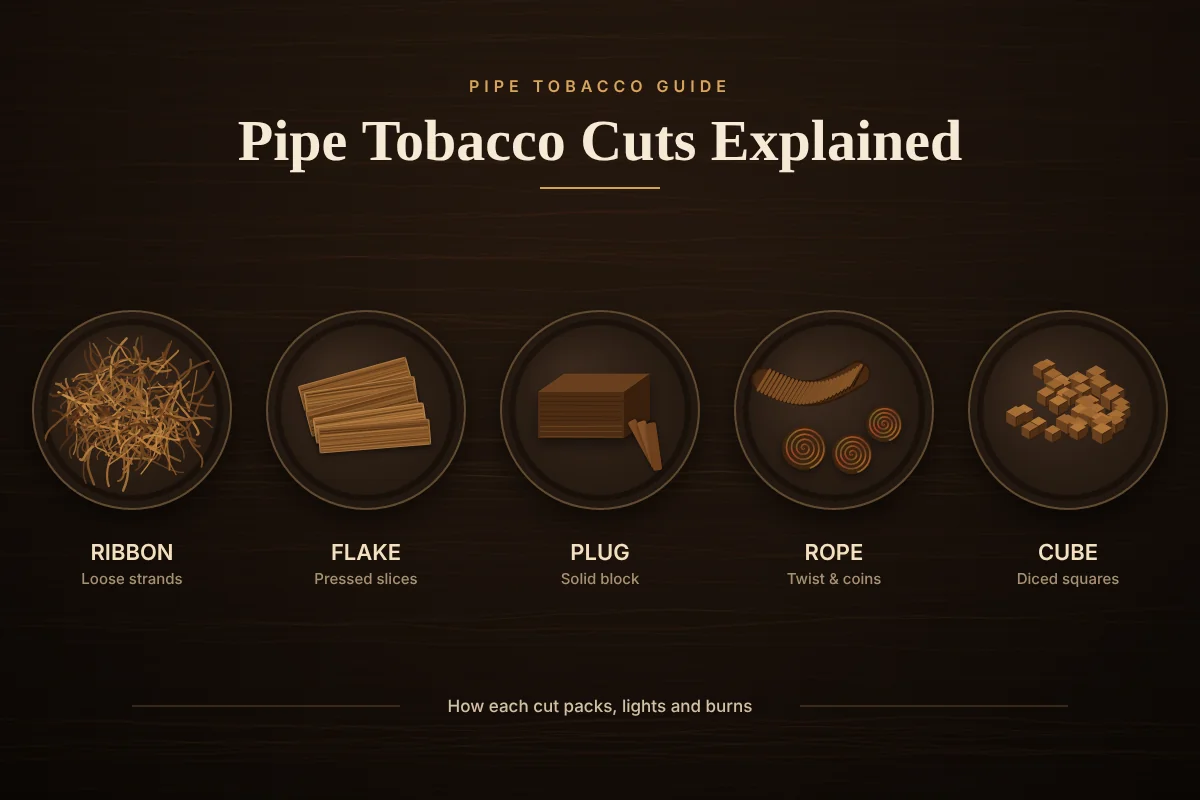
This guide covers the five base styles you will see on a label: ribbon, flake, plug, rope and cube. It also covers the common variations, like broken flake, ready rubbed, coin cut and crumble cake, and explains which cut fits which pipe and which smoker.
Quick answer: Ribbon cut is thin, loose strands that pack easily and burn fastest. Flake is pressed leaf sliced into thin sheets that burn slowly and cool. A plug is a solid pressed block you slice yourself. Rope tobacco is leaf twisted into a cord and sliced into coins, usually strong and dark. Cube cut is pressed leaf diced into small squares that burn slowly and evenly. Most budget American pipe tobacco, including every bag in the Good Stuff line, is ribbon cut.
Why Pipe Tobacco Cuts Change How a Bowl Smokes
A cut is not cosmetic. It changes three physical things inside the bowl, and those three things drive almost everything you taste.
Surface area. Thin strands expose more leaf to air and flame. More exposure means faster burning, quicker drying in the bag and a hotter smoke if you puff hard. Dense pieces expose less, so they burn slower and hold moisture longer.
Density. Pressed tobacco packs more leaf into the same space. A bowl of flake or cube holds more tobacco by weight than a bowl of loose ribbon, so it lasts longer and delivers more nicotine per bowl.
Pressing and resting. Several cuts start with pressure. Leaf is stacked, compressed, sometimes heated, then left to rest. During that time, sugars and oils from different leaves mingle. That is why a flake and a ribbon made from the same leaf often taste different. The pressing changes the tobacco, not just its shape.
The 5 Main Pipe Tobacco Cut Types
Dozens of names appear on tins and bags, but nearly all of them trace back to five base styles.
Ribbon Cut Pipe Tobacco
Ribbon cut pipe tobacco is loose leaf sliced into long, thin, flat strands, usually about a millimeter wide. It is the most common cut in American pipe tobacco and the default for budget bags, aromatics and English blends alike.
How it is made: cured leaf is cased (if the blend uses casing), stacked, then run through a cutter that shreds it into ribbons. There is no long pressing stage, so what you get is close to the leaf as it came out of curing.
How it smokes:
- Packing: the easiest of any cut. Pinch, drop, press lightly, repeat.
- Lighting: catches quickly with one or two matches.
- Burn: fastest of the five. Puff too hard and it runs hot.
- Flavor: consistent from top to bottom, with casing and top flavor coming through clearly.
- Storage: dries out faster than pressed cuts because of all that surface area.
Ribbon cut is the right starting point for new pipe smokers. It forgives packing mistakes and lights without fuss.
It is also the cut used across the budget domestic tier of our pipe tobacco collection. That includes OHM, 4 Aces, Gambler, Golden Harvest, Kentucky Select, Cheyenne, Golden Leaf and Largo.
Shag cut sits at the very fine end of ribbon. The strands are thinner and shorter, almost hair-like. Shag burns very fast in a pipe and is more common in hand-rolling tobacco than in pipe blends.
Flake Pipe Tobacco
Flake pipe tobacco is leaf that has been pressed into a solid cake, then sliced into thin sheets, usually a few inches long and a millimeter or two thick. Open a tin and you see neat stacked slices that look like thin strips of wood veneer.
How it is made: leaf is layered in a mold and pressed hard, sometimes with heat (a process called stoving), then left to rest for days or weeks. The pressed cake is sliced into flakes. Virginia flakes are the classic example, because pressing and resting bring out the natural sugar in flue-cured leaf.
There are three ways to load a flake:
- Fold and stuff. Fold the flake in half, then in half again, and push it into the bowl. Slow, cool burn, but expect a few relights early on.
- Rub out. Roll the flake between your palms until it breaks into loose pieces, then pack it like ribbon. Easier to light, slightly faster burn.
- Partial rub. Rub out half for the top of the bowl and fold the rest underneath. A good middle ground.
Two related labels come up often:
- Broken flake: flakes the maker has already broken into short pieces. It packs more easily than whole flake and keeps most of the slow burn.
- Ready rubbed: flake that has been fully rubbed out before packaging. It looks almost like a coarse ribbon cut, but the leaf was pressed first, so it smokes denser and sweeter.
Plug Pipe Tobacco
Plug pipe tobacco is the oldest pressed form in this guide. The leaf is pressed into a solid brick, and the smoker does the slicing.
How it is made: cased or uncased leaf is stacked into a mold, pressed under heavy weight and left to cure as a block. Many chewing tobaccos used the same format, and some still do in our smokeless tobacco range.
How to prepare it:
- Use a sharp pocket knife or a dedicated tobacco knife.
- Slice thin, about the thickness of a coin.
- Rub the slices out lightly, or fold them like flake.
- Only cut what you plan to smoke. The rest of the plug stays fresh.
That last point is the real advantage. A plug is its own storage container. The trade-off is effort, so plug suits smokers who enjoy the ritual as much as the smoke.
Rope Tobacco
Rope tobacco, also called twist, is leaf that has been spun into a cord. Sailors carried tobacco this way because a tight twist resists weather.
How it is made: leaf is wound tightly around a core of other leaf, often dark-fired or air-cured, then pressed and left to cure. The twisting squeezes out air and lets the leaf ferment slowly. The result is usually dark, dense and strong.
How it is sold and smoked:
- Whole rope or twist: you slice it yourself, like plug.
- Coin cut, or spun cut: the rope is pre-sliced into thin round discs. Each disc shows a spiral of leaf in cross-section, a little like a cinnamon roll.
- Curly cut: smaller coins from a thinner rope, so each disc looks like a curl.
Coins can be packed whole for a very slow burn or rubbed out for easier lighting. Rope is usually the strongest cut here, because the leaf chosen for twisting tends to be heavy burley or dark-fired tobacco. It is not a beginner's cut.
Cube Cut Pipe Tobacco
Cube cut pipe tobacco starts like plug or flake. Leaf is pressed into a dense cake, then diced into small cubes, usually about an eighth of an inch on each side.
How it smokes:
- Packing: pour it in, settle it with a tap, press lightly. Cubes do not compress the way ribbon does.
- Lighting: slower to catch. Expect a charring light and a true light a minute later.
- Burn: slow, cool and very even once lit, because each cube burns at its own pace.
- Flavor: builds gradually through the bowl as the cubes break down.
A common habit is to mix cube cut with a little ribbon cut or rubbed-out flake. The looser tobacco catches the flame and helps the cubes get going.
Crumble cake is a close cousin. The pressed cake is broken into irregular crumbs rather than neat cubes. It packs more easily than cube and burns almost as slowly.
Pipe Tobacco Cut Types Side by Side
Now that each style is clear, here is how the five base types of pipe tobacco cuts compare on the points that matter at the bowl.
| Cut | Form | Prep needed | Ease of lighting | Burn speed | Moisture hold | Best for |
| Ribbon | Thin loose strands | None | Easiest | Fastest | Lowest | Beginners, daily smoking |
| Flake | Pressed, sliced sheets | Fold or rub out | Moderate | Slow | Good | Slow, flavorful bowls |
| Plug | Pressed solid block | Slice and rub | Moderate | Slow | Best | Long storage, ritual |
| Rope | Twisted cord or coins | Slice or rub coins | Harder | Very slow | Very good | Strong, dark tobacco fans |
| Cube | Pressed, diced squares | None, but slow to light | Hardest | Slow and even | Good | Long, cool sessions |
How Pipe Tobacco Cuts Affect Burn Rate
Burn rate follows a simple rule: the less surface area per gram, the slower the burn. Ribbon sits at one end, and rope and cube sit at the other.
In practice, that means:
- A bowl of ribbon might last 20 to 40 minutes, depending on bowl size and your pace.
- The same bowl filled with folded flake or cube often runs noticeably longer, because it holds more leaf and burns it slower.
- Puffing rate matters more with ribbon. Fine strands overheat quickly, which causes tongue bite. Pressed cuts give you more room for error.
Moisture matters too. Wet tobacco of any cut goes out often and steams. Dry tobacco of any cut burns hot and harsh. Pressed cuts tend to arrive at a steadier moisture level and hold it longer, which is part of why they feel cooler in the mouth.
Matching Pipe Tobacco Cuts to Your Pipe
- Small bowls and corncobs: ribbon or broken flake. They fill quickly and light easily in a narrow chamber.
- Medium and large briars: any cut works. This is where folded flake and cube cut shine, because the deeper chamber gives them room to burn slowly.
- Wide, shallow bowls: ribbon or rubbed-out flake. Cubes and coins can be hard to keep lit across a wide surface.
- Tall, narrow bowls: folded flake is ideal. It stands upright in the chamber and burns down evenly.
How Pressing Changes Flavor
Pressing is the hidden variable behind most cuts. When leaf sits under pressure for days or weeks, it ferments lightly. Sugars darken, harsh edges soften, and the different leaves in a blend start to taste like one tobacco instead of several.
Two traditions show how far pressing can go:
- Cavendish is a process, not a cut. Leaf is steamed or heated and then pressed hard, which brings out sweetness and creates a moist, dark tobacco. You can read a short history of Cavendish tobacco and its American, Dutch and English styles. Cavendish can then be sold as ribbon, flake or cube.
- Perique takes pressing to the extreme. The leaf is packed into wooden barrels and fermented under heavy pressure for months, and it is grown only in St. James Parish, Louisiana. It is so strong that blenders use it as a seasoning, usually a small percentage of a blend.
If you enjoy a blend in ribbon form, the same leaf in flake will usually taste rounder and sweeter.
Where Good Stuff Fits
Good Stuff is made in the United States, and every blend in the line uses the same ribbon cut. What changes between bags is the leaf recipe and the casing, not the cut. We break that down fully in Good Stuff tobacco colors explained.
Because the cut is shared, Good Stuff blends mix cleanly with each other. A half-and-half of Red and Gold packs and burns as one tobacco.
| Blend | Style | Sizes |
| Good Stuff Red | Full flavor, strongest | 2 oz, 6 oz, 16 oz, 5 lb |
| Good Stuff Gold | Light, same casing as Red | 2 oz, 6 oz, 16 oz |
| Good Stuff Silver | Ultra light, mildest | 6 oz, 16 oz, 5 lb |
| Good Stuff Natural | No casing, no preservatives | 6 oz, 16 oz, 5 lb |
| Good Stuff Menthol | Strongest cooling | 2 oz, 16 oz, 5 lb |
| Good Stuff Menthol Gold | Gold blend, softer menthol | 6 oz, 5 lb |
A few cut-specific notes for Good Stuff smokers:
- Natural dries fastest. It is ribbon cut with no humectants, so it loses moisture quicker than any cased bag. Our guide to additive free tobacco and Good Stuff Natural explains why.
- Silver suits small bowls. Mild leaf in a fine ribbon is the easiest combination to keep lit in a corncob.
- Red benefits from a slower pace. Burley-forward ribbon burns hot if puffed hard, which makes the full flavor bag feel harsher than it is.
- Start small. The 2 oz Red and Gold bags let you test packing and burn in your own pipe before committing to a 16 oz or 5 lb bag.
Menthol and Menthol Gold are restricted in some states and cities, so check local rules before ordering either one.
Ribbon Cut and Rolling
Ribbon cut looks like cigarette tobacco, but it is wider, wetter and more burley-forward, so it behaves differently in a paper. We cover the full answer in can you roll pipe tobacco into cigarettes and in our roundup of roll-your-own tobacco brands.
Good Stuff is labeled and sold as pipe tobacco, so use it as the package directs. If you want tobacco made for papers and tubes, Bugler sits in our roll-your-own collection, alongside rolling papers, cigarette tubes and wraps.
When a Pipe Is Not Practical
Every cut in this guide needs time, a lighter and a place you are allowed to smoke. That rules out a commute, a work shift or a flight.
This is where many pipe smokers keep a smokeless option on hand. ZYN nicotine pouches contain no tobacco leaf at all, so there is no cut, no packing and no burn. You place a pouch under your lip, and it delivers nicotine without smoke or spitting.
A few points worth knowing if you are switching between the two:
- Strength is labeled in milligrams. ZYN comes in 3 mg and 6 mg pouches. Pipe tobacco has no printed nicotine figure, because it varies by leaf and bowl.
- Flavor works differently. In a pipe, flavor comes from the leaf and casing. In a pouch, it comes from added flavoring, which is why ZYN can offer profiles like those in our ZYN Black Cherry, Peach and Dragonberry review.
- Usage is simpler. Our guide on how to use VELO nicotine pouches covers placement and timing, and the same steps apply to ZYN.
Storing Each Cut
- Ribbon: the most vulnerable. Reseal the bag every time and press out the air. Move 16 oz and 5 lb bags into airtight jars.
- Flake and cube: hold moisture better but still dry out in an open tin. A jar with a tight lid is enough.
- Plug and rope: the most stable. Wrap the uncut portion and only slice what you need.
- All cuts: a two-way humidity pack in the working jar keeps moisture steady. It is the same method we describe in how to store Backwoods, and it works for loose tobacco too.
How to Choose Between Pipe Tobacco Cuts
- New to pipes: ribbon cut. Easy to pack, easy to light.
- Want a longer, cooler bowl: broken flake or ready rubbed first, then whole flake once you are comfortable.
- Want a slow, steady session with little attention: cube cut, ideally with a pinch of ribbon on top.
- Want strong, dark tobacco: rope or coin cut, in small amounts.
- Want tobacco that keeps for months: plug.
- Want value per ounce: budget ribbon cut in a 16 oz or 5 lb bag, stored in jars.
- Want nicotine without smoking: a ZYN pouch for the hours a pipe does not fit.
Strength depends on the leaf more than the cut, so the usual rules about burley, Virginia and stalk position still apply. Our guide to cigar strengths explained walks through that leaf logic, and OHM Turkish Yellow vs Turkish Red shows how adding Turkish leaf changes a ribbon cut blend.
If you smoke cigars too, what is a cigarillo explains how format changes the smoke, and our mild cigars are the easiest crossover for a pipe smoker who likes a gentle bowl.
FAQs
What are the main pipe tobacco cut types? Ribbon, flake, plug, rope and cube. Most other names, such as broken flake, ready rubbed, coin cut, curly cut, shag and crumble cake, are variations of those five.
How do you smoke flake pipe tobacco? Fold it and stuff it into the bowl, rub it out into loose pieces, or combine both. Folding gives the slowest burn; rubbing out makes it easier to light.
What cut is Good Stuff pipe tobacco? Every Good Stuff blend is ribbon cut. The blends differ by leaf recipe and casing, not by cut.
Does the cut change nicotine strength? Not directly. Leaf type sets strength. Pressed cuts can deliver more per bowl simply because they pack more tobacco into the same space.
Are ZYN pouches a type of pipe tobacco? No. ZYN pouches contain no tobacco leaf. They are a smokeless nicotine product with labeled milligram strengths.
Does pipe tobacco contain nicotine? Yes. All pipe tobacco is a tobacco product, nicotine is addictive, and it is for adults 21 and over only.
Summary
Pipe Tobacco Cuts decide how a blend packs, lights, burns and tastes. Ribbon cut is loose, easy and fast burning, which makes it the standard for budget bags and new smokers. Flake, plug, rope and cube all start with pressed leaf, so they burn slower, hold moisture longer and taste rounder, at the cost of more preparation. Match the cut to your pipe and your patience, store it to suit its surface area, and start with a small bag before scaling up. Every Good Stuff blend is ribbon cut, so the 2 oz and 6 oz bags are an easy way to learn the basics before trying a pressed cut, and ZYN covers the hours when a pipe is not an option.
What did you think?
Share this article
Help others discover this content by sharing it with your network.