
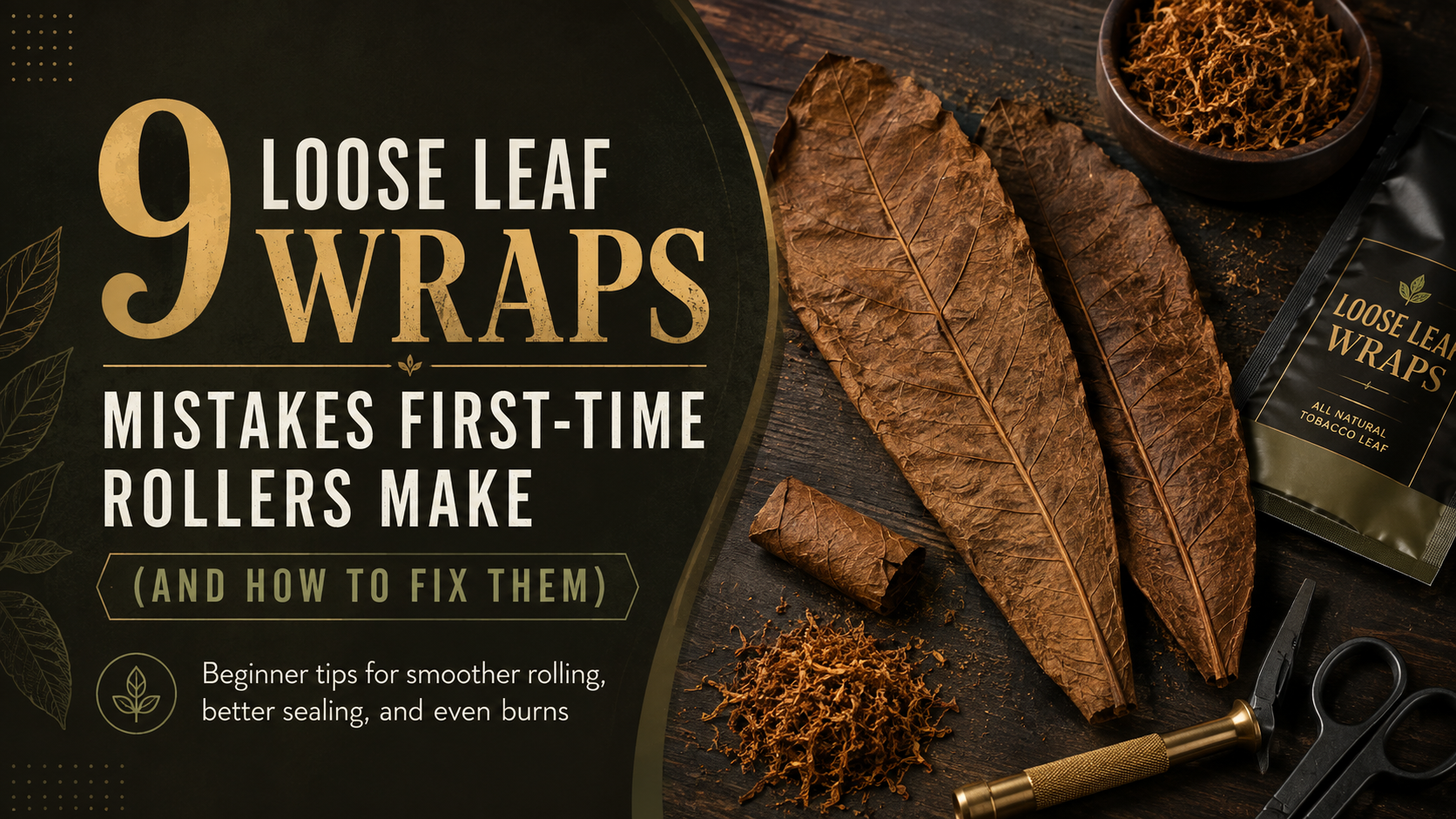
Loose leaf wraps are one of the last rolling products still made from real, whole tobacco leaf instead of paper. That is exactly what makes them satisfying once you know how to handle them, and exactly why they trip up almost everyone the first time. A paper wrap forgives a lot. A leaf does not.
The good news is that every mistake below is predictable and every one of them is fixable. Most come down to one root cause: not respecting that you are working with a natural, living material rather than a manufactured sheet. Once that clicks, the rest follows.
1. Not Checking Moisture Before You Start
This is the single most common reason a first roll goes wrong, and it goes both directions. A wrap that is too dry will crack or split the moment you try to bend it. A wrap that is too wet will not hold a seal, burns unevenly, and can taste flat or grassy.
The leaf you want feels flexible under light pressure, almost like a strip of soft leather, with no cracking sound and no visible dryness at the edges. If it feels stiff or the edges look pale and brittle, do not force it.
Why this happens: tobacco leaf is hygroscopic, meaning it constantly absorbs or releases moisture based on the air around it. A wrap that sat in a hot car, a dry room, or an unsealed bag for even a day or two can shift out of rolling range without looking obviously different until you try to bend it.
The fix: the target range most experienced rollers work within is roughly 60 to 70 percent relative humidity, similar to how premium cigars are stored. If a wrap feels dry, you do not need special equipment. Lightly dampen a paper towel, fold the leaf inside it, and seal both in a container or zip bag for 15 to 30 minutes. Check it every few minutes rather than walking away, since it is much easier to slightly under-hydrate and check again than to oversoak a leaf. Starting from a fresh, properly sealed pack in the first place, like the ones in Smokenza's Loose Leaf collection, saves you this step most of the time.
2. Overpacking the Wrap
New rollers tend to treat a loose leaf wrap like a burrito, packing as much material in as it will physically hold. The wrap will usually let you do this once. It will also tear, burn unevenly, or channel down one side, and it will be genuinely difficult to keep lit.
The fix: aim for a fill that feels firm when you press it between two fingers but still gives slightly. You should be able to draw air through it before you even light it. If you cannot, you have overpacked it. Underfilling slightly on your first few attempts is a better mistake to make than overfilling, since a loose roll is easier to correct mid-session than a split wrap.
3. Rolling Against the Grain
Every whole leaf has a visible vein structure running through it, because it grew that way. Rolling or folding against those veins, rather than with them, puts direct stress on the weakest points in the leaf and is the most common cause of a wrap splitting during the roll rather than during smoking.
The fix: before you cut or roll anything, hold the leaf up to light and trace the vein direction with your eye. Orient your cut and your roll so the main fold runs parallel to the veins, not across them. This single adjustment prevents more tears than any moisture fix does.
4. Leaving the Center Stem In
The thick central stem that runs down the middle of a whole leaf is the part most likely to crack, and it also burns differently than the surrounding leaf, which is one of the more common causes of an uneven burn that people mistakenly blame on the flavor or the brand.
The fix: before rolling, take a moment to strip the thickest part of the stem out of the section you are using. You do not need to remove all of it or damage the leaf doing so, just enough that you are not folding directly over a rigid ridge. A cleaner section without a heavy stem rolls tighter and burns more evenly from end to end, which is easiest to see on a straightforward natural leaf like Natural Dark before you try it on a thinner flavored wrap.
5. Rushing the Seal
The seal is where most first rolls actually fail, even when everything before it went fine. Two mistakes show up here in opposite directions: sealing with too much moisture, which weakens the leaf right where you need it strongest, and not sealing enough, which leaves air pockets that cause the wrap to unravel mid-session or burn a tunnel down one side.
The fix: moisten only the very edge of the seam, not the whole surface, and press it closed with steady, even pressure for several seconds rather than a quick pinch. If you have a lighter on hand, running the flame lightly along the sealed edge (without holding it in one spot) helps the seal set. Give it a short rest before lighting so the seal has time to bond.
6. Storing Wraps Wrong Between Sessions
This is the mistake that ruins wraps before a beginner even gets to roll them. Loose leaf tobacco is sensitive to both humidity and temperature, and an opened pack left in a drawer, a car, or open air will dry out within days, even faster in a hot or arid climate.
The fix: keep unused wraps sealed in their original resealable pack, or move them into an airtight container if the original seal is compromised. If you are storing wraps long-term or in bulk, a small humidity pack (the same kind used in cigar humidors) inside the container will hold them in range far longer than an airtight container alone. Keep them away from direct heat and sunlight, both of which accelerate drying regardless of humidity. This is also where buying a standard 8 packs of 5 box pays off over buying single wraps, since you only need to keep one resealable pack airtight instead of managing loose leaves individually.
7. Expecting a Pre-Shaped Wrap
Machine-made blunt wraps and cigarillos come pre-shaped and ready to fill. Whole leaf wraps generally do not, and first-timers who expect that convenience are often caught off guard by a larger, less uniform leaf that needs trimming before it is usable.
The fix: treat trimming as a normal part of the process, not a defect. A clean pair of scissors or a sharp blade, a flat surface, and a few minutes to cut the leaf into a manageable rectangle will get you a far better roll than trying to work around an oversized, irregular piece. This step also becomes faster with practice, since you start to recognize usable sections at a glance.
8. Confusing Loose Leaf Wraps With Other Tobacco Products
This is less of a rolling mistake and more of a buying mistake, but it is common enough to cover. "Loose leaf tobacco" is used loosely across the industry to mean several different things: whole leaf rolling wraps, loose tobacco for pipes or roll-your-own cigarettes, and loose leaf chewing tobacco are all separate product categories built for entirely different uses. Buying the wrong one because the name looked similar is an easy, avoidable mistake.
The fix: if what you want is a leaf sheet for rolling your own cigar or blunt, look specifically for whole leaf rolling wraps, not loose pipe tobacco or chew. If what you actually want is a thin paper wrap rather than a whole tobacco leaf, the Rolling Papers collection is the right starting point instead. Product pages that clearly separate these categories make this much easier to get right the first time.
9. Assuming All Flavors and Formats Roll the Same
Not every loose leaf wrap behaves identically, and first-timers who grab whatever is available sometimes end up comparing a thin, delicate flavored leaf against a thicker natural one and drawing the wrong conclusions about what went wrong.
The fix: if you are brand new to rolling with whole leaf, start with a natural, tobacco-forward option like San Andres or Reserve before moving to flavored lines, since natural leaf tends to be a more forgiving, consistent baseline to learn on. If you want to test a flavor without committing to a full box, the Mini Watermelon Dream and similar Mini packs cover most of the same profiles at a smaller size. Once you have the technique down, flavored and specialty lines are easier to work with because you already know what a properly hydrated, well-rolled wrap should feel like.
What a Good First Roll Actually Looks Like
Put together, the mistakes above share a pattern: they all come from treating a whole tobacco leaf like a uniform, manufactured product instead of an agricultural one. Every leaf has its own moisture level, its own vein pattern, and its own thickness, and the entire skill of rolling loose leaf comes down to reading that leaf before you commit to a fold.
A properly prepared wrap feels pliable but not soft, holds a seal without extra reinforcement, and burns evenly along its full length without tunneling to one side. If your early attempts are not hitting that yet, it is almost always one of the nine issues above, not a flaw in the leaf itself.
Getting Started With Loose Leaf Wraps
Once you have the technique down, the rest is just picking a flavor. Smokenza's Loose Leaf collection carries the full current lineup, from natural options through cream, fruit, and spirit-inspired profiles like Russian Cream and Honey Bourbon, with every pack size and price listed directly on the product page.
Frequently Asked Questions
How do I know if my loose leaf wrap is too dry to roll?
A dry wrap feels stiff, may look pale or slightly cracked at the edges, and will crackle or split when you try to bend it. Fresh leaf should flex like soft leather without resistance.
What humidity level should loose leaf wraps be stored at?
Most rollers keep whole leaf wraps in roughly the 60 to 70 percent relative humidity range, similar to cigar storage. Below that, leaf dries out and cracks; above it, wraps can become too soft to seal properly and are prone to mold if stored that way long-term.
Can I fix a loose leaf wrap that already cracked?
A small crack can sometimes be worked around by rolling with the intact side facing out, but a significantly cracked wrap is usually best replaced. Rehydrating an already-cracked leaf can help for minor cases, but it will not fully restore structural integrity once the leaf has split.
Is loose leaf tobacco the same as loose leaf chewing tobacco?
No. Loose leaf rolling wraps, loose pipe or roll-your-own tobacco, and loose leaf chewing tobacco are separate product categories. If you want a wrap for rolling your own cigar or blunt, look specifically for whole leaf rolling wraps rather than chew or pipe tobacco.
Are loose leaf wraps good for beginners, or should I start with paper?
Loose leaf wraps have a real learning curve compared to paper, mainly around moisture and vein direction, but they are not difficult once you understand those two variables. Starting with a natural, unflavored wrap and a smaller format makes the learning curve noticeably easier.
What did you think?
Share this article
Help others discover this content by sharing it with your network.