
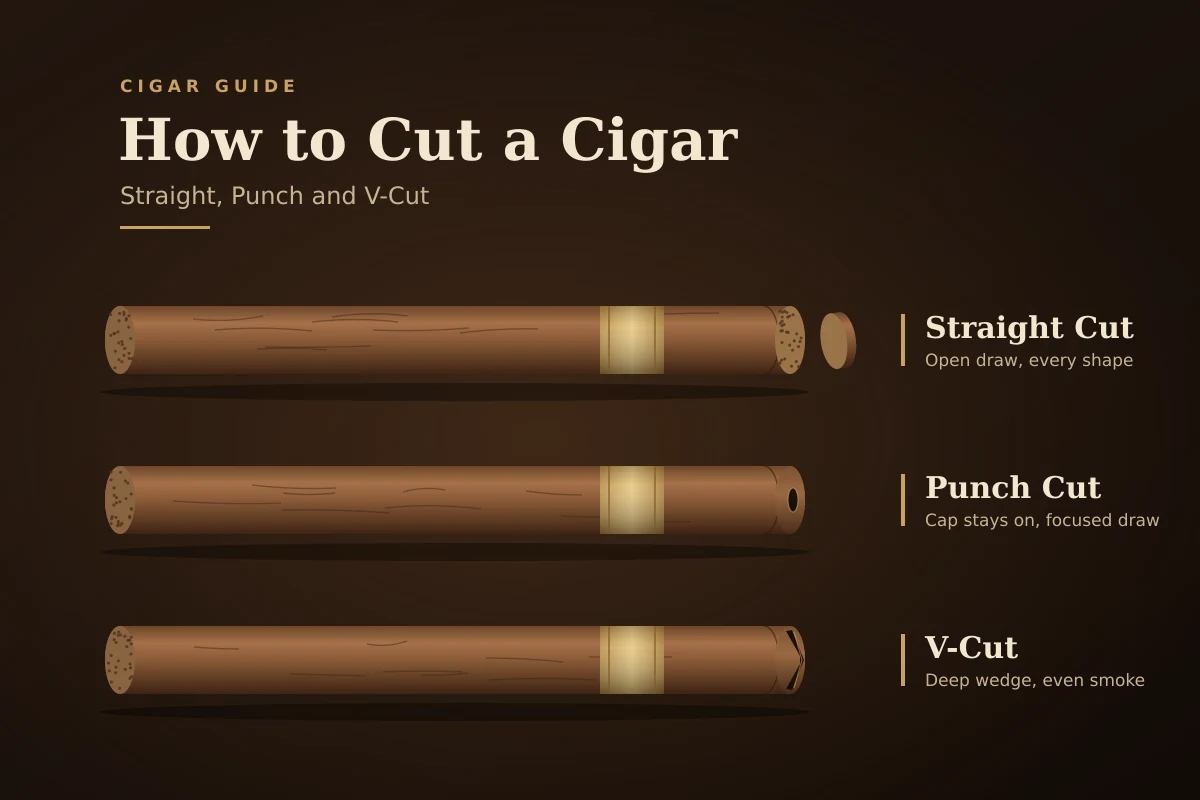
Quick answer: Remove only the top of the cap and never cut below the cap line. For a straight cut, set a double-blade guillotine about 1/16 to 1/8 inch (2 to 3 mm) above the cap line and close it in one fast motion. For a punch cut, twist a round blade a few millimeters into the center of the cap. For a V-cut, press the head into the wedge blade and snap it shut. Then take a cold draw before you light.
The cut is the first thing that can ruin a good premium cigar, and it happens before a flame ever touches the foot. Cut too shallow and the draw fights you all night. Cut too deep and the wrapper starts peeling open by the second third.
This guide covers all three cuts, which cigar cutter suits which shape, how punch size should match ring gauge, and what to do when a cut goes wrong.
Know the Head Before You Cut
The closed end you put in your mouth is the head. On a hand-rolled cigar, the head is sealed with a cap: a small round of wrapper leaf fixed in place with flavorless vegetable gum. The open end you light is the foot. You only ever cut the head.
Look closely at the head and you will see a faint seam where the cap meets the body of the wrapper. That seam is the cap line. Every rule in this guide comes back to one thing: stay above it. The cap is what keeps the wrapper from unwinding, and once you slice beneath it, nothing holds the leaf in place.
Many premium cigars, especially those rolled in the Cuban style, carry a triple cap, three thin layers stacked on the head. When you cut through the top layer or two, the bottom ring stays intact and keeps everything locked.
The shape of the head decides which cuts are available to you:
- Parejo: straight sides and a rounded head. Robusto, Toro, Churchill and Corona are all parejos. Every cut works on them.
- Figurado: a tapered, pointed head. Torpedo, Belicoso, Pyramid and Perfecto are figurados. A straight cut is the only reliable option.
- Pigtail or flag cap: a small twist or tail of wrapper left on the head by some boutique rollers. These need their own approach, covered further down.
One more check before any blade comes out: humidity. A cigar stored too dry will crack under even a sharp cutter. If the wrapper feels crisp or makes a crackling sound when you roll it gently between your fingers, let it rest in a properly set humidor first. Our guide to the best cigar humidor for home use covers the 65 to 70% range that keeps wrapper leaf supple enough to cut cleanly.
How to Cut a Cigar With a Straight Cut
The straight cut, also called a guillotine cut, is the most common way to open a cigar. It removes the entire top of the cap in one flat slice, which gives you the widest opening, the most open draw and the biggest volume of smoke per puff. It also works on every shape, parejo or figurado, which is why most smokers learn it first.
Single Blade vs Double Blade Guillotines
A single-blade guillotine pushes one blade across the head against a fixed edge. It works, but the one-sided pressure can squash a soft cigar or tear the wrapper, especially if the blade is not razor sharp.
A double-blade guillotine closes from both sides at once and meets in the center. Pressure is even, the head stays round, and the cut comes out clean. The editors at Cigar Aficionado point out that a double-bladed cutter lowers the chance of tearing the wrapper compared with tools that take more practice. If you are choosing your first cigar cutter, this is the one to start with.
How to Cut a Cigar With a Double Guillotine, Step by Step
- Find the cap line. Turn the cigar under good light until you see the seam where the cap ends.
- Open the cutter fully and slide the head into the opening. Hold the cigar steady in one hand and the cutter in the other.
- Position the blades about 1/16 to 1/8 inch (2 to 3 mm) up from the cap line, inside the cap itself. On a 50 ring gauge cigar, that is roughly the width of a pencil lead to a match head.
- Close the blades in one quick, firm motion. A slow squeeze crushes the filler. A fast snap slices it.
- Take a cold draw. Pull air through the unlit cigar. You should feel light, even resistance, similar to drinking through a thick straw. If it is too tight, trim another millimeter.
You can always take a little more off. You cannot put any back. If the visual helps, the team at The Art of Manliness has a photo walkthrough showing exactly how little cap a correct guillotine cut removes.
How to Cut a Cigar With a Tapered Head
Torpedoes and belicosos give you something parejos do not: control over the draw by where you cut. The point narrows toward the tip, so the further back you cut, the wider the opening.
Start conservatively. Snip roughly 1/8 inch off the very tip, take a cold draw, and move back in small steps until the draw feels right. Most figurados land somewhere between 1/8 and 1/4 inch removed. Cutting the whole taper off defeats the purpose of the shape, which is to funnel smoke onto the palate.
Skip the punch and the V-cutter here. A punch has no flat surface to bite into on a pointed head, and a V-blade sits off-center on the taper and often splits it. A Bolivar Cofradia Belicoso Fino #2 or an ACID Blondie Belicoso is a good cigar to practice the stepped straight cut on.
For a pigtail or flag cap, you have two choices. Snip just below the tail with a guillotine, staying well above the cap line, or pinch and twist the pigtail off with your fingers and then punch the flat top underneath.
The Punch Cut
A punch cut removes a small circle from the center of the cap and leaves the rest of the cap in place. Because most of the cap stays on, the wrapper is almost impossible to unravel, and loose flecks of tobacco rarely end up on your tongue. The smaller opening also concentrates the draw, which some smokers feel sharpens flavor.
To make a punch cut:
- Center the punch on the flat of the cap.
- Press gently and twist back and forth rather than shoving straight down.
- Stop once the blade is about 1/8 inch deep. Going further only removes filler you want.
- Pull the punch out and push the tobacco plug free with the ejector or a tap.
Punches come as small keychain “bullet” punches, multi-size rotating punches, and punches built into the base of torch lighters.
Matching Punch Size to Ring Gauge
Ring gauge is a cigar’s diameter measured in 64ths of an inch, so a 50 ring gauge cigar is 50/64 of an inch across, about 20 mm. A practical rule is to choose a punch roughly half the diameter of the head. That leaves enough cap around the hole to hold the wrapper and enough opening to draw comfortably.
| Ring gauge | Approx. diameter | Suggested punch | Typical sizes |
| 38 to 44 | 15 to 17.5 mm | 6 to 8 mm, or switch to a straight cut | Petit Corona, Corona |
| 46 to 52 | 18 to 21 mm | 8 to 10 mm | Robusto, Toro, Churchill |
| 54 to 56 | 21 to 22 mm | 10 to 12 mm | Thick Robusto, Toro |
| 58 to 60+ | 23 to 24+ mm | 12 mm or a double punch | Gordo, Gigante |
On very wide heads, two punches side by side open the draw without removing the whole cap. On thin cigars under 42 ring gauge, the punch hole gets too small to draw through, and a straight cut is the better tool.
The punch has one known weakness. Over a long smoke, tar and moisture collect around the small hole, and the last third can turn hot or bitter. When that happens, take a straight cut through the punched area and you get a fresh, open head for the finish.
The V-Cut
The V-cut, also called a wedge cut or cat’s eye cut, slices a V-shaped notch across the cap. Instead of opening the head flat, it creates a groove with two angled surfaces, which gives more opening than a punch but keeps more cap than a straight cut. The draw is concentrated, the smoke lands evenly across the palate, and the cap stays largely intact.
To make a V-cut, seat the head flat against the cutter, center it so the notch runs straight across, and close the blade in one firm motion. The notch goes deeper than a guillotine cut, usually about 1/8 inch (3 to 4 mm), but because it is narrow it stays within the cap.
The V-cut has a few limits worth knowing:
- Ring gauge capacity. Many V-cutters cannot cut a deep enough notch on heads around 60 ring gauge and up.
- Chewers beware. If you clamp down on the head or let it get too wet, the notch can collapse and choke the draw.
- Pointed heads. Like the punch, the V-cut does not suit torpedoes or belicosos.
- Sharpness. V-blades dull faster than straight blades and are harder to sharpen. A dull V-blade tears instead of slicing.
Punch Cut vs Straight Cut vs V-Cut: Side-by-Side
| Straight cut | Punch cut | V-cut | |
| Opening size | Largest | Smallest | Medium |
| Draw | Open | Restricted, concentrated | Concentrated |
| Smoke volume | High | Lower | Medium to high |
| Loose tobacco in mouth | Most likely | Least likely | Unlikely |
| Works on figurados | Yes | No | No |
| Best ring gauge range | Any | About 44 to 56 | About 46 to 58 |
| Risk of mistakes | Over-cutting below cap line | Punching too deep | Tearing with a dull blade |
| Best for | Torpedoes, thin and very thick cigars, tight draws | Robustos and Toros, loose bunches, cooler smoke | Robustos and Toros, smokers who want focus without restriction |
The punch cut vs straight cut question comes up more than any other, and the honest answer depends on how the cigar is bunched. A tightly packed cigar needs the open draw of a straight cut or it will feel like pulling smoke through a coffee stirrer. A loosely bunched cigar that burns fast and hot benefits from the restriction of a punch, which slows the airflow and keeps the smoke cooler. If you are unsure, punch first. If the cold draw is tight, follow with a straight cut. That order lets you test both without wasting the cigar.
Which Cut Works Best for Each Cigar
Once you know how to cut a cigar in all three styles, the choice comes down to the head shape and ring gauge in your hand. Here is how the common sizes in our premium cigar collection line up.
| Size (vitola) | Typical dimensions | Best cut | Good examples |
| Petit Corona and Corona | 4 to 5.75 x 40 to 44 | Straight cut | Davidoff Primeros and Winston Churchill Petit Panatelas |
| Robusto | About 5 x 50 to 54 | Punch or V-cut | Bolivar Cofradia 554 Robusto |
| Toro | About 6 x 52 to 54 | Any cut; V-cut suits maduros | AJ Fernandez San Lotano Requiem Maduro Toro, ACID 20 Connecticut Toro, Bolivar Cofradia 654 Toro |
| Churchill | About 7 inches long | Straight cut or punch | Bolivar Cofradia 754 Churchill |
| Gigante and Gordo | 60 ring gauge and up | Straight cut or double punch | Bolivar Cofradia 660 Gigante, Asylum |
| Belicoso and Torpedo | Tapered head | Straight cut only | Bolivar Cofradia Belicoso Fino #2 |
| Infused parejos | Varies | Straight cut or punch | ACID Kuba Deluxe |
Thin sizes deserve a closer look. Our guides to corona cigar sizes and petit corona cigars explain why these narrow heads leave little room for a punch. For the long format, the Churchill cigar guide covers how the size has drifted from its traditional 47 ring gauge.
Strength does not change where you cut, but it can change which cut you prefer. Bold Nicaraguan blends in our full-bodied cigars collection often smoke cooler and less peppery through the restricted draw of a punch. Delicate Connecticut-wrapped mild cigars tend to show their cream and cedar notes better through the open draw of a straight cut. Medium cigars and Dominican cigars sit happily with any of the three. If you want to see how strength is built into a blend in the first place, read cigar strengths explained.
Brand houses like Arturo Fuente, AJ Fernandez and Bolivar roll a wide spread of vitolas, so one box line can give you a parejo and a figurado to practice on side by side.
Machine-made cigarillos are a separate case. Many come with a plastic or wood tip, or a finished open head, and need no cut at all. Check the head first. Our cigarillo collection and the guide to what filtered cigars are explain which formats arrive ready to light.
How to Cut a Cigar Without a Cutter
Forgot your cutter? You still have options, ranked from best to worst:
- A sharp knife. Lay the cigar on a flat surface. Press the blade lightly on the cap just above the cap line and roll the cigar under it to score a ring all the way around. The top of the cap will lift off cleanly. A sawing motion shreds the wrapper, so use a steady, rolling stroke.
- Cigar scissors. Purpose-made cigar scissors give a clean straight cut. Household scissors tend to crush the head, so use them only as a last option.
- Fingernails. On a pigtail or flag cap, you can pinch and twist the tail off by hand. On a standard cap, this rarely works without tearing.
- A toothpick or match. Pushing a clean wooden toothpick into the center of the cap a few times creates a rough punch. The draw will be uneven, but it will smoke.
- Teeth. This is the last resort. Biting tears the wrapper, wets the head and usually leaves tobacco in your mouth.
Fixing a Bad Cut
Even experienced smokers make a bad cut now and then. Most problems have a quick fix.
- The draw is too tight. Trim another millimeter with a straight cut. If you punched first, switch to a straight cut through the punched area.
- The wrapper is starting to unravel. You cut below the cap line. Moisten a fingertip slightly and press the loose edge back into place, then keep the head out of heavy contact with your lips. Smoke a little slower so the head stays dry.
- Bits of tobacco end up in your mouth. The blade was dull or the cut was ragged. Next time, use a punch or V-cut on that cigar, and check the blade.
- The head looks crushed or flattened. A single-blade cutter or a dull blade squashed the cap. Replace or sharpen the cutter.
- The last third tastes bitter through a punch. Tar has built up around the hole. A straight cut through the head gives you a clean finish.
- The wrapper cracked when you cut it. The cigar was too dry. Our guide to aging cigars at home covers how storage affects the leaf over time.
Choosing the Right Cigar Cutter
The right cigar cutter is the one that matches the cigars you actually smoke. A few things separate a good one from a frustrating one:
- Double blades over single blades for straight cuts. Even pressure means fewer torn wrappers.
- Ring gauge capacity. Check the maximum opening. Many cutters stop around 60 ring gauge, which matters if you enjoy Gigantes.
- Stainless steel blades. They hold an edge longer and resist rust from humidor moisture.
- Multiple punch sizes. A rotating punch with three diameters covers coronas through toros.
- Easy cleaning. Wipe the blades with a dry cloth after use to clear tar and resin. Never soak the cutter.
Many smokers end up with two tools: a double guillotine for everyday use and a small punch or V-cutter for the robustos and toros they reach for most. If you are just starting out, a beginner cigar sampler pack or one of our cigar gift sets puts several shapes in front of you so you can try each cut and learn which you prefer. Our best cigars for beginners collection is another easy starting point.
Frequently Asked Questions
Which end of a cigar do you cut?
You cut the head, which is the closed, capped end you put in your mouth. The foot, the open end where you see the filler, is the end you light. It never needs cutting.
How much of a cigar should you cut off?
About 1/16 to 1/8 inch, or 2 to 3 mm, from the very top of the cap. Always stay above the cap line. On a torpedo or belicoso, start at 1/8 inch and move back in small steps until the cold draw feels right.
Is a punch cut or a straight cut better?
Neither is better across the board. A straight cut gives a fuller, more open draw and works on every shape. A punch gives a tighter, more concentrated draw, keeps the cap intact and stops loose tobacco reaching your mouth. Tightly bunched cigars favor a straight cut. Loosely bunched or hot-burning cigars favor a punch.
Can you use a V-cutter on a torpedo cigar?
It is not recommended. The pointed head gives the V-blade nothing flat to seat against, so the notch lands off-center and can split the taper. Use a straight cut on any torpedo, belicoso or pyramid.
Do you need to cut Backwoods or Black & Mild cigars?
No. Backwoods come with a finished, open head, and Black & Mild cigars have a plastic or wood tip. Both are ready to light. Our guide on how to smoke a Black & Mild covers what to do instead of cutting.
Should you cut a cigar right before smoking it?
Yes. Cut it just before you light. A cut cigar left sitting for hours loses moisture through the open head, and the wrapper near the cut can dry out and crack.
What is a cold draw?
A cold draw is a pull of air through the cigar after cutting but before lighting. It tells you whether the cut is open enough and gives a preview of the wrapper’s flavor. If the draw feels like sucking through a coffee stirrer, cut a little more.
Summary
Learning how to cut a cigar comes down to three habits: find the cap line, stay above it, and close the blade in one fast motion. Use a straight cut on figurados, very thin cigars and very thick ones. Use a punch or V-cut on robustos and toros when you want a concentrated draw and a fully intact cap. When in doubt, start small, take a cold draw and trim more only if you need it. Pick the right cigar cutter for the sizes you smoke most, and the premium cigars you put in your humidor will burn the way their blenders intended.
What did you think?
Share this article
Help others discover this content by sharing it with your network.