Nearly every premium cigar smoked in the United States is rolled in one of three countries. In 2025 the US imported 429.8 million premium cigars, and Nicaragua shipped 258.4 million of them, about 60 percent of the market. The Dominican Republic came second and Honduras third.
That makes the country on the band one of the most useful clues you get before you cut a cigar. It points to the soil, the seed varieties, the curing habits and the house style of the factory that rolled it.
This guide puts the three side by side: flavor, strength, growing regions, history and the brands worth knowing from each. Every cigar named below is in our premium cigar collection, so you can test the differences yourself.
Quick Answer: How Nicaragua, the Dominican Republic and Honduras Differ
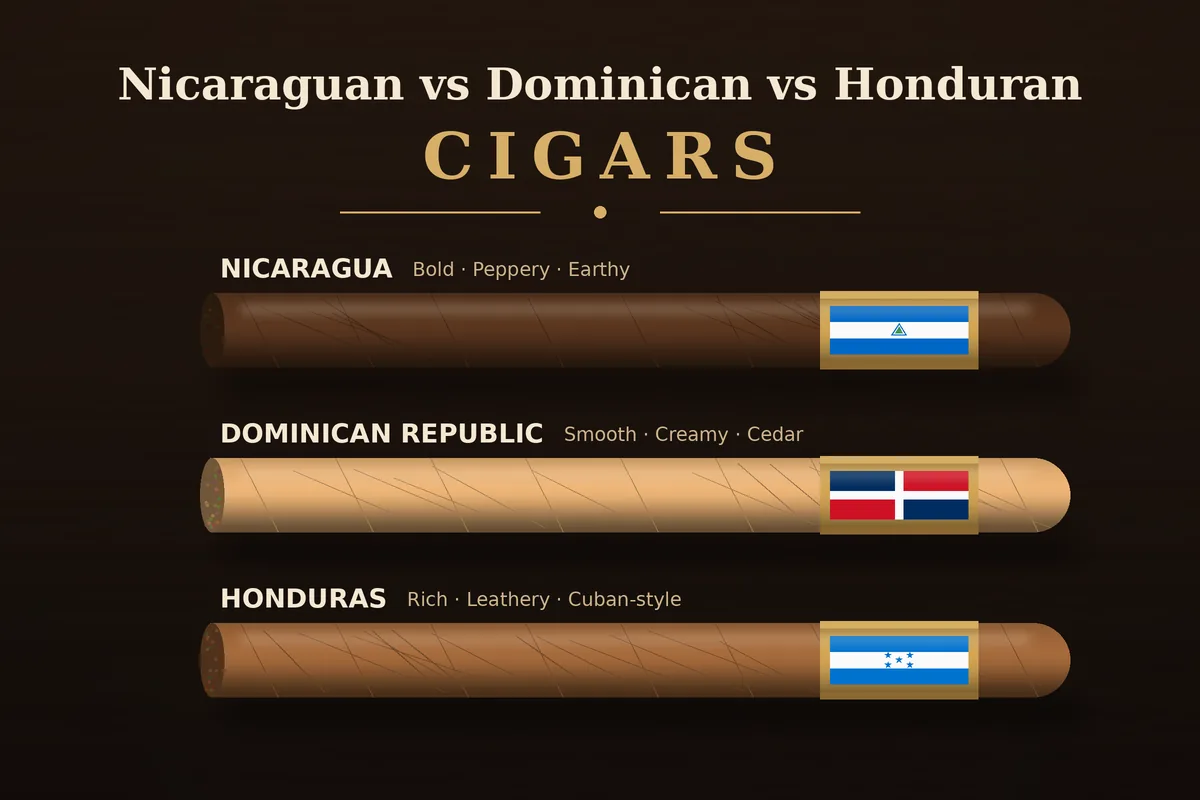
Nicaraguan tobacco grows in volcanic soil and usually tastes peppery, earthy and rich, with medium to full strength. Dominican tobacco is known for cream, cedar and nut flavors and a smoother, more refined draw, though the country also makes some very strong cigars. Honduran tobacco sits between the two on strength but leans earthy, leathery and rustic, the style many smokers compare to older Cuban cigars.
| Nicaragua | Dominican Republic | Honduras | |
| Typical strength | Medium to full | Mild to medium, with full-strength exceptions | Medium to full |
| Signature flavors | Black pepper, espresso, dark cocoa, earth, sweet spice | Cream, cedar, nuts, honey, light spice | Earth, leather, cedar, coffee, dry sweetness |
| Soil | Volcanic | Fertile river valley | Highland valleys |
| Key regions | Estelí, Condega, Jalapa, Ometepe | Cibao Valley (Santiago, Navarrete, Villa González) | Jamastrán, Talanga, Copán |
| Common seeds | Cuban-seed Criollo, Corojo, Habano | Olor Dominicano, Piloto Cubano, San Vicente | Honduran Corojo, Criollo |
| Blending style | Puros (single-country) are common | Multi-country blends are the norm | Mix of puros and blends |
| Share of US premium imports | About 60% (2025) | About 22% (2025) | About 17% (Jan to Nov 2025) |
| Good first pick | Joya de Nicaragua Antaño | Arturo Fuente Hemingway | Punch Gran Puro |
What Makes Nicaraguan Cigars Taste Different
Nicaragua's tobacco farms sit on volcanic ground in the north of the country. That soil is rich in minerals and drains fast, and it produces thick, oily leaf with plenty of flavor and plenty of nicotine in the upper leaves. Most farms are planted with Cuban-seed varieties brought over by growers who left Cuba after 1959.
Estelí Cigars and Nicaragua's Four Growing Regions
Nicaraguan tobacco comes from four main zones. Each gives a different leaf, and blenders combine them the way a cook combines spices.
- Estelí: The hottest, sunniest valley and the center of the industry. Leaf from here is strong and spicy, and Estelí cigars are known for black pepper on the first draw. Joya de Nicaragua, AJ Fernandez, Plasencia and Drew Estate all roll here.
- Condega: North of Estelí, higher and a little cooler. The tobacco is more balanced and is often used to round off Estelí ligero.
- Jalapa: Up against the Honduran border, cooler and cloudier. The leaf is thinner, silkier and sweeter, so a lot of it becomes wrapper.
- Ometepe: An island in Lake Nicaragua formed by two volcanoes. Harvests are small, with an earthy sweetness that blenders use as a seasoning.
Nicaraguan Tobacco Flavor Profile
The Nicaraguan tobacco flavor profile usually runs like this: black pepper and baking spice up front, then espresso, dark cocoa, leather and earth, with a sweet, woody finish. Puros made only from Nicaraguan leaf show it most clearly.
For the classic peppery, earthy version, try the Joya de Nicaragua Antaño Robusto Grande. For a sweeter, spicier Estelí take, the AJ Fernandez New World Puro Especial Toro is a good benchmark. If you want help naming what you taste, our cigar flavor wheel sorts the notes into groups.
Why Nicaraguan Cigars Hit Harder
The punch comes from ligero, the thick top leaves that get the most sun. Ligero from Estelí and Jalapa is potent, and many Nicaraguan blends use a lot of it. The Joya de Nicaragua Antaño Dark Corojo El Martillo and the Undercrown Maduro Robusto show how heavy that leaf can get.
Not every cigar from Nicaragua is a powerhouse, though. The Oliva Connecticut Reserve Robusto is blended with no ligero at all and smokes mild. The Plasencia Reserva Original Robusto, made with organic Nicaraguan tobacco, lands at a comfortable medium. Our guide to cigar strengths explains how strength and body differ.
From Revolution to 60 Percent of the Market
Joya de Nicaragua opened in Estelí in 1968 as the country's first premium cigar factory. The 1979 revolution, the civil war that followed and the US trade embargo from 1985 to 1990 nearly ended the industry. Factories burned and farms went untended.
The cigar boom of the 1990s brought growers and investors back, and Estelí rebuilt fast. That rebuild is the reason Nicaraguan cigars now account for roughly three of every five premium cigars imported into the US.
More Nicaraguan names worth knowing:
- Oliva Serie V Melanio Robusto from Oliva: rich, polished and medium-full.
- Aging Room Quattro Nicaragua Maestro: Cigar Aficionado's No. 1 cigar of 2019, made at the AJ Fernandez factory.
- Diesel Estelí Puro Robusto: an all-Estelí puro with plenty of spice.
- Plasencia Alma Fuerte Robustus I from Plasencia: a full, layered Nicaraguan puro.
If AJ Fernandez is your entry point, our AJ Fernandez cigars ranked guide covers every line we carry from the AJ Fernandez brand.
Dominican Cigars: Smooth by Reputation, Not by Rule
Dominican cigars come mostly from the Cibao Valley in the north, around Santiago, Navarrete and Villa González. The valley is fertile and river-fed, with a gentler climate than Estelí. Its leaf burns evenly and carries lighter oils and a soft, aromatic character.
Three seed families shape the Dominican crop:
- Olor Dominicano: The native variety. Mild, aromatic and an excellent burner, so it often goes into filler and binder.
- Piloto Cubano: A Cuban-seed variety planted after 1959. Stronger and spicier, and the source of most Dominican ligero.
- San Vicente: A Cuban-seed hybrid used heavily in filler for its strength and steady burn.
Dominican factories are also famous for blending. Instead of making puros, they pair local filler with wrapper from Connecticut, Ecuador, Cameroon, Mexico or Brazil. That habit is a big part of why Dominican cigars tend to taste layered and balanced. Our how cigars are made guide follows a Dominican leaf from field to finished cigar.
The country has a long history with the leaf. La Aurora opened in Santiago in 1903 and is the oldest cigar maker in the Dominican Republic. The Fuente family arrived in 1980 after their Estelí factory was destroyed during the Nicaraguan revolution, a story covered in our Arturo Fuente family history.
Dominican Cigar Strength: Mild, Medium and the Exceptions
The "Dominican means mild" idea comes from the 1980s and 1990s, when Connecticut Shade-wrapped Dominican cigars defined premium smoking for many Americans. Today Dominican cigar strength covers the whole scale:
- Mild: Macanudo Café Hyde Park and the Ashton Classic Magnum are creamy, gentle and easy to start with.
- Medium: The Arturo Fuente Hemingway Signature with its Cameroon wrapper, and the La Aurora 1962 Robusto Corojo, bring cedar, nuts and a little spice.
- Full: The La Flor Dominicana Double Ligero Chisel is built around Dominican ligero and is as strong as most Estelí cigars. La Flor Dominicana, founded in 1994, made its name on exactly this kind of blend.
Other Dominican benchmarks we carry include the Arturo Fuente Chateau Fuente Natural, the Arturo Fuente 8-5-8 Natural, the AVO Classic Robusto and the Romeo y Julieta 1875 Churchill. The full range sits in our Dominican cigars collection, and our best Dominican cigar brands guide ranks the names behind it.
Honduran Cigars: Earthy, Rustic and Gaining Fast
Honduran cigars are centered on Danlí, a town in the El Paraíso department close to the Nicaraguan border. Most of the tobacco grows in three areas:
- Jamastrán Valley: Near Danlí, warm and fertile, and the source of much of the country's best filler and wrapper.
- Talanga Valley: North of Tegucigalpa, producing robust, earthy leaf.
- Copán: In the west near Guatemala, a historic growing area with a sweeter, softer leaf.
Cuban exiles helped build the industry in the 1960s, and Honduran Corojo became one of the most prized wrappers of the 1990s boom. The typical Honduran cigar tastes of earth, leather, cedar and coffee, with a dry, toasty sweetness and a heavy, chewy body. It tends to feel fuller in the mouth than its nicotine level suggests.
Honduras is also the fastest-growing of the three. Its US shipments rose about 14 percent through November 2025, and through July 2026 it shipped 44.9 million cigars against the Dominican Republic's 46.9 million. The gap for second place is now very small.
Best Honduran Cigar Brands
These are the best Honduran cigar brands to start with, all rolled in Honduras:
- Camacho: A Danlí factory known for bold blends. The Camacho Nicaragua Robusto is a good example of Nicaraguan tobacco rolled in Honduras.
- Punch: The Punch Gran Puro Rancho is a Honduran puro, every leaf grown in Honduras.
- Hoyo de Monterrey: The Epicure Selección No. 2 is a smoother Honduran option.
- Don Tomas: The Clasico Robusto and Maduro Robusto are reliable everyday smokes. Our Don Tomas Clasico vs Maduro vs Sungrown guide compares all three.
- Rocky Patel: The Vintage 1992 Robusto is made in Honduras with an aged Sumatra wrapper.
- Alec Bradley: The Prensado Robusto uses a Honduran Corojo wrapper, and the Prensado Churchill was Cigar Aficionado's No. 1 cigar of 2011.
Nicaraguan vs Dominican Cigars and Honduran Blends, Tasted Side by Side
Reading about country styles only gets you so far. The fastest way to learn the difference is to smoke two cigars from the same brand and format that differ only in where the tobacco comes from.
Same Brand, Two Countries: Nicaragua and the Dominican Republic
For Nicaraguan vs Dominican cigars, two pairs work well:
- Davidoff Primeros: The Primeros Nicaragua against the Primeros Dominican. Both are short petit panatelas from Davidoff, so you can try both in under an hour.
- Romeo y Julieta 1875: The 1875 Churchill against the 1875 Nicaragua Toro.
Expect the Nicaraguan side to open with more pepper, a darker roast and a longer finish. The Dominican side usually stays creamier, with cedar and nut notes and a cleaner, shorter finish. Smoke them on the same day with the same drink, ideally water or black coffee, so nothing masks the contrast. Our cigar and coffee pairing guide covers which roasts suit which profile.
Honduran vs Nicaraguan Cigars
Honduran vs Nicaraguan cigars is the closest of the three comparisons. The countries share a border, and the Jalapa and Jamastrán valleys sit on either side of it with similar climates. Several companies, including Plasencia, Alec Bradley and Camacho, grow or roll in both countries.
Two pairs make the difference clear:
- Punch Gran Puro: The Honduran Gran Puro Rancho against the Gran Puro Nicaragua Toro.
- Alec Bradley Black Market: The Honduran-made Black Market Robusto against the all-Nicaraguan Black Market Estelí Robusto. Our Black Market vs Black Market Estelí guide goes deeper on this pair.
The Honduran cigars usually taste drier and earthier, with leather and cedar. The Nicaraguan versions bring sweeter spice and more pepper.
One point trips up a lot of smokers: the country on the band tells you where the cigar was rolled, not always where the tobacco grew. The Camacho Nicaragua is rolled in Honduras from Nicaraguan leaf, and many Dominican cigars use wrapper from three or four other countries. Check the blend details on the product page when origin matters to you.
Which Is the Best Cigar Country for You?
There is no single best cigar country. Each one leads in a different style, so the right answer depends on what you like in your cup and on your plate.
- Pick Nicaragua if you drink strong coffee, like black pepper and dark chocolate, and want a cigar with a long, spicy finish.
- Pick the Dominican Republic if you are newer to cigars, prefer cream and cedar, or want a smooth morning or golf-course smoke. Our best cigars for beginners collection leans heavily on Dominican blends.
- Pick Honduras if you want an earthy, old-school, Cuban-style cigar with a heavier body.
Still unsure? A cigar sampler lets you taste several blends side by side before you commit to a full box.
Starter Picks: Nicaraguan Cigars, Dominican and Honduran Alternatives
To compare fairly, match the strength level and stick to one size. A robusto is ideal because it burns long enough to show the full blend without taking all evening. Our robusto vs toro vs corona guide explains why, and the robusto cigars collection has every option.
A few habits make the test more useful:
- Let each cigar rest in stable humidity for a week or two after it arrives. Our guide on how long a cigar lasts covers storage.
- Use the same cut on both. A straight cut is the most neutral, as explained in how to cut a cigar.
- Take notes on the first third, the middle and the finish. Country character often shows most clearly in the last third.
FAQs
Which country makes the best cigars?
No country wins outright. Nicaragua leads for bold, spicy cigars and makes about 60 percent of the premium cigars sold in the US. The Dominican Republic leads for smooth, refined blends, and Honduras for earthy, Cuban-style smokes.
Is Nicaraguan tobacco stronger than Dominican tobacco?
On average, yes. Nicaraguan volcanic soil and heavy use of Estelí and Jalapa ligero push many blends to medium-full or full. Dominican tobacco is milder on average, but cigars like the La Flor Dominicana Double Ligero prove the country can match Nicaragua on strength.
Are Dominican cigars good for beginners?
Many are. Connecticut Shade-wrapped Dominican cigars such as Macanudo Café and Ashton Classic are some of the most common first premium cigars. Start with a robusto or corona and smoke slowly. Our how to smoke a cigar guide covers the basics.
What do Honduran cigars taste like?
Most taste of earth, leather, cedar and coffee, with a dry, toasty sweetness and a heavy body. Honduran Corojo wrappers add spice and a slightly sweet edge.
Does "Made in Nicaragua" mean the tobacco is Nicaraguan?
Not always. The band shows where the cigar was rolled. A cigar can be rolled in one country with leaf from several others, as with the Camacho Nicaragua, which is rolled in Honduras from Nicaraguan tobacco. A puro is the only style where every leaf comes from one country.
Why does Nicaragua make most premium cigars sold in the US?
It combines volcanic soil, Cuban-seed tobacco, low production costs and a large pool of skilled rollers in Estelí. After the 1990s boom, many of the biggest brands built or expanded factories there.
Summary
Nicaraguan cigars bring pepper, espresso and earthy strength from volcanic soil, and they make up most of the premium cigars sold in the US. Dominican cigars favor cream, cedar and careful blending, with strength that ranges from gentle to very full. Honduran cigars offer an earthy, leathery, Cuban-style profile and are growing faster than either rival. The best way to choose is to smoke one robusto from each country at the same strength level, then let your own palate decide. Every pick in this guide is waiting in our premium cigar collection.
What did you think?
Share this article
Help others discover this content by sharing it with your network.