
WARNING: This product contains nicotine. Nicotine is an addictive chemical.
This guide is written for adults 21 and over.
You light a cigar, smoke it down to the band, and know you liked it. Then a friend asks what it tasted like, and the best you can offer is "pretty good."
That answer won't help you pick your next cigar. It won't help the person behind the counter help you either.
The fix is a shared set of words and a simple routine for using them. Below you'll find a wheel of flavor families, a step-by-step tasting method, a glossary of common descriptors, and a note template you can copy.
Quick answer: A flavor wheel sorts cigar tastes into broad families (earthy, woody, spicy, sweet, creamy, fruity, nutty) and then narrows each one into specifics, so you move from "sweet" to "vanilla" to "vanilla custard." Pair it with slow draws and short written notes, and you'll be naming flavors within a few cigars.
What Is a Cigar Flavor Wheel and Why Use One?
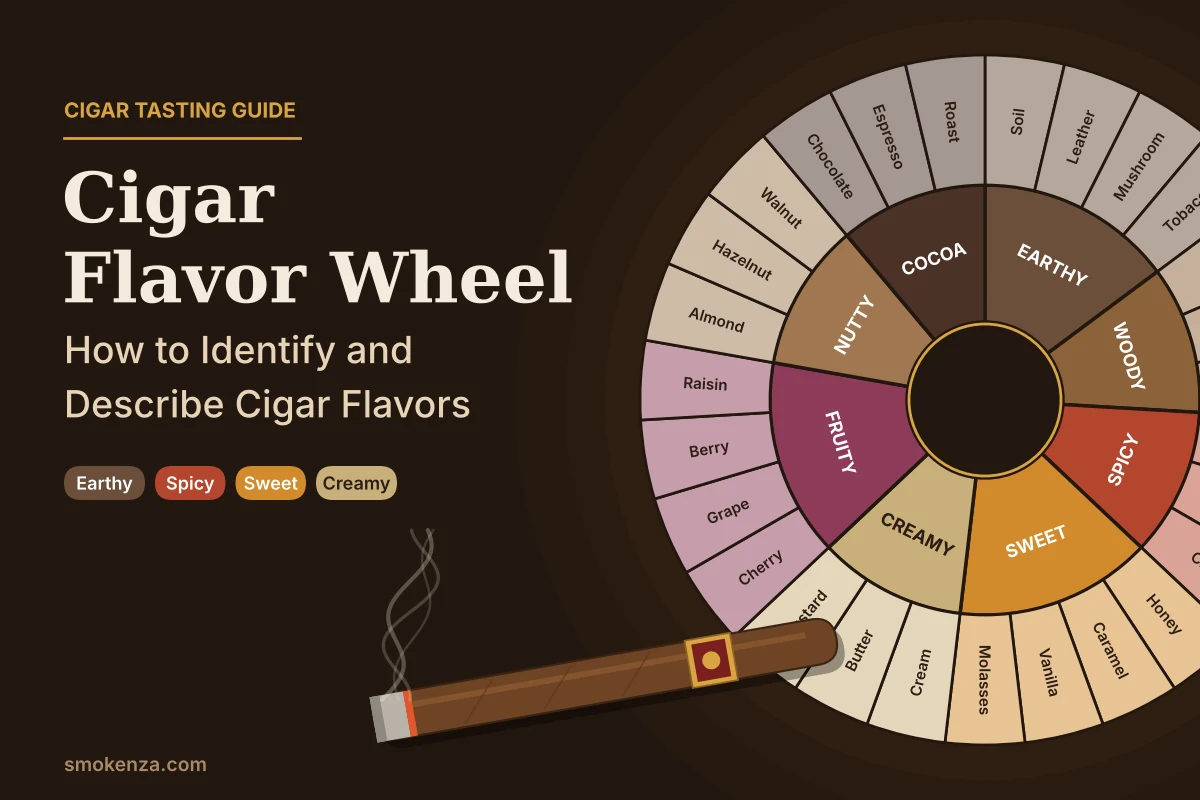
A flavor wheel is a circle of tasting words arranged from general in the center to specific at the edge. The inner ring holds broad families like earthy or sweet. Each ring outward gets more precise, so "sweet" opens into honey, caramel and vanilla.
Coffee roasters have used the same layout since 1995, when the Specialty Coffee Association published its Coffee Taster's Flavor Wheel, later rebuilt in 2016 with World Coffee Research. Wine tasters rely on a similar tool. It suits cigars well because tobacco goes through curing, fermentation and aging, the same kinds of processes that shape the taste of coffee, chocolate and wine.
Three reasons it's worth using:
- Shared vocabulary. "Cedar and cream" means the same thing to you, a friend and a tobacconist.
- Easier comparisons. Notes written with the same words let you line up two cigars side by side.
- Better requests. Asking for "cocoa and light pepper" gets you a far closer match than asking for "something smooth."
One caution: a cigar's flavor changes from the first puff to the last. Treat the wheel as a map for describing what you taste at each stage, not a score for the whole cigar. Much of that flavor starts with the leaf itself, which our guide to cigar anatomy covers in detail.
Reading a Cigar Flavor Wheel from the Center Out
Start in the middle and only move outward when you're sure. Pick the family first, then ask yourself one narrower question at a time.
Example path 1: Sweet → Creamy → Vanilla → Vanilla custard. You notice sweetness. It feels soft and rounded rather than sharp, so it leans creamy. The creaminess tastes like vanilla. Because it's thick and rich rather than light, you land on vanilla custard.
Example path 2: Earthy → Woody → Cedar. The smoke tastes dry and natural, not sweet. It reminds you more of wood than soil. The wood smells like a fresh pencil shaving, which is cedar.
If you only get as far as the family, that's still a useful note. "Earthy, a little sweet" beats "good" every time.

Natural Flavors vs. Added Flavors in Cigars
Every taste in a cigar comes from one of two places: the tobacco itself, or something added to it.
Natural flavors come from the leaf. Seed variety, soil, climate, curing, fermentation and aging all shape them. A cigar with no flavoring at all can still taste of cocoa, cedar, coffee or dried fruit, purely from how the tobacco was grown and processed.
Added flavors come from infusion or surface treatment. Vanilla, cherry, rum, wine and honey are the most common. The method changes how you taste them:
- A surface flavor sits on the wrapper or tip. It's strongest on the lips and in the first few draws.
- An infused flavor is worked into the tobacco. It builds from the inside and tends to last through the smoke.
If your palate leans toward dessert and fruit notes, sweet flavored cigars are the easiest place to practice naming flavors, because the notes are bold enough to pick out on the first few draws.
The two sources often layer together. A vanilla-infused cigar can still show earth or toast from the tobacco underneath. That's where a wheel helps most: it gives you separate words for the added note and the natural one, so you can describe both.
Where Cigar Flavors Come From: Wrapper, Binder and Filler
A cigar has three tobacco layers, and each one adds something different to what you taste.
- Wrapper: the outer leaf. It touches your lips first and drives first impressions, especially sweetness and aroma.
- Binder: the leaf that holds the filler together. It adds body and can bring extra spice or earth.
- Filler: the bundle of leaves inside. It carries most of the strength, depth and lasting flavor.
Wrapper type gives you a rough idea of what to expect before you light up:
| Wrapper | Typical notes |
| Connecticut Shade | cream, cedar, light nuts, mild sweetness |
| Habano | black pepper, cinnamon, cedar, earth |
| Maduro | cocoa, coffee, molasses, dark sweetness |
| Corojo | spice, leather, earth |
| Cameroon | toast, light spice, subtle sweetness |
| Sumatra | earth, cedar, mild spice |
These are tendencies, not rules. Our breakdown of the Habano wrapper shows how one leaf type can still vary from blend to blend.
Strength is not flavor. Strength refers to nicotine impact. Body is how full the smoke feels in your mouth. Flavor is what you taste and smell. A mild cigar can be packed with cream, nuts and cedar, while a full-strength cigar can taste fairly simple. Our guide to cigar strength explains the scale if you're unsure where a cigar sits.
How to Identify Cigar Flavors, Step by Step
A cigar flavor wheel works best when you pair it with a slow, repeatable tasting routine. Follow the same six steps every time, and your notes will start to line up from one cigar to the next.
- Smell the unlit cigar. Hold the foot (the open end) near your nose, then the wrapper. Note anything familiar: hay, barnyard, cocoa, sweet spice.
- Take a cold draw. After cutting, draw air through the unlit cigar. You'll often catch notes here that get louder once lit, such as raisin, cocoa or pepper.
- Light it and go slow. Take the first few puffs gently, roughly one every 30 to 60 seconds. Name the family first (sweet, earthy, woody), then try for a specific note.
- Retrohale gently. Push a small amount of smoke out through your nose to pick up aroma. Never inhale cigar smoke into your lungs.
- Pause between draws. A short break and a sip of water let your palate reset, so flavors don't blur together.
- Write it down right away. A two-word note made in the moment beats a long one written from memory an hour later.
Tasting by Thirds: How Flavors Change During the Smoke
Most cigars change as they burn, so tasters split them into three sections.
- First third: usually the lightest and sweetest part. Wrapper notes and any added flavor show up most clearly here.
- Second third: the filler takes over. Expect more body, plus spice, wood or earth.
- Final third: flavors get stronger and more concentrated. Pepper, leather and dark roast are common, and some bitterness can creep in if the cigar runs hot.
Size changes the timing. A long, thick cigar gives you more time in each third, while a small cigarillo can pass through all three in a few minutes. Smoking slowly keeps the cigar from overheating, which helps stop the last third from turning harsh.
Retrohale and Aroma
Your tongue picks up only a handful of basic tastes: sweet, salty, sour, bitter and savory. Specific notes like cedar, vanilla or coffee come mostly from aroma. The National Institutes of Health explains that flavor is those basic tastes combined with aroma, which reaches your nose through a channel at the back of the throat. That's why a gentle retrohale often turns a vague "sweet" into a clear "caramel." Start with a very small amount of smoke, since retrohaling can feel sharp with spicy cigars.
Common Cigar Flavor Descriptors, Explained
Use this table as the wheel in word form. Find the family first, then pick the closest specific note.
| Family | Specific notes | What it tastes or smells like | Often found in |
| Earthy | soil, leather, mushroom, tobacco leaf | damp ground after rain, an old leather jacket | Maduro, Corojo, Nicaraguan filler |
| Woody | cedar, oak, toast | a pencil shaving, a wooden box, toasted bread | Connecticut, Dominican blends |
| Spicy | black pepper, cinnamon, clove | a tingle on the tongue or a bite on the retrohale | Habano, Corojo, ligero-heavy blends |
| Sweet | honey, caramel, vanilla, molasses | a sugary edge on the lips and the finish | Maduro, flavored and infused cigars |
| Creamy | cream, butter, custard | soft and rounded, coats the mouth | Connecticut Shade, vanilla-infused cigars |
| Fruity | cherry, grape, berry, dried fruit | jammy sweetness or a raisin-like tang | wine and cherry flavored cigars, aged tobacco |
| Nutty | almond, hazelnut, walnut | dry, roasted, slightly oily | Connecticut, Cameroon |
| Cocoa and coffee | dark chocolate, espresso, roasted | bittersweet and a little dry | Maduro, San Andrés wrappers |
Flavored cigars make good practice because their main note is loud. Try naming the families on these:
- Backwoods Sweet Aromatic: a light honeyed sweetness over a rustic, earthy leaf. Good for learning to separate the added note from the tobacco.
- Backwoods Russian Cream: vanilla custard up front with a warm, coffee-liqueur edge. A clear example of the creamy family.
- Black & Mild Wine: a grape and red wine sweetness that sits in the fruity family.
- Black & Mild Jazz: a sweet vanilla note with a soft finish. Useful for telling the sweet family apart from the creamy one.
Once you can name the main note on these, move to an unflavored cigar and look for quieter versions of the same families.
Using a Cigar Flavor Wheel to Write Your Own Tasting Notes
Good tasting notes follow a simple formula: aroma + first note + how it changes + finish. Four parts, one line, and you have a note you can compare against any other cigar you smoke.
Here's a beginner-friendly example:
"Cedar and light cream on the cold draw, vanilla in the first third, black pepper in the middle, dry cocoa on the finish."
It's short, uses plain words, and tracks the cigar from start to end.
A few habits make your notes more useful:
- Compared to foods you know. "Tastes like graham crackers" is a perfectly good note.
- Retire "smooth" as your only word. Smooth tells you the cigar wasn't harsh, nothing more. Ask what was underneath.
- Note texture. Creamy, dry, thick, thin and oily describe how the smoke feels, and they help separate similar cigars.
- Rate the finish. How long does the flavor stay after you exhale? Short, medium or long is enough.
Cigar Flavor Wheel Tasting Note Template
Copy this into your phone or a notebook and fill it in while you smoke:
Cigar:
Size / wrapper:
Date:
Pre-light aroma:
Cold draw:
First third (family > note):
Second third (family > note):
Final third (family > note):
Retrohale:
Texture:
Finish (short / medium / long):
Would I smoke it again? Why:
Match the Flavors You Taste to Your Next Cigar
Your notes are most useful when they guide the next pick. Look at which families show up most often, then use this as a starting map:
| If you keep noting... | Try next |
| Sweet, creamy, vanilla, fruit | Flavored or infused cigars |
| Cedar, cream, nuts | Connecticut Shade wrappers |
| Pepper, cinnamon, spice | Habano wrappers |
| Cocoa, coffee, molasses | Maduro wrappers |
| Earth, leather | Corojo or Nicaraguan blends |
If you're new, three rules keep the learning curve short:
- Start mild. Heavy nicotine can drown out subtle flavors. Our list of the best cigars for beginners is a good starting point.
- Go small. Shorter formats let you taste more cigars in less time.
- Change one thing at a time. Try the same blend in two wrappers, or two flavors from one brand, so you know what caused the difference.
When you want more layers than a single added flavor, premium infused cigars combine sweet notes with real tobacco depth. Our ACID Blondie vs Kuba Kuba comparison shows how two infused cigars from the same line can land in very different parts of the wheel.
Frequently Asked Questions
What are the main flavors in cigars?
Most cigar flavors fall into eight families: earthy, woody, spicy, sweet, creamy, fruity, nutty, and cocoa or coffee. Each family breaks down into specific notes, such as cedar under woody or black pepper under spicy. Flavored cigars add notes like vanilla, cherry, rum or wine on top of the tobacco's natural character.
How do I describe the taste of a cigar?
Start broad, then narrow down. Name the family first, like sweet or earthy, then pick a specific note, like honey or leather. Add when you noticed it (first, second or final third) and how the smoke felt. A short line such as "cedar and cream, then pepper" is a solid description.
Why does my cigar taste different in the last third?
As a cigar burns down, more of the filler's flavor comes through and the smoke gets more concentrated. Notes like pepper, leather and dark roast become stronger. Smoking too fast heats the cigar and can make this section taste bitter, so slow your pace near the end and give it time to cool between draws.
Do flavored cigars taste like tobacco at all?
Yes, though how much depends on the cigar. Surface-flavored cigars taste mostly of the added note at first, with tobacco coming through as you smoke. Infused cigars blend the two more evenly. In most flavored cigars you can still find earthy, woody or toasty tobacco notes under the sweetness if you look for them.
What is the difference between flavor and strength?
Flavor is what you taste and smell, such as cocoa, cedar or vanilla. Strength describes the nicotine impact a cigar has. The two don't move together: a mild cigar can taste rich and complex, and a strong cigar can taste fairly plain. That's why a good tasting note describes them separately.
Final Thoughts
Naming cigar flavors gets easier with a routine. Pick a family, narrow it to one specific note, and write it down before it fades. After a handful of cigars, you'll have a record of what you enjoy and the words to ask for more of it.
If sweet and creamy notes keep showing up in your notes, see the full flavored cigar range and bring the template above to your next smoke.
What did you think?
Share this article
Help others discover this content by sharing it with your network.