
WARNING: This product contains nicotine. Nicotine is an addictive chemical. For adults 21+ only.
Most new pipe smokers pick a pipe by its looks and regret it within a month. The bowl material decides how hot the pipe runs in your hand, how much care it needs and how many years it lasts. Price matters far less than fit.
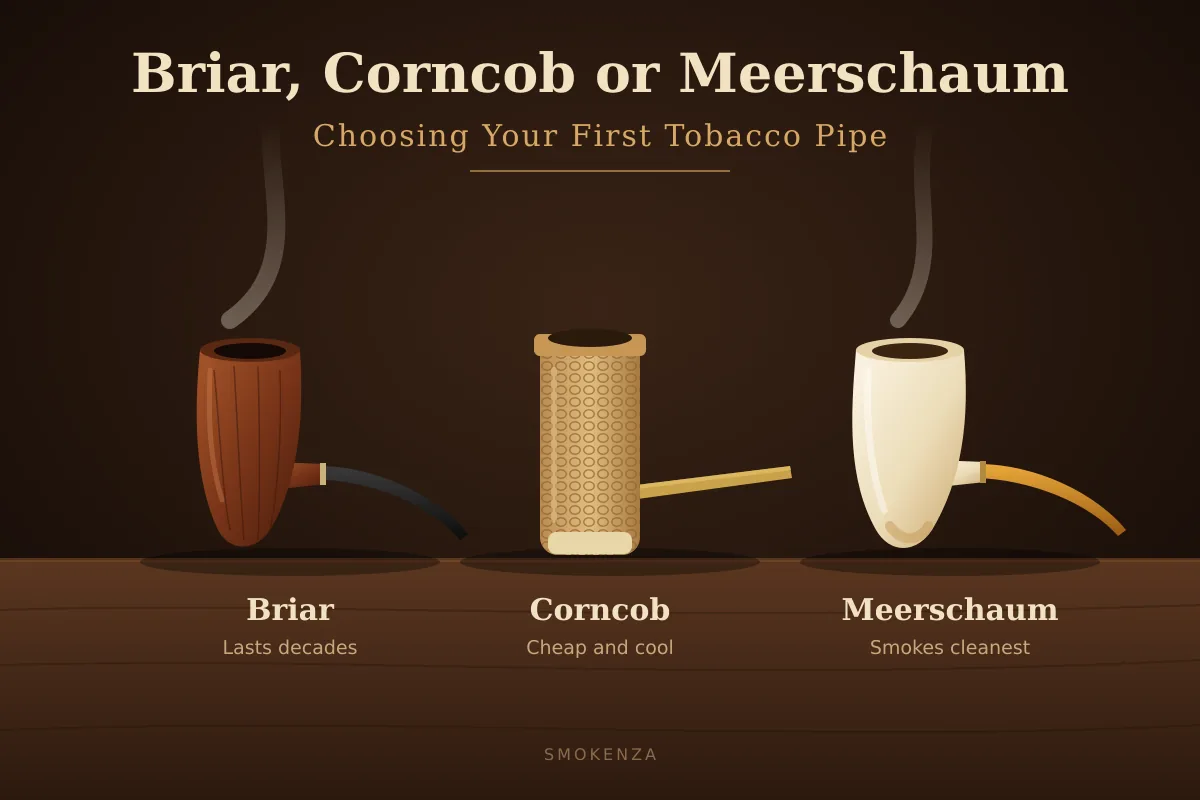
Quick answer: For most beginners, a corncob pipe is the smartest starting point. It costs under $20, needs no break-in and smokes cool even when you puff too fast. Move up to a briar pipe once you know the hobby sticks. A meerschaum pipe smokes the cleanest of all but costs more and cracks if dropped. A clay pipe is cheap and neutral, but it runs hot and breaks easily.
Below, each of the four main pipe materials is compared on heat, taste, care and cost. After that comes a straight answer on the best tobacco pipe for beginners, a break-in routine, and the mild blends that suit a new bowl.
Pipe Materials Compared: What Your First Tobacco Pipe Is Made Of
Four materials cover almost every pipe a beginner will see. Here is how they stack up side by side.
| Material | What it is | Typical new price (approx., US) | Break-in | Heat in hand | Lifespan | Best for |
| Corncob | Dried, hollowed corn cob | $5 to $20 | None | Cool | Months to a few years | Testing the hobby cheaply |
| Briar | Burl wood of the tree heath shrub | $40 to $150 (factory pipes) | Yes, builds a carbon cake | Moderate | Decades | Daily smokers |
| Meerschaum | Sepiolite, a soft white mineral | $60 to $250+ (block) | None | Cool and dry | Decades, if never dropped | Careful hands, many blends |
| Clay | Fired clay | $10 to $40 | None | Hot | Until it breaks | Tasting a blend neutrally |
Two traits matter most for a beginner. How forgiving is the pipe when you puff too hard, and how much damage does one mistake do? Cobs and meerschaums forgive heat. Briar rewards patience. Clay forgives almost nothing.
Briar Pipe: The Standard for a Reason
A briar pipe is carved from the burl of the tree heath, a shrub that grows on rocky Mediterranean hillsides. The burl sits between the trunk and roots. It is dense, hard and slow to char, which is why briar has been the default pipe wood since the 19th century.
What briar does well:
- Lasts for decades. A well-kept briar can outlive its first owner.
- Builds flavor over time. A thin carbon layer, called cake, forms inside the bowl and softens the smoke.
- Comes in every shape. Straight, bent, small, large, smooth or sandblasted.
What briar asks of you:
- A break-in period. The first 5 to 10 bowls can taste woody or sharp while the cake forms.
- Rest between smokes. Most smokers let a briar dry for about a day before refilling it.
- Gentle puffing. Smoke it too fast and the wood gets hot, which can scorch the bowl.
For a first briar, a medium bowl in a straight billiard or apple shape is the safest pick. Straight pipes are easier to clean with a pipe cleaner. Good makers season briar blocks for months before carving, which cuts the raw taste of a new pipe. Small sand pits filled with putty in a cheaper factory briar look odd but do not affect the smoke.
Corncob Pipe: The Cheapest Way to Learn
A corncob pipe is made from a dried, hollowed cob fitted with a simple stem. The modern cob industry started in Washington, Missouri, where a Dutch immigrant woodworker named Henry Tibbe began turning cob pipes in 1869. His firm, Missouri Meerschaum, is still the oldest and largest maker of cob pipes. Tibbe borrowed the name because he likened his cobs to the prized meerschaum pipes of the day.
Corn cob is light and porous. It soaks up moisture, stays cool in the hand and needs no break-in. The first bowl or two can carry a faint sweet, grainy note that fades quickly.
The trade-offs are real but small:
- Shorter life. A cob smoked daily may last months to a couple of years before the bowl thins or chars through.
- Basic stems. Most cobs ship with plain plastic stems.
- Rustic looks. A cob will never pass for a showpiece.
Those trade-offs explain why experienced smokers so often answer "get a cob" when asked what your first tobacco pipe should be. Mistakes cost a few dollars, not a cracked heirloom. Keep the cake in a cob very thin, and clean the bowl with a soft scrape rather than a sharp reamer.
Meerschaum Pipe: Stone That Smokes Clean
A meerschaum pipe is carved from sepiolite, a soft white mineral. The German name means "sea foam." According to Britannica, the most important commercial deposit is the plain of Eskişehir in Turkey, and the material is soft when mined but hardens as it dries.
Meerschaum is porous enough to draw moisture away from the smoke. That gives a dry, cool, neutral smoke from the first bowl, with no break-in and no cake to manage. It also holds very little flavor from one blend to the next, so you can switch from an aromatic to a natural blend without leftover taste, a problem smokers call ghosting.
Over many bowls, a waxed meerschaum shifts from white to honey and then amber. Collectors prize that color change.
The weak spot is durability:
- One drop can crack it. Never knock the bowl against a hard edge to empty it.
- Let it cool before removing the stem. Twisting a warm shank risks splitting it.
- Hold it by the stem early on. Oily fingers can stain the bowl unevenly.
Watch for pressed meerschaum, which is made from bonded scraps. It costs less, colors poorly and smokes warmer than carved block meerschaum.
Clay Pipe: Historic, Hot and Fragile
The clay pipe was Europe's everyday tobacco pipe for roughly two centuries before briar took over. Fired clay adds no taste of its own, needs no break-in and costs little.
The drawbacks hit beginners hardest. Thin clay heats up fast, so the bowl can become too hot to hold. Clay also snaps if dropped, and short-stemmed versions send warm smoke straight to the tongue. A long churchwarden clay smokes cooler, but it is awkward to carry. Clay works best as a second pipe for tasting a new blend with nothing in the way.
Briar vs Meerschaum: Which Should You Pick?
The briar vs meerschaum question comes down to durability against purity of taste. Both last for decades with care. They fail in different ways.
| Factor | Briar | Meerschaum |
| Break-in | 5 to 10 careful bowls | None |
| Taste | Warm, rounder once caked | Dry, clean, very neutral |
| Switching blends | Holds old flavors, best kept to one blend style | Switches easily |
| Drop damage | Usually a scuff | Often a crack |
| Rest between bowls | About a day | Can be refilled once cool |
| Price for a reliable first pipe | Lower | Higher |
| Look over time | Grain darkens slightly | Colors from white to amber |
Pick briar if you will carry the pipe around, smoke one style of tobacco, or want a pipe that shrugs off accidents. Pick meerschaum if you smoke at home, like trying many blends, and handle your things carefully. Plenty of smokers end up owning both.
Corncob vs Briar Pipe: Is the Upgrade Worth It?
In the corncob vs briar pipe matchup, the cob wins every beginner category. It is cheaper, cooler, needs no break-in and costs little to replace. Briar wins on lifespan, stem quality, looks and the richer flavor a mature cake brings.
The upgrade is worth it once the habit is real. A useful rule: if you still reach for your cob several times a week after two or three months, a briar will pay back its price. If the cob has sat in a drawer, you saved yourself $80.
So What Is the Best Tobacco Pipe for Beginners?
The best tobacco pipe for beginners is the one that forgives mistakes while you learn to pack, light and sip slowly. For most people that is a cob, followed by a briar. Your situation can change the order.
When Your First Tobacco Pipe Should Be a Cob
- You are not sure the hobby will stick.
- Your budget is under $20.
- You plan to smoke outdoors, on the porch or in the yard.
- You want to try sweet aromatic blends that tend to burn hot and wet.
When to Start With a Briar
- You already know you enjoy pipe smoking, perhaps from a friend's pipe.
- You can spend $50 to $100 on one pipe meant to last years.
- You will smoke mostly one type of blend.
Choose a medium bowl, a straight or slightly bent shape and a smooth finish. Avoid oversized bowls, which hold more tobacco than a beginner can smoke without overheating.
When a Meerschaum Makes Sense
- You smoke indoors at a table, not on the move.
- You want to sample many blends without flavor carry-over.
- You received it as a gift and are willing to handle it gently.
A meerschaum is a fine first tobacco pipe for a careful smoker. It just leaves no room for a dropped bowl.
Five Mistakes New Pipe Smokers Make
Most bad first experiences trace back to the same handful of errors. None depend on the pipe material, and all are easy to fix.
- Picking a huge bowl. A big chamber looks generous, but it holds more tobacco than a beginner can smoke slowly. A medium bowl finishes in 30 to 45 minutes and stays cooler.
- Puffing like a cigarette. Hard, fast draws push the temperature up, scorch briar and cause tongue bite. A pipe needs a gentle sip every few seconds.
- Packing too tight. If the draw feels like pulling through a straw full of sand, empty the bowl and start again. Loose at the bottom and springy at the top is the rule.
- Panicking over relights. Even experienced smokers relight a bowl three or four times. Tamp the ash lightly, then pass the flame across the top.
- Lighting with a torch. Jet flames are too hot and char the rim of briar and cob. Wooden matches or a soft-flame pipe lighter are kinder to the bowl.
Before you pay for any pipe, check two things. The stem should seat snugly without force, and a pipe cleaner should pass from the stem tip into the bowl. A draw that feels tight in a new pipe usually stays tight.
How to Break In and Care for Your First Tobacco Pipe
Good habits in the first two weeks decide whether a pipe smokes sweet or bites for years. The routine is the same for every material, with one extra step for briar.
- Pack it properly. Fill in three stages, light to firm, so air still moves through the bowl. Our guide on how to pack a pipe walks through each stage.
- Start with half bowls in a briar. Fill a new briar about halfway for the first 5 to 10 smokes. This lets cake form evenly at the bottom. Cobs and meerschaums can take full bowls from day one.
- Sip, do not puff. Draw gently every few seconds. If the bowl gets too hot to hold, set it down for a minute.
- Let it cool before taking it apart. Removing a warm stem can loosen the fit or crack the shank.
- Run a pipe cleaner after every bowl. It pulls out moisture before it sours the pipe.
- Rest a briar for about a day. Wood needs time to dry. This is why many smokers rotate two pipes.
- Keep cake thin. In a briar, about the thickness of a coin is plenty. Cobs and meerschaums need little or none.
Never rinse a briar or meerschaum bowl with water. If your tongue starts to sting, the fix is usually slower puffing or drier tobacco, both covered in our guide to pipe tobacco tongue bite.
What Tobacco Should Go in a New Pipe?
A new smoker learns faster with a mild, forgiving blend than with a strong or heavily flavored one. Smokenza's pipe tobacco collection carries domestic bags from mild to full, so you can start light and move up.
Mild Blends That Suit Your First Tobacco Pipe
- OHM Silver Pipe Tobacco 6 oz: one of the smoothest picks from OHM, forgiving if you pack a little tight.
- Good Stuff Natural Pipe Tobacco 6 oz: no added casing, so you taste the leaf itself. Our post on additive free tobacco explains what it leaves out.
- Golden Harvest Natural Blend 1 oz: a small, low-cost bag for testing a new pipe without committing to a large pouch.
- Kentucky Select Silver Ultra Light 8 oz: a light everyday blend from Kentucky Select.
- OHM Natural Pipe Tobacco 6 oz: a plain, unflavored option for a meerschaum, where neutral leaf shows off the clean smoke.
If you are unsure what the color codes on these bags mean, Good Stuff tobacco colors explained and 4 Aces tobacco flavors compared break them down. For a wider view of blend styles, read aromatic vs English vs Virginia pipe tobacco and our guide to natural pipe tobacco.
Match the Blend to the Pipe Material
- Menthol and strongly flavored blends ghost hard in briar and cob. If you want something like OHM Menthol Gold, give it its own cob.
- Meerschaum handles variety best. Rotate natural, Turkish and flavored bags without carry-over. Our Turkish pipe tobacco comparison helps if that style appeals.
- Fuller blends wait until your technique settles. Bags like Good Stuff Red 2 oz burn stronger and punish fast puffing. Check our Good Stuff nicotine guide before stepping up.
Most domestic bag tobacco is a fine ribbon cut. It lights easily but burns faster than a flake, so slow sipping matters more. Pipe tobacco cuts explained covers the differences. Keep opened bags sealed, and if one dries out, follow our steps to rehydrate pipe tobacco from bags.
Frequently Asked Questions
Do you inhale pipe smoke?
No. Like a cigar, pipe smoke is drawn into the mouth for flavor and let out. Our post on whether you inhale cigars explains why the same rule applies.
How long does a corncob pipe last?
A cob smoked daily usually lasts several months to a couple of years. Slow puffing and a thin cake stretch that range.
Can you smoke a new briar pipe right away?
Yes. Start with half bowls, sip slowly and rest the pipe between smokes while the cake forms.
Is a meerschaum pipe good for beginners?
It smokes beautifully from the first bowl, but it is expensive and fragile. It suits a careful beginner who smokes at home.
What is the cheapest way to start pipe smoking?
A cob plus a small bag such as Golden Harvest Natural 1 oz or Good Stuff Gold 2 oz keeps the first outlay very low.
Does pipe tobacco go bad?
Sealed bags keep for years. Opened bags slowly dry out. See does pipe tobacco go bad for storage tips.
Is bagged pipe tobacco the same as cigarette tobacco?
Not quite. Cut, moisture and tax class differ. Our guide to pipe tobacco vs cigarette tobacco covers the details.
The Bottom Line
Choosing your first tobacco pipe is less about prestige and more about forgiveness. A corncob pipe gives you the cheapest, coolest way to learn. A briar pipe is the long-term upgrade once the habit sticks, a meerschaum pipe rewards careful hands with the cleanest taste, and a clay pipe is best kept as a tasting tool. Pair whichever you pick with a mild bag from the pipe tobacco collection, sip slowly, and let the pipe tell you when you are ready for the next one.
What did you think?
Share this article
Help others discover this content by sharing it with your network.